Building Evacuations, Drills & Fire Safety
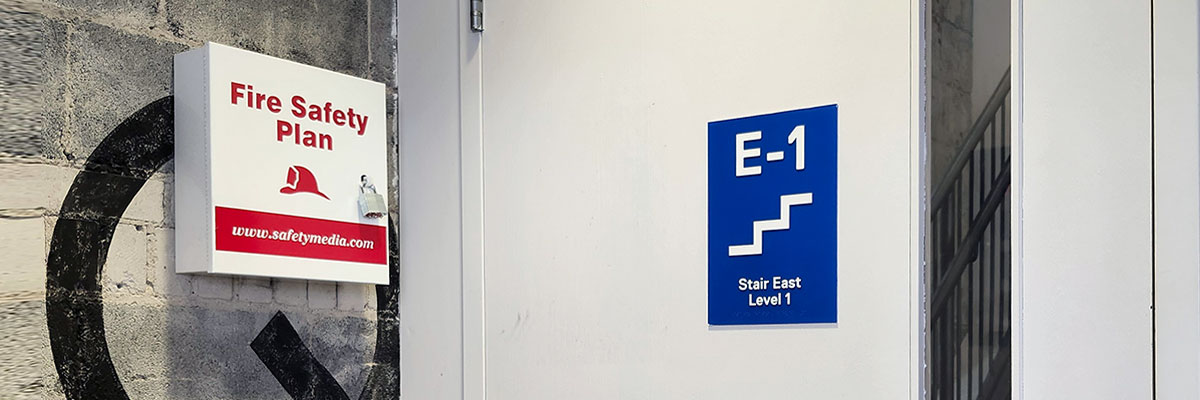
From time to time, building evacuations and drills are required to ensure the safe exit of occupants. These could be in response to an active alarm or in response to a fire in the building. In some cases, it could be in response to a non-fire hazard in the building. TMU has prepared the following guidelines to assist community members prepare in the event of an evacuation.
Make sure you are aware of university guidance and resources
TMU’s Emergency Management website includes customized guidance for students, faculty and staff and leaders. We encourage you to review the guidance for information including:
- Downloading TMU Safe and signing up for text messages.
- Contacting 911 if you encounter an emergency on campus.
- What to do if you require support in the event of an evacuation.
- Guidance for faculty or contract lecturers to ask students to inform you if they require evacuation assistance and what to do if a student requires evacuation assistance.
- Guidance for leaders if an employee indicates they require support in the event of an emergency.
Fire safety: Be prepared
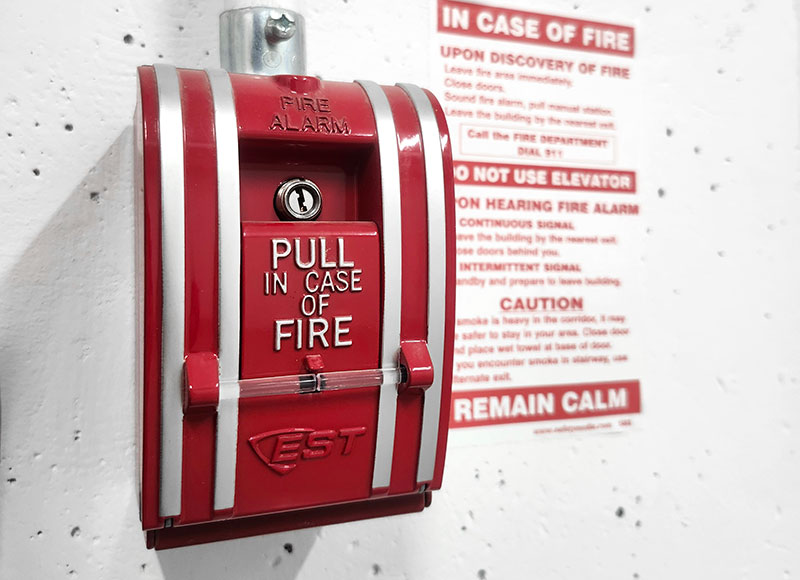
Know the location of the fire exit, the fire alarm manual pull station and fire extinguisher closest to your workspace or classroom(s). Familiarize yourself with the procedures below so that you are generally prepared in case of a fire.
What to do when an alarm signals an evacuation
Upon hearing an alarm or being directed to leave, the person in charge of a class, meeting or activity is responsible for stopping the activity and directing people to leave by the nearest safe exit. You must comply with this person and quickly and safely exit the building. Provide assistance to persons with disabilities if it is safe to do so as appropriate.
Only if it is safe to do so should you take any personal belongings. One hand should be free at all times to open doors and use the hand rails. If dropped, personal belongings may become a tripping hazard that could potentially impede the evacuation of others.
Always make sure to close all doors behind you as this aids in slowing the spread of a fire.
There are many types of health conditions and impairments that may affect a person’s ability to safely evacuate a building, including those who:
- require the use of a wheelchair, walker, crutches or cane;
- have temporary conditions (e.g. pregnancy, recovery after surgery, breaks or sprains);
- have vision and/or hearing impairments;
- have breathing problems;
- have visible or hidden disabilities;
- are prone to severe excitability or claustrophobia; and/or
- have any limitation that would make using stairwells dangerous to themselves or other evacuees.
Guidance for students on what to do if you require support in the event of an evacuation
Guidance for faculty and staff if you require support in the event of an evacuation
Guidance for leaders: If you have an employee who requires support in the event of an emergency, ensure that you work with them to implement an individualized accommodation plan for emergencies.
- Leave the fire area immediately, removing any person in immediate danger. Make sure that the doors to the affected area are closed.
- Activate the fire alarm system by pulling the nearest pull station (i.e. stairwell) as you leave the fire area.
- Do not use a fire extinguisher unless trained. You are not to put yourself at risk.
- Call 911 when it is safe to do so. Provide them with the details and do not hang up until you have provided all the information.
- Exit the building using the nearest stairwell.
- Before opening any doors, test the door for heat by using the back of your hand.
- When you check a door for heat, you should always use the back of your hand and not your palms. If you burn your palms, it may make it difficult for you to use them to open doors or crawl on the floor if needed.
- If the door is hot, leave the door closed and unlocked. If you are in an office with no alternate exit, remain where you are and alert 911 to your location. Otherwise, try an alternate exit.
- If the door is not hot, brace yourself against the door and open it slightly. If you feel air pressure or a hot draft, close the door quickly, leaving it unlocked. If you are in a room with no alternate exit, remain where you are and call 911 and alert them of your location. Otherwise, try an alternate exit.
- If the door is not hot and you did not feel air pressure or a hot draft, walk to the nearest exit and leave the building.
- Use the stairwell and/or exterior exit doors to exit. Do not use the elevators. If you encounter fire or smoke in the stairwell, use an alternate exit (crossover).
- If a door feels too hot to the touch, do not open it. There could be fire/smoke on the other side and both factors may impair your ability to continue down to the ground floor.
- Remember to remain calm.
- Stop whatever you are doing.
- Drop to the ground.
- Roll to smother the flames.
Follow the steps outlined in Emergency Management instructions for support in the event of an evacuation and refer to the yellow “In an Emergency” placard in the room for your exact location.
Understanding “convenience stairs” vs. emergency “exit stairwells”
In an emergency, exit stairwells should be prioritized for evacuation whenever possible. Building occupants should avoid using convenience stairs for evacuation because the stairs are exposed and do not offer protection from hazardous conditions.
Convenience stairs
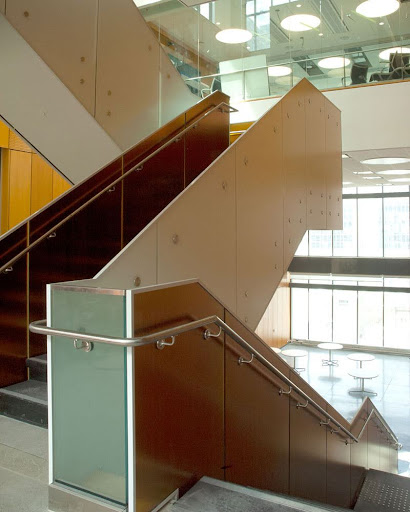
Many TMU buildings have open areas and atriums with grand staircases or escalators that are convenient for moving between floors and add design focal points to architecture. They typically end inside the building in a lobby or main space.
However in an emergency evacuation, the openness of their design leaves users exposed to the dangers of smoke, fire or other hazards for which these stairs were not designed to mitigate.
Exit stairwells
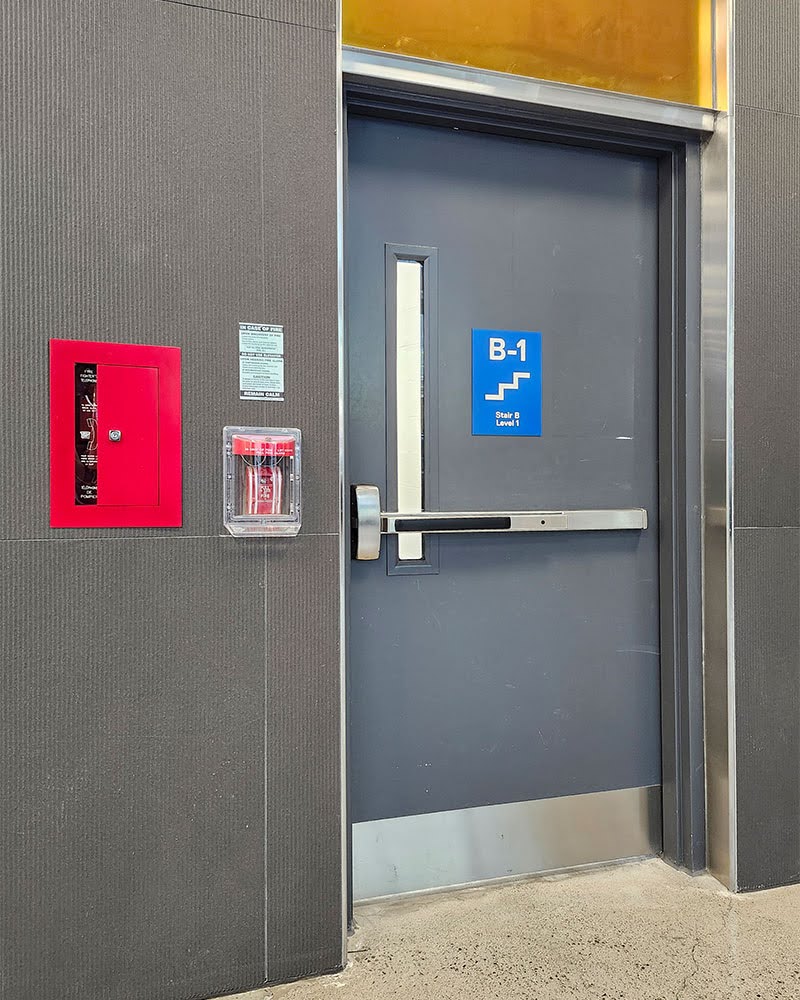
Exit stairwells are enclosed by walls and behind fire-rated doors that are engineered to resist high heat and reduce the spread of smoke and flame.
Unlike convenience stairs which typically end inside a building, exit stairwells lead users directly to an exterior door or direct route outside. Exit stairs also include non-slip treads, emergency lighting in the event of a power failure, clearly marked egress routes.
Fire alarm systems at TMU
TMU is equipped with two different alarm systems: single and two-stage. Several of the buildings that students, faculty and staff occupy are maintained by TMU. However, there are a number of buildings that are not maintained by the university and therefore may have unique alarm systems.
Below is a list of the buildings that are not maintained by TMU. Contact the building manager to find out about each building’s specific evacuation procedures.
| Building code | Building name |
Building address |
|---|---|---|
| AOB | Atrium on Bay | 20 Dundas St. West |
| BKS | Campus Store | 17 Gould Street |
| BTS | Bell Trinity Square | 483 Bay Street |
| CAR | Carlton Cinema | 20 Carlton Street |
| CIV | Civil Engineering Storage | 106 Mutual Street |
| CPK | English Language Institute and International College (College Park) | 424 Yonge Street |
| DAL | 147 Dalhousie Street | 147 Dalhousie Street |
| DSQ | 10 Dundas St. East | 10 Dundas St. East |
| MAC | Mattamy Athletic Centre | 50 Carlton Street |
| MAG | Magnet | 10 King St. East |
| MER | Merchandise Building | 159 Dalhousie Street |
| MRS | MaRS Building | 661 University Avenue |
| PKG | Parking Garage | 300 Victoria Street |
| PTB | Paintbox | 563 Dundas St. East |
| SMH | St. Michael’s Hospital / iBEST / Li Ka Shing Knowledge Institute | 209 Victoria Street |
| TEC | Toronto Eaton Centre | 220 Yonge Street |
| YDI | Yonge-Dundas Intersection | 1 Dundas Street West |
| YNG | 415 Yonge Street | 415 Yonge Street |
TMU-managed with single-stage alarm system
Below is a list of buildings that are maintained by TMU. These buildings are equipped with a single-stage alarm system.
- Signal: you will hear the alarm signal and where installed the visual strobes will flash.
- Action: Proceed to the closest, safest exit and egress from the building. Once outside, move at least 15m (50 feet) away from the building.
- Follow-up: TMU Security or municipal Fire Services will confirm when re-entry to the building is allowed.
| Building code | Building name | Building address |
|---|---|---|
ARC |
Architecture Building |
325 Church Street |
BND |
114 Bond Street |
114 Bond Street |
BON |
111 Bond Street |
111 Bond Street |
CED |
The Chang School of Continuing Education (Heaslip House) |
297 Victoria Street |
CIS |
Creative Innovation Studio |
110 Bond Street |
COP |
101 Gerrard Street East |
101 Gerrard Street East |
ENG |
George Vari Engineering and Computing Centre |
245 Church Street |
EPH |
Eric Palin Hall |
87 Gerrard Street East |
HEI |
School of Graphics Communications Management (Heidelberg Centre) |
125 Bond Street |
ILC |
International Living / Learning Centre |
133 Mutual Street and 240 Jarvis Street |
IMA |
School of Image Arts |
122 Bond Street |
IMC |
The Image Centre |
33 Gould Street |
MON |
Civil Engineering Building |
341 Church Street |
OAK |
Oakham House |
63 Gould Street |
OKF |
O’Keefe House |
137 Bond Street |
PIT |
Pitman Hall |
160 Mutual Street |
PRO |
112 Bond Street |
112 Bond Street |
RCC |
Rogers Communication Centre |
80 Gould Street |
SBB |
South Bond Building |
105 Bond Street |
SCC |
Student Campus Centre |
55 Gould Street |
SHE |
Sally Horsfall Eaton Centre for Studies in Community Health |
99 Gerrard Street East |
SID |
School of Interior Design |
302 Church Street |
VIC |
Victoria Building |
285 Victoria Street |
TMU-managed with two-stage alarm system
For two-stage alarms, please listen carefully to distinguish the signal, as there will be two different tones.
Stage 1: Alert signal
- Signal: The alert signal is a continuous chime or bell. Stand by and be alert for a potential evacuation of the building. If the building is equipped with a voice communication system (speakers), you may hear a digital voice message providing information and instructions.
- Action: Stay where you are, get ready to leave and await further instructions.
- Follow-up: If the alarm stops, then all is clear and you may resume regular activities.
Stage 2: Evacuation signal
- Signal: The alarm is a temporal pattern signal (three beats followed by a pause). Upon hearing the alarm you must evacuate the building immediately. Do not wait for further announcements. Do not use the elevator. If the building is equipped with a voice communication system (speakers), you may hear a voice announcement providing information and instructions.
- Action: Proceed to the closest, safest exit and egress from the building. Once outside, move at least 15m (50 feet) away from the building.
- Follow-up: TMU Security or municipal Fire Services will confirm when re-entry to the building is allowed.
Below is a list of buildings that are also maintained by TMU. However, these buildings are equipped with two-stage alarm systems.
| Building Code | Building name |
Building address |
|---|---|---|
CUI |
Centre for Urban Innovation |
44 Gerrard Street East |
DCC |
Daphne Cockwell Health Sciences Complex |
288 Church Street |
JOR |
Jorgenson Hall |
380 Victoria Street |
KHE |
Kerr Hall East |
340 Church Street |
KHN |
Kerr Hall North |
31/43 Gerrard St. East |
KHS |
Kerr Hall South |
40/50/60 Gould Street |
KHW |
Kerr Hall West |
379 Victoria Street |
LIB |
Library Building |
350 Victoria Street |
POD |
Podium |
350 Victoria Street |
SLC |
Student Learning Centre |
341 Yonge Street |
SOM |
School of Medicine |
150 Central Park Dr, Brampton |
RAC |
Recreation and Athletics Centre |
40/50 Gould Street |
TRS |
Ted Rogers School of Management |
55 Dundas Street |
Questions?
For questions regarding building evacuations or drills, please contact Dan Dixon, compliance Engineer, at dan.dixon@torontomu.ca.