Academic & Research Support
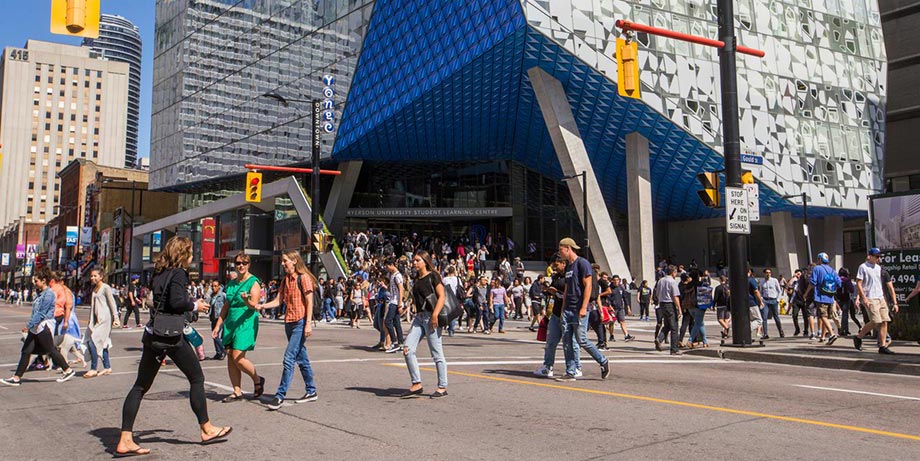
Explore the various services available on campus to support your graduate education
Academic services
Academic Accommodation Support provides confidential services to students who live with disabilities that affect their studies. If you need accommodation, contact the Student Learning Support Reception desk to book an appointment. If you have already registered, you can view and send your Accommodation Letters to professors, schedule tests and exams with accommodations and register for skill-building workshops online.
Central computer labs for general purpose are available for all Toronto Metropolitan students and they provide access to many software applications. Your school or department may have other facilities available for your use. Lab hours vary throughout the year. Rooms with teaching access are available as drop-in labs approximately 50% of the time. Weekly room schedules are posted on the lab doors every Monday morning and online.
The University is governed by the Senate and the Board of Governors. The Senate consists of 51 elected members including students, faculty, librarians, alumni and 18 non-elected members of the administration, including the Chancellor.
The Board consists of students, members of the public, alumni, faculty and administrative staff. Elections normally take place in the winter term.
The Academic Integrity Office (AIO) is a neutral office that seeks to promote a culture of integrity and educational excellence at Toronto Metropolitan University.
(PDF file) Toronto Metropolitan University's Policy 60: Academic Integrity applies to all students at the University. Toronto Metropolitan expects you to display exemplary personal and academic ethics and values. Please read, understand and follow this policy.
Please also familiarize yourself with the Academic Integrity Office student resources.
Obtain professional guidance in improving your academic skills with Graduate Student Learning Support.
Graduate Student Support is for individuals who are looking for help with academic skills and the demands of graduate-level study. SLLS offers services for Master’s or PhD students. Book an individual appointment to discuss research papers, grant applications, theses and dissertations. Graduate students can join a graduate writing group, meet with a dissertation coach, or attend our Dissertation Retreats to develop academic skills specific to graduate education.
Programming
Programming will be offered virtually for the spring/summer semesters. Students can find an overview of services and supports and register for all of our programs at Graduate Student Support.
1-on-1 Writing Appointments
Graduate students can book up to two appointments per week with a graduate writing consultant for one-on-one help with academic writing, research, grant applications, thesis/MRP writing, and more.
Dissertation Coaching
Feeling stuck in the writing process for your PhD dissertation? Meet with a dissertation coach to develop writing strategies, set up an accountability system, and receive direction and feedback on the written components of your dissertation.
Graduate workshops
SLLS offers interactive workshops on a variety of graduate-focused writing topics, designed to help you become more familiar with the essential skills necessary for academic success in graduate school, and invite you to interact with your peers. Each workshop consists of two parts (50-minutes each) offered in tandem: a) Instructional (Theory) and b) Peer-review (Practice).
You can register for the workshops here by selecting “Graduate Student Support” and then “Workshops”. Workshops are offered during the fall and winter semesters and as in-class presentations upon request.
Dissertation/MRP Coaching
Feeling stuck in the writing process for your PhD dissertation or Master's MRP? Meet with a dissertation coach to develop writing strategies, set up an accountability system, and receive direction and feedback on your process, approach, or the structure of your dissertation
How it works:
- (google form) Submit a request for a 50 minute 1-on-1 appointment with a dissertation/MRP coach (external link)
- The initial appointment will include an informal needs assessment and goal setting
- Subsequent sessions will focus on the progression of your goals and providing feedback unique to your writing needs
What we can help with:
- Identifying and setting goals
- Establishing good work habits and setting up an accountability system
- Developing a strategy and a realistic writing schedule
- Preparing for defences
- Building resilience and overcoming imposter syndrome or writer’s block
- Finding a clear direction when you feel stuck
- Learning effective writing and research strategies
- Organizing your writing process
- Learning ways to monitor your progress
- Demystifying aspects of the grad school journey
- And more!
Graduate Write-A-Thon
Returning in Winter 2025
TMU graduate students, let’s spend the day writing together!
Writing doesn't need to be so daunting. Building community can help. This Graduate Write-a-thon is our chance to get down to writing, together.
Whether you’re writing a paper, editing a proposal, or revising a thesis, we invite you to join us for intensive writing time, individual support, and camaraderie!
Immerse yourself in your work in a quiet, virtual distraction-free setting. Enjoy dedicated writing space and time, individual support, and a community of peers committed to the same goal.
Bring your work, and we will provide a structure and support, as well as lunch, coffee, and snacks.
Weekly Coffee & Writing Group: Wednesdays 2-4 p.m.
Coffee and Writing sessions provide a distraction-free atmosphere for graduate students to make progress on their writing with the support of an expert writing tutor who will help participants move through any specific writing blocks. Participants are encouraged to turn off their phones and notifications for two hours and join these silent graduate writing sessions.
A dedicated study area for graduate students is available on the 7th floor of the Student Learning Centre (SLC) at Yonge and Gould.
SLC Graduate Study Room
Graduate students can access the SLC Graduate Study Room (SLC-713) using their OneCard. Nicknamed “The Forest,” the seventh floor of the SLC also features a large Silent Study Room (SLC-720) and 30 bookable Collaborative and Group Work Rooms (CGWRs).
You no longer need to book a desk before arrival. Desks will be first come first serve. CGWRs will continue to be bookable spaces at half capacity.
Everyone entering the SLC will need:
International Relations can help you gain knowledge of another culture, experience new approaches to your subject and return home with greater insight into the world at large.
Students who participate in international education activities not only work towards a degree but also act as important ambassadors – bringing Toronto Metropolitan to the world and bringing the world to Toronto Metropolitan.
Toronto Metropolitan students who spend time studying or working overseas frequently reflect on the experience as a highlight of their university career.
The ServiceHub in the Podium building is an integrated hub of Registrar's services and support including:
- tuition and fee payments
- enrolment services
- financial assistance (including OSAP administration)
Client Service Ambassadors are available in-person, on the phone and online to answer your inquiries and support you from admission to graduation.
Learning, research and teaching opportunities
The Jack Layton Leadership School aims to build the leadership capacity of students to effect social change. The school engages community members and faculty in social justice issues through storytelling, engaging in creative arts workshops, panel discussions, lectures, and community tours. Network with leaders to work on a shared vision of justice based on anti-racist, feminist, Indigenous, queer, anti-poverty and reflective approaches. No prior experience is necessary, only a commitment to social change.
The Office of the Vice-President, Research and Innovation (OVPRI) is Toronto Metropolitan University’s central research administration office. The office is responsible for advancing the research agenda at Toronto Metropolitan University and works with faculty, government and industry to help foster the creation of new knowledge and the establishment of innovative partnerships.
As a Research Assistant (RA), students assist principal investigators in conducting research activities not related to the student’s studies. The minimum rate of pay is defined by the Granting Council (SSHRC, NSERC or CIHR) or organization/institution which is funding the principal investigator. When that institution is Toronto Metropolitan University, the minimum rate of pay is defined in the OPSEU Collective Agreement, Article 14, Section 14.06. The terms of employment of graduate students will be consistent with this collective agreement. However, the minimum recommended rate of pay for graduate students is the rate at which Graduate (Teaching) Assistants are paid, which is outlined in the CUPE 3 Collective Agreement.
Contact your program for details about program-specific RA positions.
Teaching development is a primary resource area within the Centre for Excellence in Learning and Teaching. Through a collaborative approach, the Centre fosters a community dedicated to big thinking about curriculum, pedagogy and creative ways of developing inclusive teaching practices that enrich the student learning experience.
At Toronto Metropolitan University, a teaching assistant (TA) or graduate assistant (GA) refers to a graduate student who is employed to assist with teaching or related duties. The student is a Toronto Metropolitan University student currently enrolled on a full-time basis in one of the university’s Master’s or PhD programs.
This type of employment opportunity is typically offered by a department or school. Full-time graduate students can be employed for a maximum of 10 hours per week. The rate of pay can be found on the Human Resources (HR) website in the CUPE Local 3904 Unit 3 Collective Agreement. Students may be offered a GA position by their program, and/or the positions will be posted on the HR website. Terms of employment of graduate students will be consistent with the collective agreements between the university and its employee groups.
Teaching Development offers a number of ongoing supports and resources for TAs and GAs.
Zone Learning is a new model of experiential learning built to allow students to apply their degree coursework to real world startups, causes, companies, projects or ventures.
The 10 zones form a community of incubators or spaces where people come together to brainstorm, kickstart projects, and build startups. Zone Learning members have the opportunity to: grow their network, gain experience, build their résumé and even access funding. The Zone Learning community is open to all, and is often especially useful for graduate students.
Zones of interest to graduate students:
- SCI888 (Science Discovery Zone)
- BACE Program (Biomedical Zone)
- Lab2Market (external link) (iBoost Zone)
- VOLT Program (iBoost Zone)
Intellectual Property and other relevant topics and events