Advancing the future of cancer care
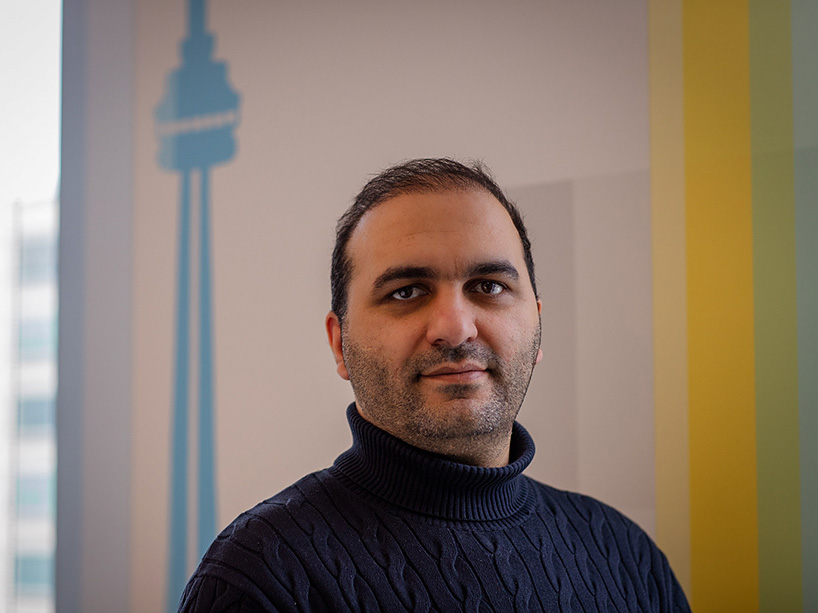
Dr. Farshad Moradi Kashkooli is the recipient of the prestigious 2024 John C. Polanyi Prize. Photo: Andy Lee.
Dr. Farshad Moradi Kashkooli has received the 2024 John C. Polanyi Prize in Physics for his cutting-edge hybrid cancer treatment platform that combines therapeutic ultrasound and nanomedicine.
His research motivation began with losing his mother to cancer, and was deepened when his mentor Dr. Jahangir Tavakkoli passed away from advanced cancer in December 2024.
“These personal losses, along with my deepening belief in the power of interdisciplinary science—where even modest advances in physics, biology, oncology, mathematics and engineering can converge to transform patient care—continue to strengthen my resolve,” said Dr. Moradi Kashkooli, a Banting Postdoctoral Fellow jointly based at TMU and St. Michael’s Hospital. “If, by the end of my career, I have helped save or improve even a single life, I will consider that my most meaningful achievement.”
Through interdisciplinary research spanning biomedical physics, engineering and mathematical modelling, Dr. Moradi Kashkooli’s approach offers a non-invasive, more precise alternative to conventional cancer treatments such as chemotherapy and radiation. By optimizing drug delivery and overcoming existing therapeutic limitations, the new treatment has the potential to improve the lives of cancer patients worldwide.
As Ontario’s most prestigious honour for early-career researchers, the $25,000 Polanyi Prize is “profoundly meaningful” to Dr. Moradi Kashkooli. “It is more than professional recognition; it feels like a moment of validation for the years of dedication, perseverance and sacrifice that have defined my research journey. It reaffirms that the work I’ve committed myself to is making a real and measurable impact.”
Dr. Moradi Kashkooli chose TMU for his postdoctoral fellowship based on its interdisciplinary research environment and reputation as a national leader in biomedical ultrasound research, and its partnership with St. Michael’s Hospital through the Institute for Biomedical Engineering, Science and Technology (iBEST).
“Beyond the research infrastructure, TMU provided a platform where I could grow, contribute meaningfully and pursue high-impact scientific goals,” said Dr. Moradi Kashkooli. “The university’s culture of collaboration, mentorship and innovation has been foundational to both my personal and professional development.”
Dr. Moradi Kashkooli has authored nearly 80 peer-reviewed journal articles, presented at leading national and international conferences, and received over 10 competitive fellowships and awards at the institutional, national and international levels.
“I am profoundly grateful to TMU for providing the resources, mentorship and intellectual community that have empowered me to pursue impactful, translational research,” said Dr. Moradi Kashkooli. “TMU’s steadfast commitment to interdisciplinary excellence, together with the collaborative environment fostered at iBEST, has been integral to my development—first as a Banting Postdoctoral Fellow, then as a Rising Scientist in Therapeutic Ultrasound recognized by the International Society of Therapeutic Ultrasound (ISTU), and now as a Polanyi Prize recipient.”
Dr. Moradi Kashkooli expressed deep gratitude to those who supported his scientific journey, highlighting the pivotal role of his mentors at TMU, Dr. Michael C. Kolios and the late Dr. Tavakkoli: “Their guidance has shaped every step I’ve taken at TMU—and will continue to take in my scientific journey.”
He also acknowledged his former mentors, key collaborators Dr. Anshuman Jakhmola and Dr. Graham Ferrier, and Dr. Eno Hysi for their continued support. “Above all, I’m profoundly thankful to my family. Their unwavering love and belief in me have been the foundation of all I’ve achieved,” said Dr. Moradi Kashkooli.