Crash-test breakthrough earns TMU civil engineer top thesis award
“I was honestly in shock because the task had felt so insurmountable. I immediately shared the results with my supervisors, my father, my wife and even my students in class. Thinking about it now still makes me smile,” said Civil Engineering PhD alumnus Dr. Ahmed Diab, whose deep-seated passion for bridges led him to groundbreaking achievements that could one day change how bridge safety is tested and designed.
Recognizing his innovative contributions to civil engineering, Dr. Diab was recently honoured with the Dr. C. Ravi and Shanti Ravindran Outstanding Doctoral Thesis Award. “I didn’t expect to receive it, but when I did, I was thrilled,” said Dr. Diab. “It felt amazing to have my hard work and late nights acknowledged, and I’m incredibly grateful to my supervisors, Dr. Khaled Sennah and Dr. Ahmed Mostafa for their support.”
Curiosity and mentorship leads to breakthrough
His breakthrough came after a complex trailer truck simulation model presented to him by Dr. Sennah, which had 14,000 errors and was unable to run. With a background in programming, Dr. Diab took on the challenge and successfully reworked the model to be used for barrier crash-test simulations, which could offer a reliable and cost-effective way to assess bridge barrier safety.
Growing up in a household where engineering was a daily topic of conversation, Dr. Diab developed an early fascination with how things were built. “My dad’s a civil engineer, so I was exposed to that world from a young age,” he said. “But what really sparked my interest in bridges was playing with Lego and Meccano as a child.”
When he enrolled in TMU’s Civil Engineering master’s program, it was clear that bridge engineering would be his focus. In his second year, he worked part-time in Dr. Khaled Sennah’s lab. “That’s when I really started to connect the dots,” said Dr. Diab. “Dr. Sennah saw my potential and eventually became my supervisor, guiding me through my master’s and PhD research.”
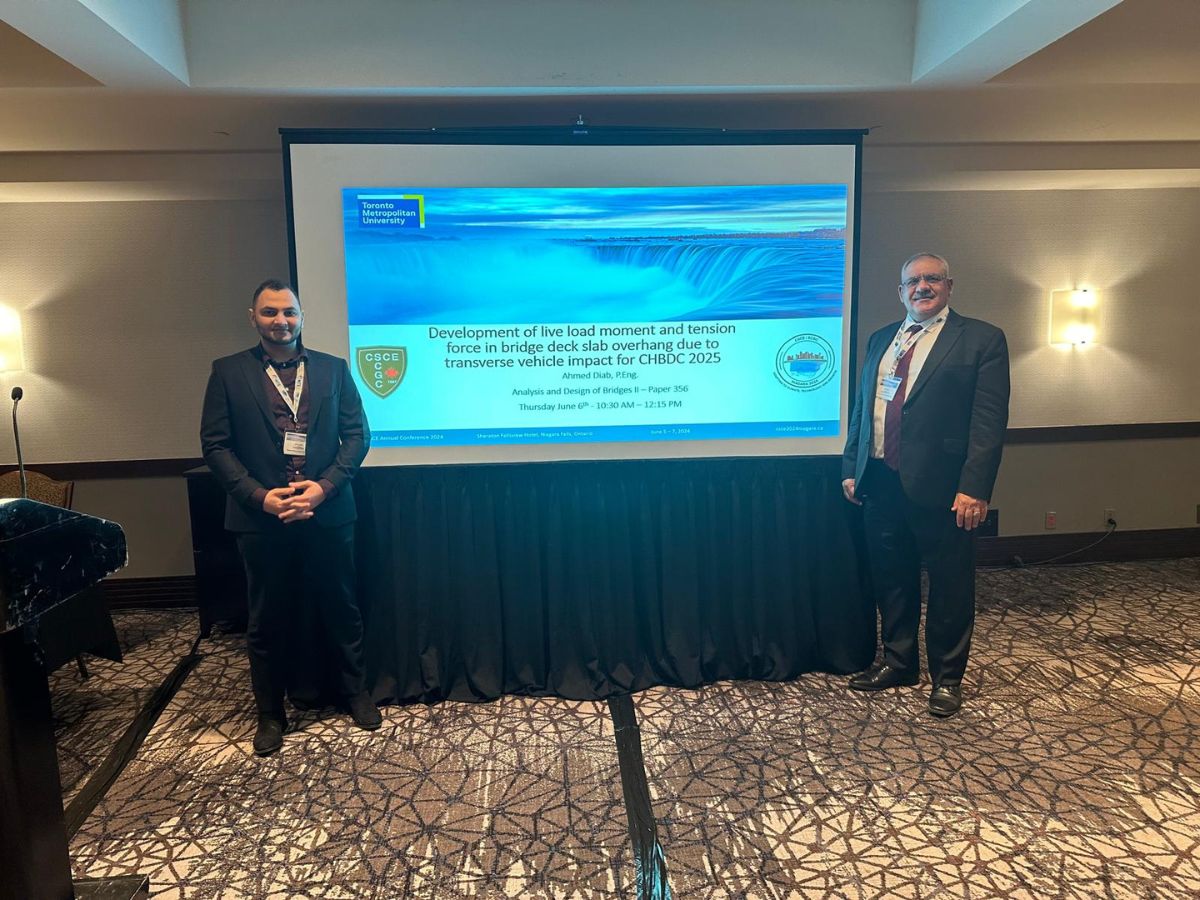
Dr. Ahmed Diab and Supervisor Dr. Khaled Sennah present at the 2024 Canadian Society of Civil Engineering conference in Niagara Falls.
Now, Dr. Diab is researching the behaviour of concrete bridge barriers and their supporting deck overhangs under vehicle impact. His work uses advanced crash-test computer simulations to predict how bridges will respond to vehicle collisions based on vehicle speed, material properties and suspension—a process that could eventually replace costly and time-consuming physical crash tests.
“We are hoping that one day we can replace physical crash testing entirely. Even if that does not happen right away, this tool can still be used to verify designs before physical tests, which saves both time and money,” he said.
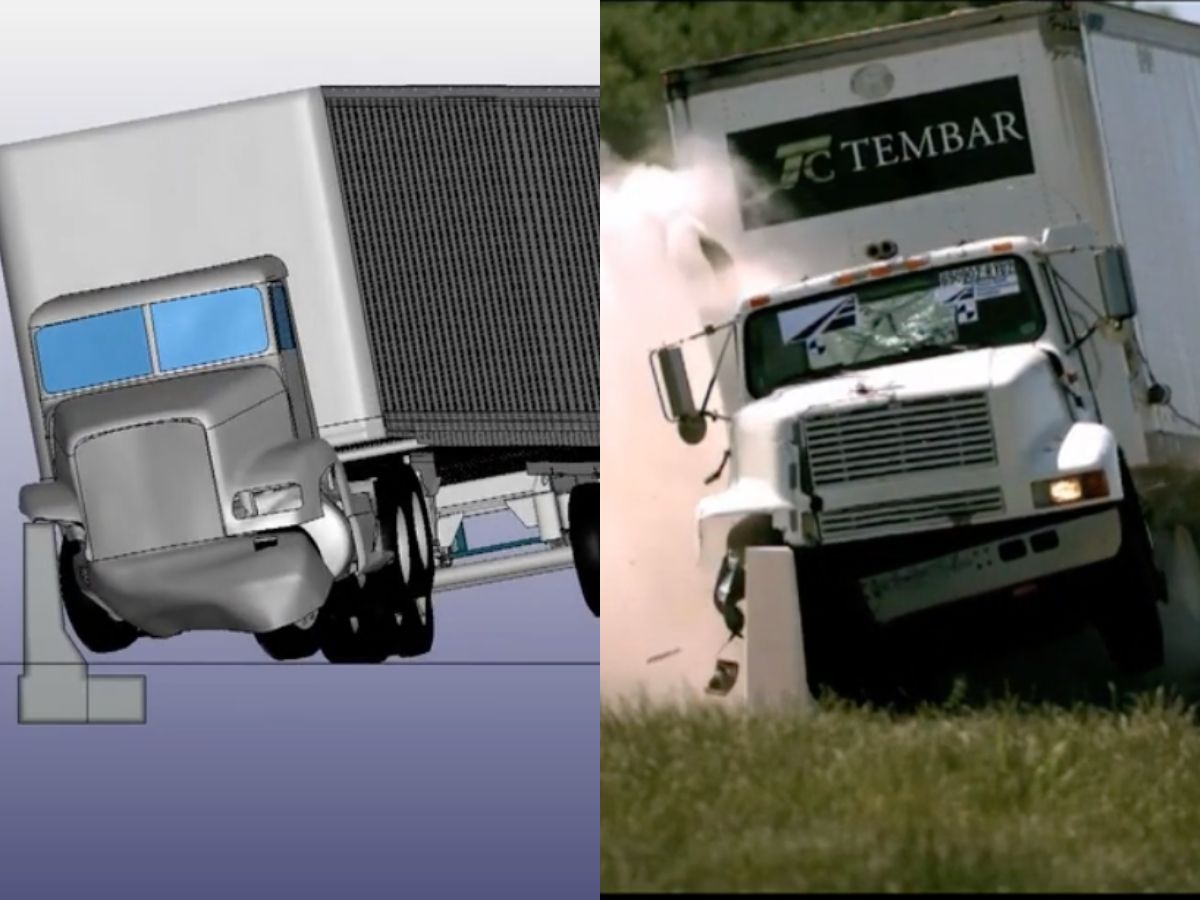
Construction Material Testing & Engineering (CMTE) worked with TMU to run computer simulations that show how a reinforced concrete barrier behaves when a vehicle crashes into it. They used LS-DYNA, a specialized program that models real-world impacts.
Pushing the boundaries of crash-test simulation
Bridge safety testing, currently a physical process regulated by organizations like the Ministry of Transportation, involves expensive crash tests for every new bridge design. By using simulation technology, Dr. Diab’s work could streamline this process, potentially leading to faster, more efficient testing methods in the future.
Dr. Diab explains that the work involved two main stages: first, adjusting the trailer truck model’s dimensions and weight so it ran correctly; second, running full crash simulations and validating them by comparing the results with data from past real-world crash tests. Once the model’s accuracy was verified, it could then be used to predict crash scenarios that have not yet been tested in real life.
The outcomes of this work led Dr. Diab to develop guidance and equations that help designers and engineers predict how much force and bending the edge of the roadway on a bridge will carry during an impact. He also developed a more realistic representation of a steel-reinforced bridge barrier's yield-line failure pattern, a mechanism used to avoid overestimating load capacity. These design equations were adopted into the 2025 Canadian Highway Bridge Design Code so practitioners can apply them directly.
As he continues to expand his research, Dr. Diab is focused on refining the crash simulation model and extending it to other types of bridge barriers, including steel-reinforced and glass-fiber-reinforced polymer barriers. “We’re continuing to test different barrier designs and develop new equations to predict how these designs behave under impact loading,” he said. “This is a long-term project, but the potential for making bridges safer is enormous.”
Inspiring the next generation at TMU
Alongside his research, Dr. Diab also made a mark as an educator at TMU. He served as the course instructor for the undergraduate bridge engineering class, a role that he considers one of the most memorable moments of his academic career. “It was so rewarding to share the knowledge I’ve built over the years and connect with students,” he said. “I loved seeing them engage with the material, and I hope I was able to inspire them the way my professors inspired me.”
Looking ahead, Dr. Diab plans to continue his research and teaching career. “I want to stay in academia and keep contributing to the field,” he said. “There’s still so much to learn and so many ways we can make infrastructure safer and more efficient.”
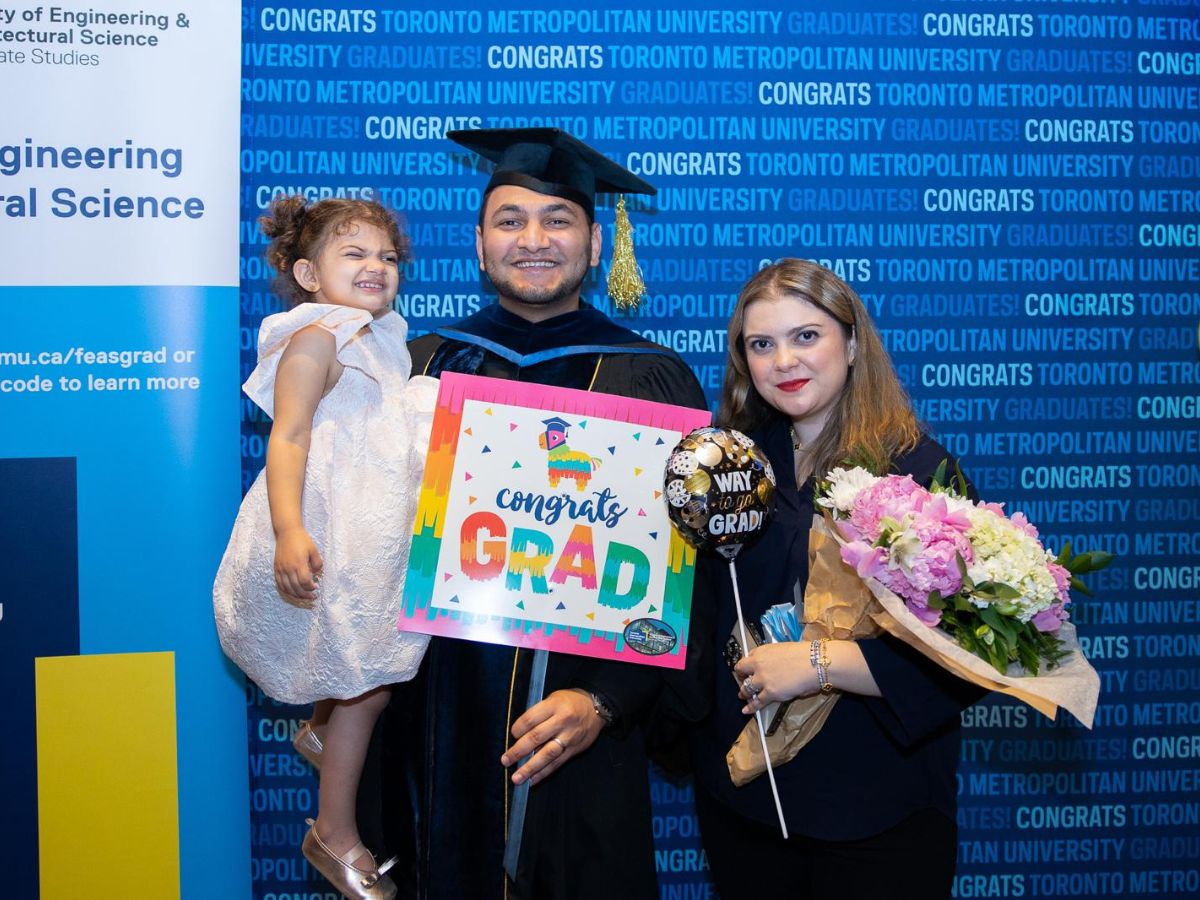
Dr. Ahmed Diab celebrates his graduation with his wife Rose and their daughter Leyla.