Digital Skills for Older Adults
Canada | 2026
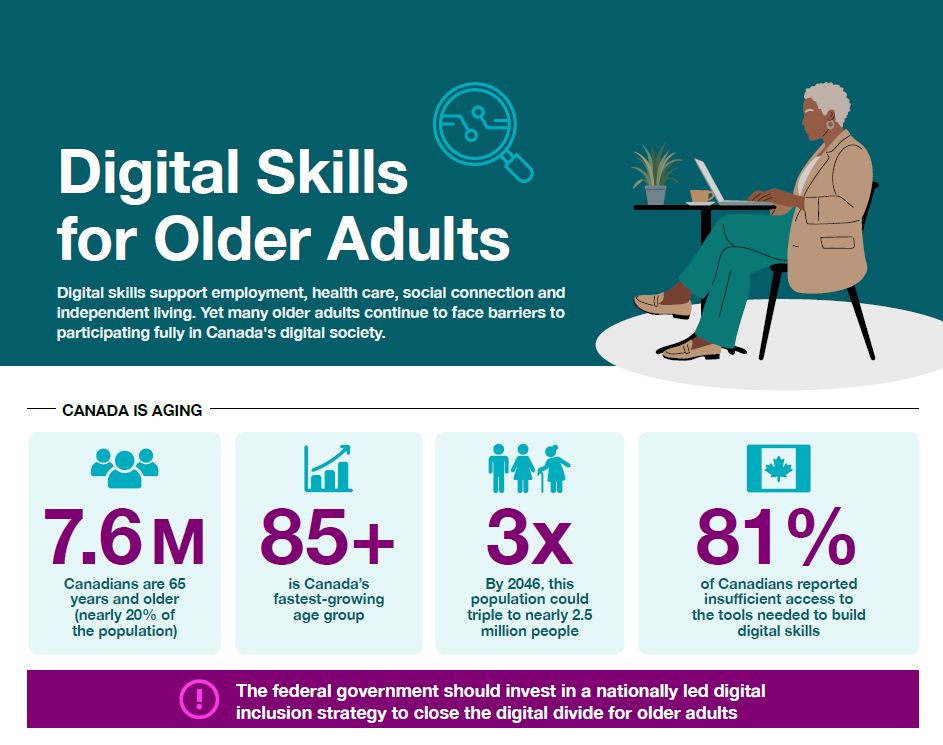
Canada is facing a digital skills gap that is excluding older adults from digital society. This is a significant issue for a growing older population, with projections showing that Canada’s population aged 85 and older could triple to nearly 2.5 million people by 2046. Older adults encounter significant barriers to digital literacy including limited basic digital skills, affordability issues, lack of tailored training programs, disability-assisted devices, and concerns regarding their privacy and safety online. Although efforts have been made to address the digital skills gap, they have had little success in addressing the wide-ranging needs and challenges faced by the older adult population, especially those from equity-deserving groups. As such, targeted, evidence-based interventions are needed to ensure effective design and delivery of digital skills training programs.
This report aims to support national and local dialogue by presenting existing research on digital literacy including older adults including the latest data on the older population and barriers to digital literacy. The authors also provide insights into effective training programs and partnership opportunities.
Digital skills training approaches
Targeted skills training programs must account for the diverse needs of older adults, which vary by labour market participation, age-related barriers, and training needs. To address these needs, instructional digital skills training design should consider the following factors:
- Objectives: Setting clearly outlined training objectives with measurable outcomes lead to strong learning outcomes.
- Personalized and relationship-based training models: Effective training models build on existing trust networks or new relationships that can improve learning outcomes among older adults. These approaches include peer-to-peer mentoring in one-on-one or smaller group settings, which is more effective than large classes with a one-size-fits-all approach.
- Access and connectivity: Programs should address structural barriers related to affordability and access such as providing devices and internet access, especially to low-income older adults.
- Inclusion and equity: Taking an inclusive, intersectional approach is important for meeting the needs of diverse participants.
- Outcomes and scalability: Tracking and measurement of outcomes is a key part of skills training design. By tracking outcomes such as digital skills acquisition and confidence levels related to digital literacy, programs can use evidence-based strategies to improve future programming.
Conclusions and recommendations
More in-depth research is needed to support evidence-based approaches to the needs that are emerging as a result of digitization. Future research should also prioritize long-term, intersectional examinations that track progress and digital equity. Based on the insights provided in this report, the authors present recommendations for strategic direction and funding and training design. These recommendations include:
- A nationally led digital inclusion strategy for older adults.
- Align digital skills with workforce, health and aging policies.
- Use instructional, personalized and accessible delivery models.
- Use social support, intergenerational and peer training models and trusted community spaces.
Read the full report for more details about the latest research and recommendations on digital skills for older adults in Canada.
Les compétences numériques au troisième âge
Le Canada fait face à un déficit de compétences numériques qui exclut les personnes âgées de la société numérique. Il s’agit d’un enjeu important pour une population âgée en croissance, alors que les projections indiquent que le nombre de personnes de 85 ans et plus au Canada pourrait presque tripler d’ici 2046, pour atteindre près de 2,5 millions. Les personnes âgées se heurtent à d’importants obstacles en matière de littératie numérique, notamment des compétences numériques de base limitées, des difficultés liées au coût, un manque de programmes de formation adaptés, un accès insuffisant à des appareils d’assistance pour les personnes en situation de handicap, ainsi que des préoccupations liées à la protection de leur vie privée et à leur sécurité en ligne. Même si des efforts ont été déployés pour combler le déficit de compétences numériques, ils ont eu peu de succès pour répondre à l’ensemble des besoins et des défis auxquels font face les personnes âgées, en particulier celles issues de groupes visés par des mesures d’équité. Des interventions ciblées et fondées sur des données probantes sont donc nécessaires pour assurer la conception et la prestation efficaces de programmes de formation aux compétences numériques.
Ce rapport vise à appuyer le dialogue à l’échelle nationale et locale en présentant les recherches existantes sur la littératie numérique chez les personnes âgées, notamment les données les plus récentes sur la population âgée et les obstacles à la littératie numérique. Les auteures et auteurs y présentent également des pistes de réflexion sur les programmes de formation efficaces et les possibilités de partenariat.
Approches en matière de formation aux compétences numériques
Les programmes ciblés de formation aux compétences numériques doivent tenir compte de la diversité des besoins des personnes âgées, qui varient selon leur participation au marché du travail, les obstacles liés à l’âge et leurs besoins en matière de formation. Pour répondre à ces besoins, la conception pédagogique des programmes de formation aux compétences numériques devrait tenir compte des facteurs suivants :
- Objectifs : Définir des objectifs de formation clairs, accompagnés de résultats mesurables, favorise de solides résultats d’apprentissage.
- Modèles de formation personnalisés et axés sur les relations : Les modèles de formation efficaces s’appuient sur des réseaux de confiance existants ou sur de nouvelles relations qui peuvent améliorer les résultats d’apprentissage chez les personnes âgées. Ces approches comprennent le mentorat entre pairs, en formule individuelle ou en petits groupes, qui est plus efficace que les grands groupes fondés sur une approche universelle.
- Accès et connectivité : Les programmes devraient s’attaquer aux obstacles structurels liés au coût et à l’accès, notamment en fournissant des appareils et un accès à Internet, en particulier aux personnes âgées à faible revenu.
- Inclusion et équité : Il est important d’adopter une approche inclusive et intersectionnelle pour répondre aux besoins de participantes et participants aux profils diversifiés.
- Résultats et mise à l’échelle : Le suivi et la mesure des résultats constituent un élément clé de la conception des formations aux compétences numériques. En suivant des résultats comme l’acquisition de compétences numériques et les niveaux de confiance liés à la littératie numérique, les programmes peuvent s’appuyer sur des stratégies fondées sur des données probantes pour améliorer les futures activités de programmation.
Conclusions et recommandations
Des recherches plus approfondies sont nécessaires pour soutenir des approches fondées sur des données probantes qui répondent aux besoins émergents liés à la numérisation. Les recherches futures devraient également accorder la priorité à des analyses intersectionnelles à long terme permettant de suivre les progrès réalisés et l’équité numérique. À partir des pistes de réflexion présentées dans ce rapport, les auteures et auteurs formulent des recommandations concernant l’orientation stratégique, le financement et la conception des formations. Ces recommandations comprennent les éléments suivants :
- Une stratégie nationale d’inclusion numérique pour les personnes âgées.
- L’arrimage des compétences numériques aux politiques relatives à la main-d’œuvre, à la santé et au vieillissement.
- Le recours à des modèles de prestation pédagogiques, personnalisés et accessibles.
- Le recours au soutien social, à des modèles de formation intergénérationnels et entre pairs, ainsi qu’à des espaces communautaires de confiance.
Lisez le rapport complet pour en savoir plus sur les recherches et les recommandations les plus récentes concernant les compétences numériques chez les personnes âgées au Canada.