Diversity Institute research informs conversations on Canada's AI future

Wendy Cukier, from the Diversity Institute (left) and Yvonne Ruke Akpoveta, from The Change Leadership, at the 2026 Change Leadership Conference, where leaders from across sectors explored the future of work, organizational transformation and the role of AI in shaping tomorrow's workforce.
Toronto’s Tech Week (external link) kept the Diversity Institute (DI) team on the move, with researchers presenting work on inclusive AI adoption, leading discussions, and participating in events across the city. DI shared insights on inclusive AI adoption for individuals and SMEs, workforce readiness and job creation, and talent development drawing on research with partners for the Future Skills Centre (external link) . Tech Week preceded the launch (external link) of Canada’s AI for All: Canada’s new national artificial intelligence strategy by Prime Minister Mark Carney. Many of the priorities outlined in the federal strategy align with DI’s insights and recommendations to Parliament including investments in sovereign AI infrastructure, measures to strengthen public trust, a focus on responsible AI adoption particularly for SMEs, and a national AI skills strategy including supporting advanced research but also skills for AI innovation and AI literacy for all.
The week included Signal49's invitation-only Industry Insights Tour, the City of Toronto's Ecosystem Connects session on Scaling AI in Toronto: Procurement and Adoption Pathways, the launch of ELLA Legacy hosted by YSpace ELLA (external link) out of York University, and the Change Leadership Conference 2026 with included researchers, policy makers, business leaders and community groups.
Invention is not innovation
One of the most pressing challenges facing organizations face is moving from words to action recognizing both the opportunities and risks associated with the technology. “While maintaining our leadership with technology is critical, responsible AI adoption is primarily a change-management process that requires new skills, workflows, governance frameworks and above all, trust. ‘Wait and see’ is not really an option given the pace of change and the fact that employees are outpacing their employers in their use of the technology.” She said referencing the DI study with the Environics Institute and Future Skills Centre that found half of employees using AI tools at work have received no formal training or organizational guidance, creating significant risks for workers and employers alike.
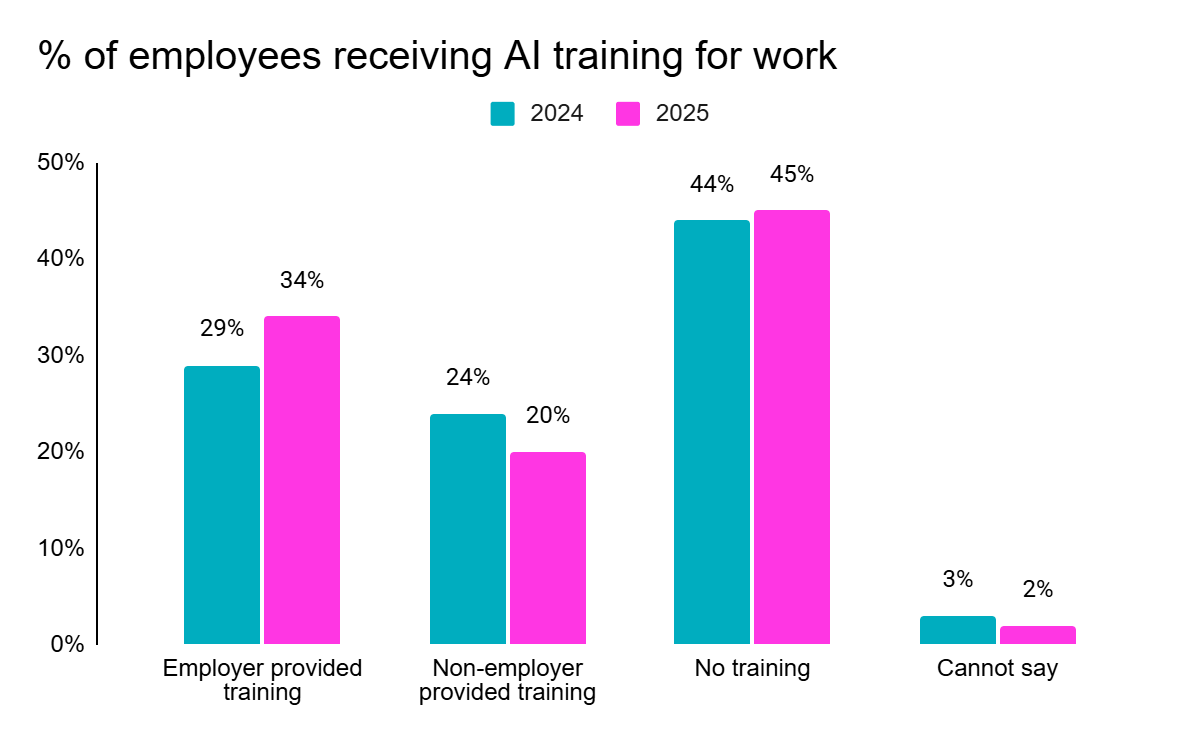
FSC funded research by DI and Environics found nearly half of employees using AI at work reported receiving no AI-related training in both 2024 (44%) and 2025 (45%). Although employer-provided training increased by 5 percentage points over the period, only one-third of employees received AI training from their employer.
Critical Role of Immigrants in Canada’s AI Ecosystem
Cukier highlighted the critical role immigration has played in building Canada's AI and technology ecosystem. From pioneering AI researchers such as Geoffrey Hinton and Yoshua Bengio, to today's highly skilled technology workforce, immigrants have helped drive innovation and fill talent gaps across the sector. “We have to think about an interesting fact: diverse populations, including Indigenous Peoples, are more likely to have AI skills,” she said. Additionally, immigrants are significantly overrepresented in many of Canada's STEM occupations (external link) and make up roughly one-third of the country's digital technology workforce. As Canada launches its AI strategy, Cukier emphasized that success will depend not only on world-leading research, but also on the talent, skills and adoption needed to translate invention into innovation.
While immigrants are a key driver of Canada's digital talent advantage, Cukier noted that they also report some of the highest levels of concern about automation and job security. Drawing on research conducted by DI and the Environics Institute for Survey Research, she said that 60% of recent immigrants reported worrying about losing their job to automation, compared with roughly 45% of first- and second-generation Canadians. More than half of first- and second-generation respondents also expressed concerns about maintaining stable full-time employment, a figure that rises to nearly 70% among recent immigrants. The findings underscore the importance of pairing AI adoption with investments in skills development, worker supports and trust-building measures that help ensure the benefits of innovation are widely shared.
AI skills for small and medium-sized enterprises
Cukier also emphasized the central role of SMEs in Canada’s economy and the need to design inclusive AI adoption approaches, digital skills training and workforce strategies around their realities. Research shows 44% of SMEs (external link) report skilled labour shortages limit their ability to increase sales or production. Yet, SMEs are most likely to use AI to do more with less rather than reducing workforce. Furthermore, immigrant owned SMEs drive innovation, with 34% of decision-makers in innovative SMEs (external link) being born outside Canada, and nearly 11% of immigrant-led firms planning to increase research and development spending, compared with 6.7% of all private firms. As Canada advances major investments in housing, defence, infrastructure, critical minerals, energy and clean growth as well as AI, she noted that SMEs remain the engine of economic growth across sectors, and that their adoption of AI will be critical to productivity and competitiveness. Drawing on DI research, she also highlighted the importance of inclusive talent strategies, noting that women, immigrants, Indigenous Peoples, racialized people, persons with disabilities and other equity-deserving groups represent a significant and growing share of Canada’s entrepreneurs and workforce.
Across Toronto Tech Week, Cukier emphasized that responsible AI adoption is fundamentally a people challenge, not a technology challenge. “AI implementation is not a software rollout, it is a change process involving people, workflows, data, governance and trust.” The goal, she argued, “is not to use more AI, but to improve work, strengthen decision-making, build capability and drive measurable impact.” Achieving that vision will require investments in training, upskilling and work-integrated learning that help workers and businesses adapt with confidence. When employees understand the change, have access to the right skills and trust that risks are being managed, organizations can move more quickly from experimentation to responsible adoption. Many of the priorities Cukier emphasized throughout Toronto Tech Week, including skills development, responsible AI adoption, public trust and support for SMEs, were reflected in the federal government's AI for All strategy, released days later, a direction welcomed by the Diversity Institute.