Beyond STEM: Women and the AI Opportunity

For decades, discussions about women in the technology workforce have centred on a longstanding problem: Women remain underrepresented in science, technology, engineering and mathematics (STEM), in information and communications technology (ICT), and especially in the technical and senior roles that shape technological development.1 That problem has not disappeared. But if artificial intelligence (AI) is framed primarily as another STEM challenge, we risk overlooking a much larger opportunity for women.
The AI economy will not be built only by people who design models, write code or develop AI systems. Its effects will increasingly depend on a much larger group of people who decide where AI is useful, connect it to organizational and sectoral problems, assess outputs and risks, and help people adapt.2
The implications of this broader skills framework are significant, particularly for women. Canada still needs more women with advanced technical AI expertise, and everyone needs basic AI literacy. But the largest opportunity for broad participation may sit between those two priorities: AI Innovation Skills. These are hybrid capabilities that combine AI knowledge with subject-matter expertise, process knowledge, critical thinking, communication, judgement and change management. Properly conceptualized, AI adoption is therefore not just a technology challenge. It is a change-management challenge, and that creates pathways for women from a much wider range of disciplines and occupations to participate in, lead and benefit from AI.
What is artificial intelligence
Artificial intelligence (AI) is a broad field encompassing computer systems designed to perform functions associated with human intelligence, including learning, reasoning, prediction, perception, language and decision-making.3 AI includes expert systems, which rely on predefined rules; machine learning, which learns patterns from data; and deep learning, which uses artificial neural networks to process large amounts of complex data. 4,5 More recent forms include generative AI, which creates new content such as text, images, audio, video and code; agentic AI, which can plan and execute multi-step tasks; and physical AI, which can perceive and act in the physical world. 6,7,8 Different forms and uses of AI call for different capabilities, ranging from basic literacy and responsible use to organizational adoption and advanced technical development, and thus changing jobs, tasks, workflows and responsibilities in various ways.
Skills AI adoption requires
A useful starting point is to distinguish between the different kinds of AI competency. The Diversity Institute’s AI competency framework separates Basic AI Literacy, AI Innovation Skills and Deep AI Skills. Basic AI Literacy covers what people need to understand AI and its capabilities and limitations, use common tools safely, assess outputs and recognize risks. AI Innovation Skills focus on putting AI to work by combining practical AI understanding with domain knowledge, including identifying useful applications, evaluating tools, redesigning workflows, implementing AI, leading change and measuring results. Deep AI Skills are the advanced scientific and technical capabilities required to design, build, train, adapt, deploy, test, monitor and maintain AI systems and their safeguards.
A manager, entrepreneur, health professional, educator, communications specialist or public servant can be highly capable at applying AI without being able to build the underlying model. This is why a skills strategy focused only on coding, machine learning or technical credentials would miss much of the work required to move AI from experimentation to value.
“We need deep AI skills to build the tools and AI literacy for all. But the middle is much bigger: we need people who understand their businesses and processes and have the skills to put AI to work responsibly.”
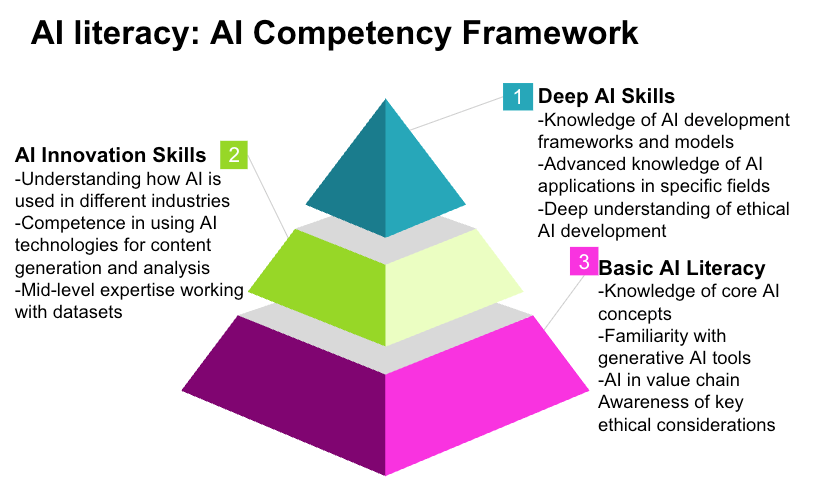
AI Competency Framework 9
Women remain underrepresented in tech, but STEM is not the whole story
The historical representation gap remains important. In 2023, women accounted for approximately 37.5% of STEM graduates in Canada, but that aggregate masks large differences by discipline. Women represented about 60.0% of graduates in science and science technology, compared with 22.7% in engineering and engineering technology and 32.1% in mathematics, computer and information sciences.10
The pattern narrows further in technology employment. Earlier Diversity Institute research found that women’s representation in the ICT sector had remained around 30% for more than a decade and fell to about 21% when the analysis focused on technical roles.11 That work also pointed to an important shift: digital occupations increasingly exist outside traditional technology companies, hybrid skills are becoming more important, and low-code and no-code technologies are changing who can perform digitally enabled work.
More recent Information and Communications Technology Council (ICTC) calculations using 2024 Labour Force Survey data show similar results.12 Women represented 24.4% of technology-related occupations within the ICT sector and 27.9% of all occupations in the sector. Their representation was higher when digital work was considered across the economy, at 30.0% of technology-related occupations across all industries and 32.6% of employment in the broader digital economy.
Even the broader digital economy measure shows limited progress over time. ICTC reports that women represented 32.6% of Canada’s digital economy in 2024, compared with 30.5% in 2006. Women’s representation also narrows sharply at senior levels, accounting for just 9% of executive and senior management positions in the ICT sector, compared with 37.4% of senior management positions across private-sector businesses, reinforcing that simply growing the technology sector does not automatically remove structural barriers to advancement.13
Women’s exposure to AI-driven change is not limited to technology roles. A 2026 International Labour Organization (ILO) analysis covering 84 countries found that occupations in which women are concentrated were almost twice as likely to be exposed to generative AI as occupations in which men are concentrated, 29% compared with 16%.14 This partly reflects women’s greater representation in clerical, administrative and business support roles. The ILO also concludes that, for most occupations, generative AI is more likely to change tasks, skills and working conditions than result in widespread job losses.
The implication is not to move away from STEM, it is to stop treating STEM as the full boundary of AI opportunity. Women remain underrepresented among those who build technology, and addressing this gap remains important. At the same time, AI adoption takes place across the entire economy and depends on expertise that is distributed far more broadly.
The bigger opportunity is adoption, and adoption is a change management process
The tendency to equate AI opportunity with technical development understates how technical diffusion actually occurs. Developing a model is a technical challenge. Adopting AI across an organization is an organizational one.
Generative AI is reshaping how work is organized and gets carried out. Simply putting new technology into an employee’s hands does not ensure meaningful use or value. Organizations need to redesign end-to-end workflows, establish governance, build trust, involve employees, provide training and support, and manage the transition to new ways of working.15
Labour market evidence from the Organisation for Economic Co-operation and Development (OECD) makes the same point from the skills side. Across the countries in its analysis, 72% of vacancies in highly AI-exposed occupations demanded at least one management skill and 67% demanded at least one business process skill.16 The OECD also highlights the importance of social, emotional, digital and other complementary skills. Most workers affected by AI will not need to become AI developers, but many will need to combine an understanding of AI with the skills required to apply it in context.
These are precisely the capabilities involved in AI adoption: understanding a business or service problem, mapping an existing process, determining where AI could add value, evaluating a tool, redesigning responsibilities, communicating with employees and stakeholders, managing privacy and other risks, checking outputs, measuring results, and deciding when human judgement or technical expertise is required.
This is where the much discussed “revenge of the English major” captures something important. The point is not that technical expertise matters less, but that AI may make a broader range of skills more valuable. Two of Anthropic’s cofounders illustrate this. Jack Clark, who studied literature and creative writing, has argued that as AI advances, the ability to synthesize ideas across disciplines and ask the right questions may matter more, while narrow, rote technical skills may become less distinctive.17 Daniela Amodei, who studied literature, makes a similar case. Drawing on her own path into AI, she has emphasized curiosity, the ability to learn across disciplines, and interpersonal skills, arguing that people bring different forms of comparative advantage to technical teams.18 Their experiences point to a broader shift: succeeding with AI is not only about building the technology, but also about knowing how to question it, apply it, interpret it and connect it to real world problems.
Women are using AI, but gender gaps persist in the workplace
Women are clearly engaging with AI, but differences in where and how they use it are pointing to a gender divide, particularly in the workplace. Statistics Canada found that women and men initially reported the same overall rate of workplace generative AI use, 22% each, during the September 2024 to July 2025 collection period. Once differences in education, occupation and industry were taken into account, however, women were less likely to report using generative AI at work. Within health care and social assistance, where women are well represented, only 13% of women reported workplace use compared with 21% of men, while the corresponding figures in professional, scientific and technical services were 47% and 55%.19
The Diversity Institute’s analysis of the nationwide Survey on Employment and Skills adds an important dimension.20 In 2026, women are more likely than men to report using AI for school, at 77.3% compared with 64.0%, but somewhat less likely to use it for work, 42.1% compared with 44.9%, or for personal purposes, 53.3% compared with 58.2%. Women’s reported school use also rose sharply from about 50% in 2025 to 77% in 2026.
The same data show a familiarity gap. In 2026, 50.6% of women reported being somewhat or very familiar with workplace AI programs, compared with 58.4% of men. The pattern was visible among racialized women (66.3% racialized women vs. 70.6% of racialized men), Black women (74.2% vs. 81.0%), Indigenous women (60.7% vs. 64.9%), and immigrant women (62.4% vs. 67.0%). Women with disabilities showed the largest familiarity gap (49.8% vs. 60.7%), while 2SLGBTQ+ women reported higher familiarity than 2SLGBTQ+ men (63.2% vs. 56.9%).
The education-to-work pattern is especially revealing. Racialized women were more likely than racialized men to use AI for school, (79.0% vs. 65.0%), but less likely to use it for work (46.0% vs. 54.0%). Immigrant women reported school use of 84.8% compared with 75.0% among immigrant men, but work use of 48.8% compared with 56.8%. Women with disabilities and 2SLGBTQ+ women showed a similar pattern: relatively strong school use, but weaker or roughly similar workplace use.
Among women who use AI, reported productivity benefits are substantial and have increased over time. The proportion of women saying AI made them more productive increased from 75.0% in 2024 to 80.3% in 2026, compared with 83.8% of men in 2026. Black women reported perceived productivity gains at roughly the same rate as Black men (89.9% vs. 88.9%), with a similar pattern among immigrant women and immigrant men (85.4% vs. 85.2%). Racialized women, Indigenous women and women with disabilities reported somewhat lower levels than men in the same groups.
Workplace conditions may help explain why women’s AI use does not always translate into broader adoption in employment. Men were more likely to say their employer encouraged AI use (43.7% vs. 38.2% of women). Nearly half of women (48.2%) reported receiving no AI training at work, compared with 40.1% of men. The gap was particularly pronounced for Black women (37.0%) compared with Black men (26.3%), Indigenous women (35.5% vs. 15.9%), women with disabilities (35.7% vs. 28.5%), immigrant women (50.1% vs. 42.2%) and 2SLGBTQ+ women (47.2% vs. 42.4%). Among people not using AI at work, the most common reason for both women and men was that the programs were not useful for the type of work they did, reported by 48.8% of women and 56.2% of men.
The challenge is not simply to persuade women to learn AI. Many women are already learning and using it, and they report significant benefits. The larger question is whether workplaces provide the training, tools and organizational conditions that enable women to apply AI effectively, contribute to how it is adopted and benefit from the opportunities it creates.
Expanding women’s pathway to AI
As AI spreads across sectors and occupations, there are distinct ways to strengthen women’s participation and advancement in the AI economy.
- Basic AI Literacy needs to be widespread: As AI becomes embedded in workplaces, education, public services and everyday life, women need opportunities to understand its capabilities and limits, use common tools safely, verify outputs, protect information and recognize bias, misinformation and other risks.
- Invest in AI Innovation Skills as a pathway to broader participation in AI adoption: These skills sit between basic use and advanced technical development. They enable people to identify applications, redesign work, integrate AI responsibly and turn technological capabilities into organizational value. They draw from AI knowledge, but also from project management, entrepreneurship, communications, behavioural understanding, process improvement, critical thinking, sector knowledge and change management.
- More women need pathways into Deep AI Skills: Increasing women’s participation among the people who design, build and govern AI systems remains essential for economic opportunity and for whose perspectives shape technology.
- Provide wraparound supports that enable diverse women to access, complete and benefit from AI skills training programs: AI training initiatives should account for the barriers that can determine who is able to participate and complete training. This can include flexible delivery, childcare, financial supports, mentorship, and connection to employers.
- Engage employers in the design and delivery of AI programs: Employers involvement can help ensure skills training reflect the AI skills, applications and workplace contexts relevant to specific occupations and roles. Employers can also provide applied learning opportunities and support women’s professional development and advancement.
- Address workplace conditions that influence who gets to use and benefit from AI: Skills development alone will not close participation gaps. Employers should ensure that women have equitable access to AI tools, opportunities to experiment with and apply AI in their work, and are included in decisions about how AI is introduced and how workflows and roles are redefined.
References
- Cukier, W., & Broughton, S. (2024). Advancing women in the information and communications technology workplace: A review of leading practices. Diversity Institute, Toronto Metropolitan University & Future Skills Centre. https://www.torontomu.ca/diversity/reports/advancing-women-in-the-information-and-communications-technology/
- Roth, E. (2025, August 13). Reconfiguring work: Change management in the age of gen AI. McKinsey & Company. https://www.mckinsey.com/capabilities/quantumblack/our-insights/reconfiguring-work-change-management-in-the-age-of-gen-ai (external link)
- Russell, S., & Norvig, P. (2021). Artificial intelligence: A modern approach (4th ed.). Pearson.
- Jordan, M. I., & Mitchell, T. M. (2015). Machine learning: Trends, perspectives, and prospects. Science, 349(6245), 255–260. https://doi.org/10.1126/science.aaa8415 (external link)
- (external link) LeCun, Y., Bengio, Y., & Hinton, G. (2015). Deep learning. Nature, 521(7553), 436–444. https://doi.org/10.1038/nature14539 (external link)
- Brown, T. B., Mann, B., Ryder, N., Subbiah, M., Kaplan, J., Dhariwal, P., Neelakantan, A., Shyam, P., Sastry, G., Askell, A., Agarwal, S., Herbert-Voss, A., Krueger, G., Henighan, T., Child, R., Ramesh, A., Ziegler, D. M., Wu, J., Clemens, W., … Amodei, D. (2020). Language models are few-shot learners. Advances in neural information processing systems, 33, 1877-1901. https://doi.org/10.48550/arXiv.2005.14165 (external link)
- OECD. (2026). The agentic AI landscape and its conceptual foundations (OECD Artificial Intelligence Papers No. 56). OECD Publishing. https://www.oecd.org/en/publications/2026/02/the-agentic-ai-landscape-and-its-conceptual-foundations_a9d4b451.html (external link)
- Stryker, C. (2026, January 19). What is physical AI? IBM. https://www.ibm.com/think/topics/physical-ai (external link)
- Diversity Institute. (2026). A Three-Level AI Competency Framework for Inclusive AI Adoption [forthcoming]. Diversity Institute. Future Skills Centre.
- Statistics Canada. (2025). Postsecondary graduates, by International Standard Classification of Education, institution type, Classification of Instructional Programs, STEM and BHASE groupings, status of student in Canada, age group and gender (Table 37-10-0164-01). Government of Canada. https://doi.org/10.25318/3710016401-eng (external link)
- Cukier, W., & Broughton, S. (2024). Advancing women in the information and communications technology workplace: A review of leading practices. Diversity Institute, Toronto Metropolitan University & Future Skills Centre. https://www.torontomu.ca/diversity/reports/advancing-women-in-the-information-and-communications-technology/
- Ivus, M., & Podolna, O. (2024). Breaking Barriers and Building Futures: Women Entrepreneurs as Catalysts for Sustainable Growth. Information and Communications Technology Council. https://ictc-ctic.ca/reports/breaking-barriers-and-building-futures (external link)
- Lindstrom, C. (2026, August 19). Representation and Advancement: Women in Canada's Digital Economy. Information and Communications Technology Council. https://ictc-ctic.ca/news-and-events/news-articles/representation-and-advancement-women-in-canadas-digital-economy (external link)
- International Labour Organization. (2026). Gen AI, occupational segregation and gender equality in the world of work. International Labour Organization. https://doi.org/10.54394/00033798
- Roth, E. (2025). Reconfiguring work: Change management in the age of gen AI. McKinsey & Company. https://www.mckinsey.com/capabilities/quantumblack/our-insights/reconfiguring-work-change-management-in-the-age-of-gen-ai (external link)
- OECD. (2026). Skills in the AI age. OECD. https://www.oecd.org/en/publications/skills-in-the-ai-age_972bd15e-en/full-report.html (external link)
- Griffiths, B. (2026, April 14). An Anthropic cofounder's advice on what to study in college. Business Insider. https://www.businessinsider.com/jack-clark-anthropic-college-degrees-2026-4 (external link)
- McDowell, M. (2026, June 29). Daniela Amodei Says Curiosity Is Underrated. Stanford Graduate School of Business. https://www.gsb.stanford.edu/insights/daniela-amodei-says-curiosity-underrated (external link)
- Hahmann, T., & Lovei, M. (2026, June 17). Workplace artificial intelligence use: A profile of sociodemographic and job characteristics. Statistics Canada. https://www150.statcan.gc.ca/n1/pub/75-006-x/2026001/article/00007-eng.htm (external link)
- Diversity Institute. (2026). Survey on Employment and Skills [Unpublished survey data]