Building connections: Global Africa Summit looks to unlock Canada–Africa trade opportunities
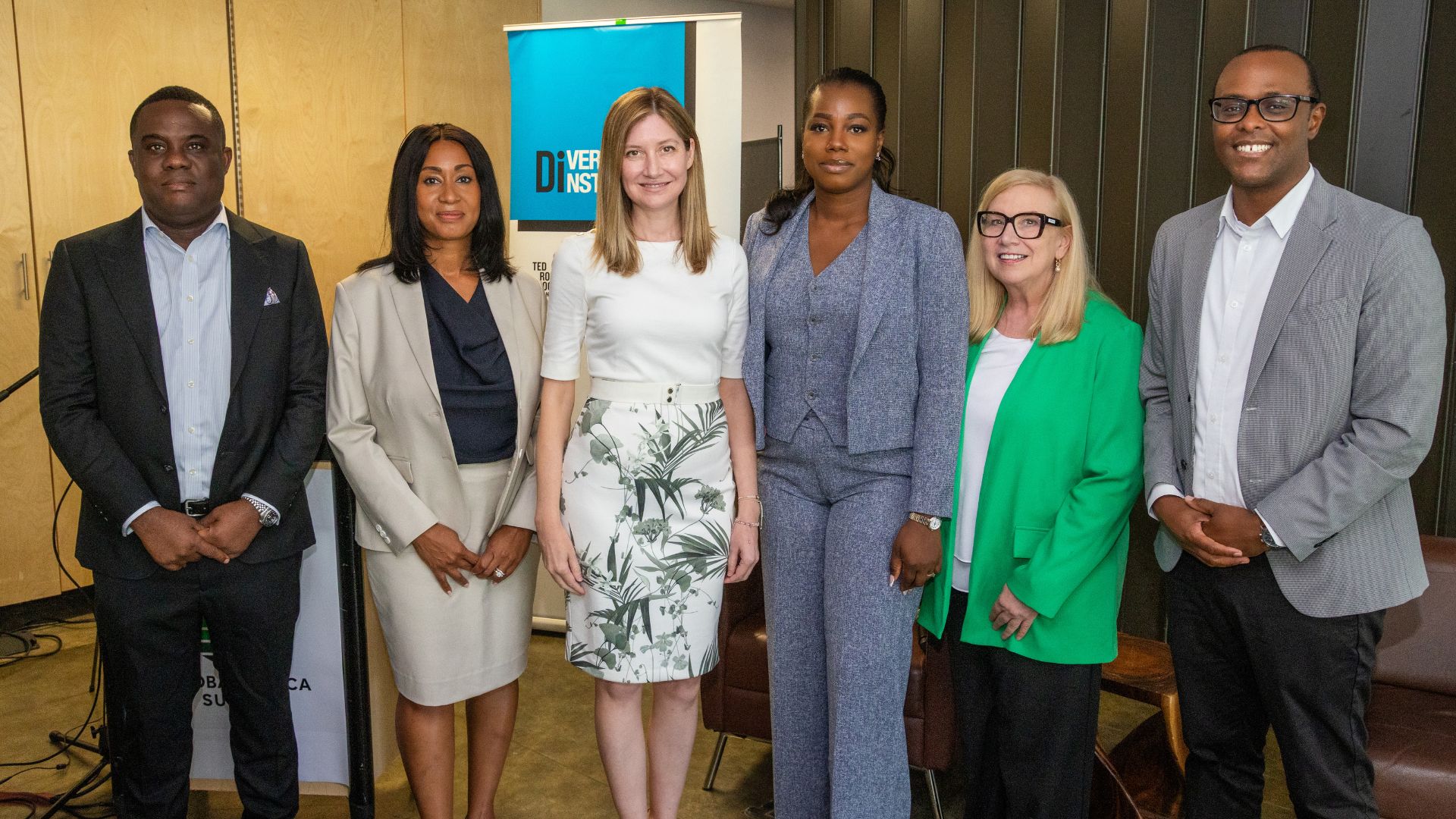
Leaders from the Diversity Institute (DI) and Africa Investment Network (AIN) with representatives from Global Affairs Canada and Ghana during the Global Africa Summit at the Ted Rogers School of Management. From left to right: Nii Odoi Yemoh, Executive Director, Reality Capital, and President, Ghana-Canada Chamber of Commerce; Jane Reindorf-Osei, Founder and CEO, AIN; Cheryl Urban, Assistant Deputy Minister, Africa and Pan-Geographic Affairs, Global Affairs Canada; Margaret Kuma-Mintah, Minister, Investment and Tourism Officer, Ministry of Foreign Affairs, Ghana; Wendy Cukier, Founder and Academic Director, DI; and Mohamed Elmi, Executive Director, DI.
The Global Africa Summit – Toronto, convened by the Africa Investment Network (AIN) and co-hosted by the Diversity Institute (DI) at the Ted Rogers School of Management (TRSM), drew together almost 100 participants focused on practical ways to expand trade, investment and entrepreneurship between Canada and African markets.
The Toronto gathering built on previous summits in Washington, D.C., and Accra and marked the first time the summit was held in Canada.
“Today we bring together business leaders, policymakers, and academics,” said Cynthia Holmes, dean of TRSM. “What I hope is that we're providing a venue here through the business school to forge new ties.”
Entrepreneurship as a trade advantage
For Mohamed Elmi, executive director of DI, the timing is significant. Canada has made trade diversification a priority, he said, but achieving it requires building relationships and market knowledge beyond Canada's traditional partners.
“Diversification cannot simply be doing more of the same or doing more of the same with the same places over and over again,” Elmi said. “It requires us to build new relationships, develop new sources of market intelligence [and] engage seriously with regions that help shape our future in the global economy.”
Research by DI, including the recently edited book, Immigrant Entrepreneurship: Challenges and Opportunities published by Palgrave MacMillan (external link) , underscores the importance of immigrants generally in driving economic growth and prosperity. In Canada, immigrants are far more likely to start businesses than Canadian born people and those businesses have higher growth rates and employment than others. Immigrant-owned businesses are more likely to export than others and Canada’s immigrant diasporas are its global competitive advantage and critical to Canada’s international brand. The recent State of Women Entrepreneurship (external link) (SOWE) report underscores the particularly important role of women among immigrant entrepreneurs. For example, women account for almost 40% of Black entrepreneurs in Canada compared to 20% overall.
Opportunities to harness the power of the African diaspora, in particular, are greater than ever before with the new African Continental Free Trade Area which brings together the 55 member states of the African Union, connecting 1.3 billion people, and a US$3.4 trillion economy. It is also the largest trade agreement to embed gender equality as a core principle.
Elmi also pointed to Canada's African diaspora as an economic asset, bringing market knowledge, relationships and experience that can help bridge economies. “One of Canada's greatest advantages as we seek to strengthen economic relationships with African countries is the diaspora itself,” he said.
That ability to connect people and markets was a recurring theme. Jane Reindorf-Osei, founder and CEO of AIN, described encountering entrepreneurs with strong businesses and investors searching for opportunities, but few mechanisms to bring them together. “The challenge was never a lack of talent; it was a lack of connection,” she said.
Turning opportunity into deals
Cheryl Urban, Assistant Deputy Minister for Africa and Pan-Geographic Affairs at Global Affairs Canada, said the federal government's Africa strategy is increasingly focused on translating those connections into results.
“The tone in the government of Canada today is all about delivery,” Urban said. “It's: find results, get deals, and make real things happen.”
While Canada's commercial relationship with Africa is growing, it remains relatively small and concentrated. Urban said Africa accounts for approximately one per cent of Canadian exports, while 80% of bilateral merchandise trade is concentrated in seven countries.
Government supports, including the Trade Commissioner Service, Export Development Canada, FinDev Canada and the new Africa Trade Hub, are intended to help Canadian businesses navigate those markets.
Pamela Hay, Regional Counsellor (Commercial) to Mozambique and Zimbabwe with Global Affairs Canada, highlighted opportunities in technical education, digitalization, energy, engineering and consulting. She also stressed that success requires local knowledge, financing and relationships, particularly for SMEs entering unfamiliar markets.
Her advice was practical: work with local partners, visit markets in person, understand how business practices differ and use Canada's trade infrastructure for support. The Africa Trade Hub, she said, can help companies assess where their ideas may have the best chance of succeeding.
For DI, those connections reflect a broader body of research showing that entrepreneurship is central to inclusive economic growth. The summit put that research into practice; bringing entrepreneurs, institutions, government and diaspora networks together to turn knowledge and connections into economic opportunities.