Rethinking AI Skills: Why STEM Alone Won’t Prepare Us for What’s Ahead
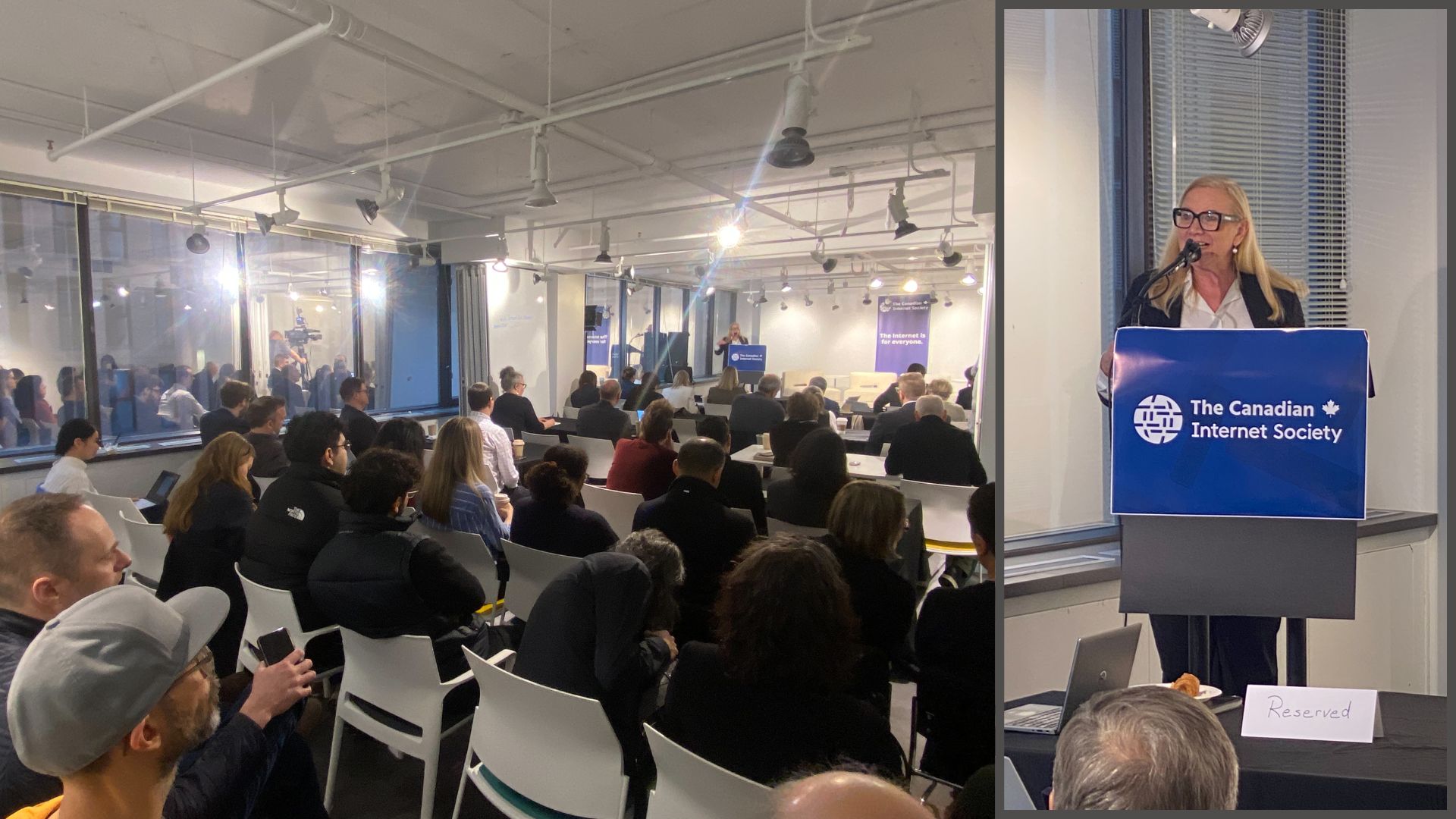
At this year’s Digital Access Day, hosted by the Canadian Internet Society, Wendy Cukier, founder and academic director of the Diversity Institute delivered keynote remarks to open the event.
As Canada accelerates conversations around artificial intelligence (AI), a central challenge is emerging: how to maintain its global strength in AI invention while ensuring that people, businesses and communities are not left behind on adopting AI.
At this year’s Digital Access Day, hosted by the Canadian Internet Society (external link) in Ottawa, government leaders, academics and technology industry experts came together to tackle that challenge among others such as cybersecurity, scaling up of Canada’s AI companies, the impact of AI and digital sovereignty on Indigenous peoples, data centres powering AI, technology talent retention and skills development requirements.
Digital sovereignty, access & inclusion
Digital Access Day opened with Parliamentary Secretary to the Minister of Industry, Karim Bardeesy outlining three priorities shaping Canada’s AI approach: protecting talent and investments, empowering meaningful AI adoption to drive economic growth, and building AI sovereignty to remain globally competitive. These themes were echoed by Marc Schaan, Associate Deputy Minister at Innovation, Science and Economic Development Canada (ISED), who stressed the central role of trust, quoting Evan Soloman, Minister Responsible for the Federal Economic Development Agency for Southern Ontario, he said, “Technology moves at the speed of innovation, but adoption moves at the speed of trust.” Schaan highlighted the need for updated policy frameworks, “That's why we've committed to tabling legislation to update Canada's private sector privacy framework to reflect a digital and data intensive economy, clear and modern privacy expectations create the conditions under which organizations can innovate responsibly and people can participate confidently.”
AI paradox: AI invention, adoption, risks and opportunities for Canadians
Wendy Cukier, founder and academic director of the Diversity Institute (DI), who delivered a keynote highlighting the AI Paradox: Canada leads in development of technology but lags in adoption. “The emphasis on access, talent and trust feels especially important, and it sets the stage for the discussion I want to advance today,” Cukier said.
“I have worked on technology adoption for more than 30 years, from the early internet to digital transformation, and one lesson stands out: the pace of change is so different now that you can't plan when you can't predict the unknown and a lot of the lessons we've learned historically don't apply anymore.” Cukier went on to say that “The technology is producing extraordinary gains for some organizations, people and sectors, while others are struggling to benefit at all. In Canada, that challenge is especially acute because we are a country of small and medium-sized enterprises, and many SMEs simply do not have the time, money or capacity to implement complex tools at the same pace as large firms.”
Cukier discussed AI’s enormous potential to increase productivity, while also warning about the risk of job dislocation. She noted that some estimates typically suggest 30% of jobs are at risk,30% will change and 30% will remain unchanged but argued that the reality is that nearly 100% of jobs will change in some way. She also noted that too little attention is being focused on the potential for job creation. “The research is still emerging” she said, “but there is considerable evidence that large organizations are using AI to increase efficiency and we are already seeing significant layoffs or attrition as jobs, particularly entry level roles, disappear. But large businesses are a small fraction of private sector employment in Canada. The most significant impact is on Small and Medium Enterprises which dominate the economy. “What is interesting here is that most are small businesses; they are looking to use technology to grow, to innovate and to scale, not to reduce employment.”
She closed her remarks by warning that we cannot ignore the gap between AI’s promise and the reality of adoption. Nor can we overlook the very risks, threats to security, privacy, governance, fraud, disinformation and misuse are real. That is why it is a mistake to focus the skill discussion only on science, technology, engineering and math (STEM). Of course we need deep technology skills - that is what gave Geoffrey Hinton the Nobel Prize. But as the cofounder of Anthropic noted, we need broader perspectives from humanities and social sciences now more than ever. We need people who understand ethics, regulation and policy, people who understand organizational and consumer behaviour, people who understand economics and entrepreneurship and more. In our work at the Future Skills Centre we define these as AI innovation skills, the skills we need to drive responsible adoption. And the third level of skills we need are AI literacy for all. Regardless of their roles, all Canadians are vulnerable if they are not aware of the risks as well as the potential of the technology. If we want AI to strengthen productivity and opportunity across the economy, equity, diversity and inclusion must be part of the strategy from the start.
She also referenced several key reports and FSC projects Bridging the AI Gap in SMEs in Canada report, Artificial Intelligence in Action for Small and Medium-Sized Enterprises as well as the AI competency framework and training programs and capacity building efforts focused on SMEs.