Understanding the Drivers of Entrepreneurship in Canada’s Territorial North

Canada’s territorial north is a region of great economic potential and increasing strategic importance. The territorial north’s economy is characterized by a dynamic landscape of emerging opportunities in renewable energy, defence, infrastructure, tourism, and international trade alongside more traditional resource-based industries. The Barriers and Enablers to Northern Entrepreneurship, a recent report from the Diversity Institute, supported by the Future Skills Centre, highlights issues critical to Canada’s prosperity, sustainability and commitments to Truth and Reconciliation. The report focuses on the challenges and opportunities for northern entrepreneurship in Yukon, Northwest Territories (NWT), and Nunavut, a region characterized by geographic isolation, limited infrastructure, and supply chain barriers as well as significant potential and the rich history, culture, talent and resourcefulness of Indigenous peoples.
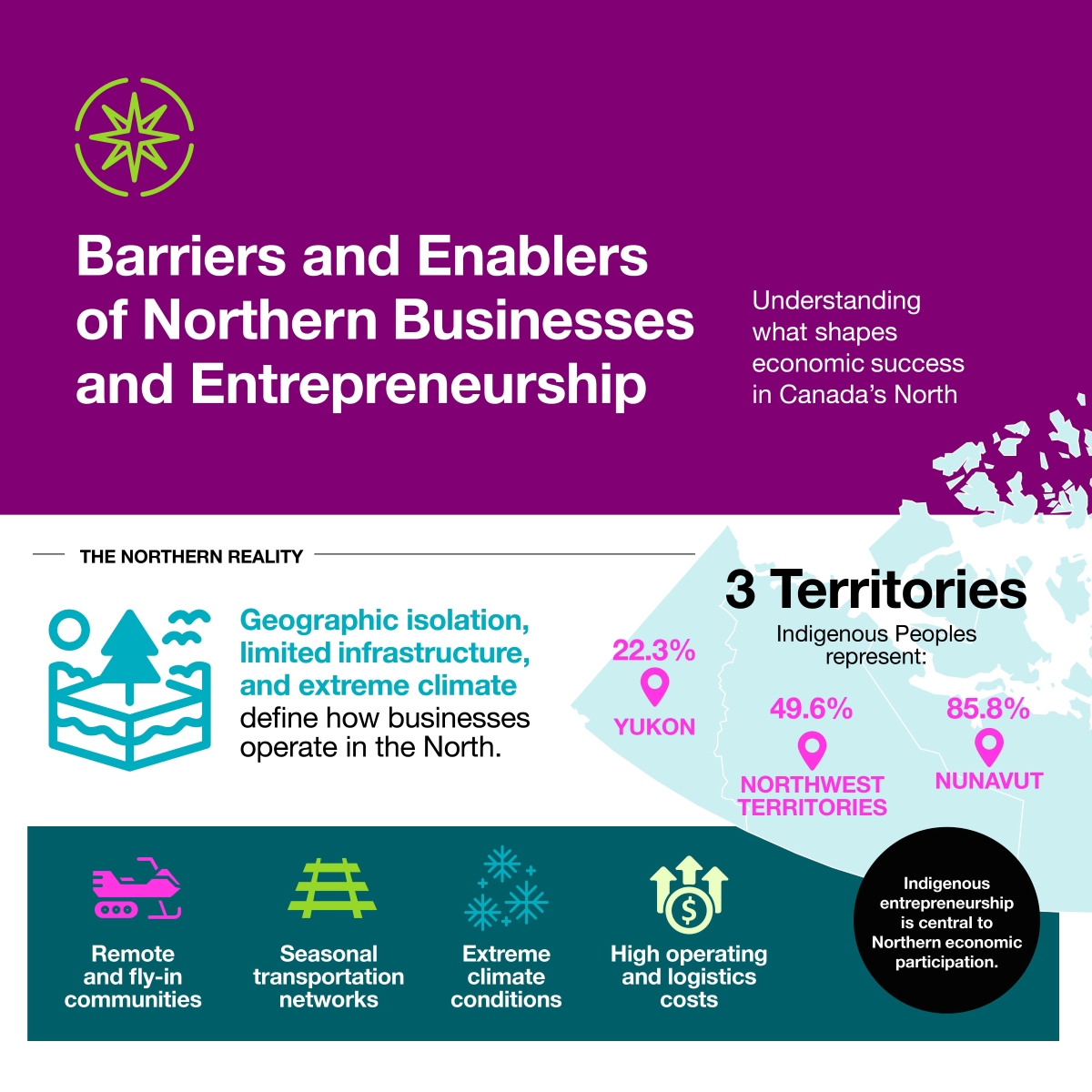
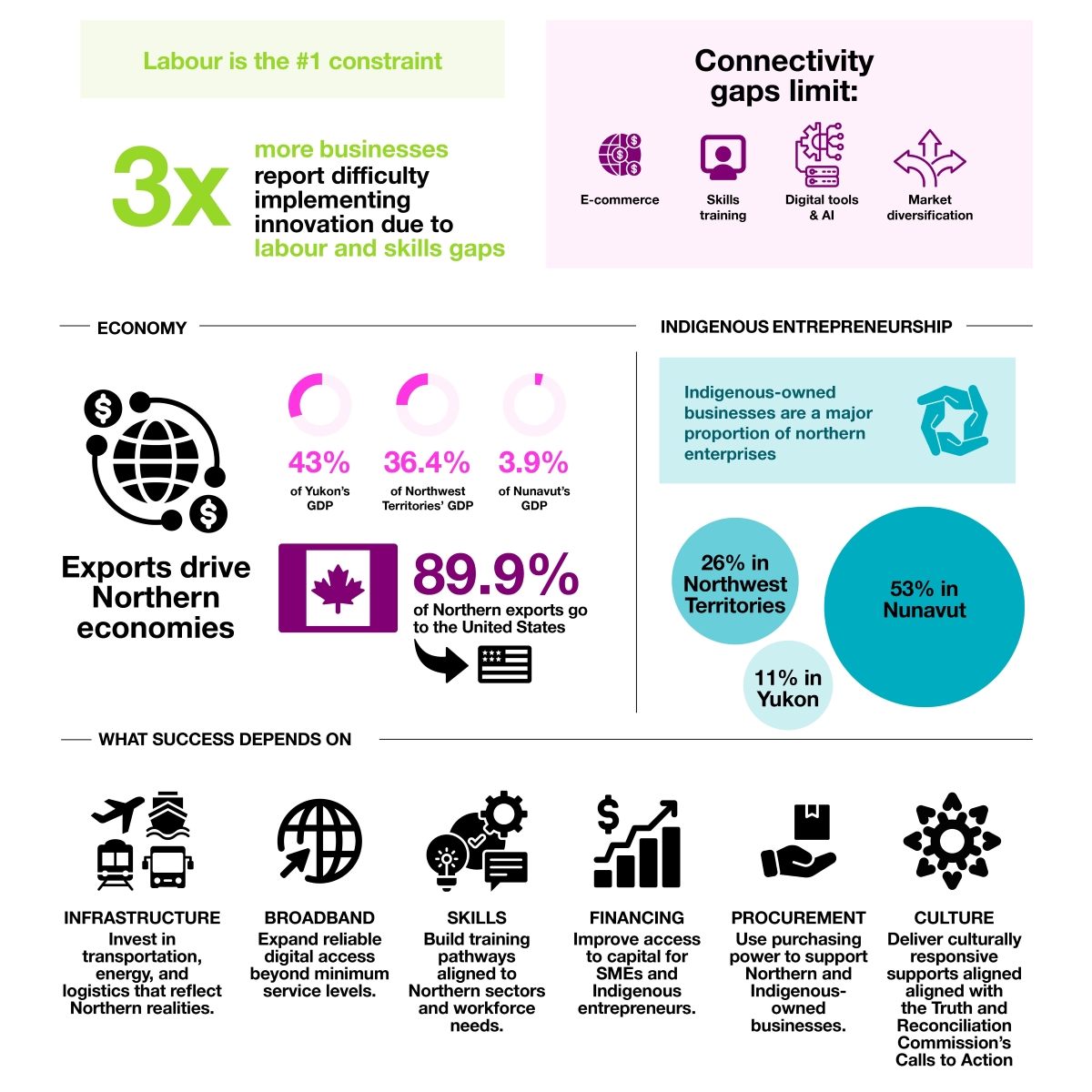
The northern economy has many larger enterprises, but small and medium-sized enterprises (SMEs) led by Indigenous peoples and northerners dominate the economic landscape. As of June 2025 SMEs comprised 99.6% of all business in the territorial north and even make up 68.8% of businesses in the mining, quarrying, and oil and gas extraction sectors, which are traditionally led by large businesses. Northern SMEs require continued support to adopt new technologies, diversify market opportunities and grow. Trade is an important pillar of the northern economy with Nunavut and NWT demonstrating significant export strength. Exports accounted for 45.9% of NWTs GDP in 2018 and for 43% of Nunavut’s GDP in 2023 making their economies vulnerable to trade uncertainty and supply chain disruptions. The data shows a North that is increasingly integrated into global markets, yet heavily reliant on imports with Nunavut’s imports reaching 34% of GDP in 2023. To reduce this reliance and foster local innovation, more needs to be done to assist the development of northern entrepreneurs and indigenous-led SMEs.
Indigenous Peoples are central to this landscape, and entrepreneurship represents an important pathway towards economic prosperity and reconciliation for Indigenous peoples in the territorial north. As of 2021, Indigenous Peoples comprised 85.8% of the population in Nunavut, 49.6% in NWT, and 22.3% in Yukon. But they are still under-represented as business owners. In early 2025, Indigenous Peoples were majority-owners of 53.4% of businesses in Nunavut, 25.5% in NWT, and 11.3% in Yukon. In the Northwest Territories, Indigenous entrepreneurship is projected to grow by 23% between 2024 and 2034, driven by a young and expanding population.
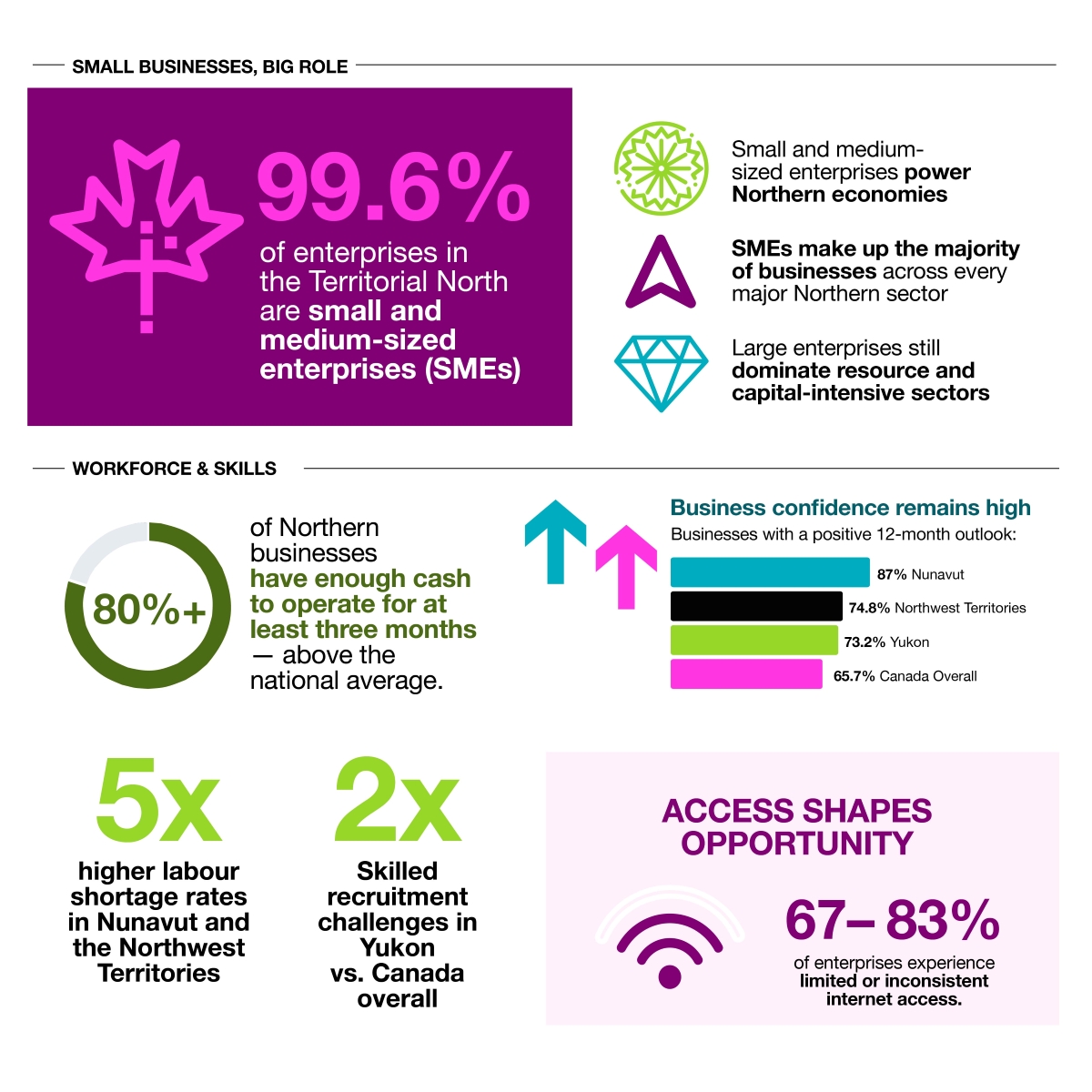
Realizing the full potential of Northern entrepreneurship requires addressing systemic barriers while leveraging key enablers. A lack of labour and technology-proficient workers in particular is a major barrier for the growth of SMEs in the north.This is particularly the case in construction, which accounts for 11.7% of Yukon’s GDP and demands a workforce equipped with advanced skills and education. Skills training and capacity building are critical to meeting the calls to action outlined by the Truth and Reconciliation Commission (TRC): Call to Action 92, which highlights the importance of providing equitable access to training and education for Indigenous peoples but also training for non-Indigenous management and staff in intercultural competency, history, and anti-racism to create more inclusive workplaces.
All northern businesses face significant systemic barriers, including high operational costs driven by geographic isolation and a lack of reliable digital connectivity. Indigenous entrepreneurs face additional barriers, such as restricted access to financing resulting from historical biases and Section 89 of the Indian Act, which prohibits the use of on-reserve property as collateral for loans. Many programs meant to support entrepreneurs are not well adapted to the specific needs of entrepreneurs in the territorial north or to the needs of Indigenous entrepreneurs. Additionally, many programs utilize digital platforms, which means they are often out of reach for remote communities that lack digital infrastructure. To foster growth, the region requires the further development of customized ecosystem supports as well as use of levers such as supplier diversity and community benefits to provide much needed capital.
While Indigenous university graduates have similar employment outcomes to non-Indigenous peoples, there remain persistent educational and employment gaps between Indigenous and non-Indigenous Canadians which require targeted action. Investments in training and education in the north need to recognize the realities of the additional costs of appropriate wrap around supports to address historic disparities but also the need for significant investments in basic infrastructure. This is consistent with the TRC Call to Action #10, which emphasizes the need to improve attainment levels and success rates while protecting Indigenous languages and integrating culturally appropriate curriculum. As Canada plans significant investments in major projects in the North, it requires a laser focus on developing local labour market capacity with employment focused, culturally appropriate and flexibility training co-developed with Indigenous communities. Support for Indigenous owned northern businesses is the key to long term economic development and sustainability.
A Path Forward
By following the TRC’s calls to provide sustainable funding for community-controlled projects and ensuring that economic benefits remain within northern communities, we can build an entrepreneurial ecosystem that is both prosperous and just. The transition to a high-tech, diversified Northern economy is not just an economic necessity; it is an opportunity to fulfill our collective responsibility toward reconciliation, ensuring that the next generation of northern entrepreneurs have the tools, education, and institutional support to thrive.
To unlock the full potential of northern entrepreneurship, The Barriers and Enablers to Northern Entrepreneurship calls for coordinated, long-term action co-designed with Indigenous communities. Key recommendations include investing in resilient transportation networks and high-speed broadband to lower operating costs and enable businesses to fully participate in digital commerce, e-commerce, and AI-driven opportunities. It also urges governments, funders, and institutions to address systemic biases embedded in traditional financing models and to ensure that information about funding and training reaches entrepreneurs through trusted, community-based channels.
In alignment with the Truth and Reconciliation Commission’s Call to Action 92, the report highlights the importance of co-developing training initiatives with Indigenous partners and equipping non-Indigenous personnel with intercultural competency, historical awareness, and anti-racism training to build respectful and sustainable economic relationships. Further recommendations include leveraging regional procurement to strengthen local SMEs and creating a specialized entrepreneurship competency framework with sector-specific training in fields such as tourism and construction, supported by culturally relevant wraparound services.
These recommendations represent only a snapshot of the insights based on consultations, comprehensive evidence, regional perspectives, and practical strategies that can help translate these recommendations into meaningful and lasting change.
Funder
The Future Skills Centre – Centre des Compétences futures is funded by the
Government of Canada’s Future Skills Program.
The opinions and interpretations in this publication are those of the authors
and do not necessarily reflect those of the Government of Canada.
References
Statistics Canada. (2025, August.) Table 33-10-1014-01 Canadian business counts, with employees, June 2025. (external link) Government of Canada.
Obale, O., & Tazbaz, A. (2025, March). Northwest Territories’ merchandise trade with the world (external link, opens in new window) . Parliament of Canada.
Indigenous Services Canada. (2023). An update on the socio-economic gaps between Indigenous Peoples and the non-Indigenous population in Canada: Highlights from the 2021 Census. (external link, opens in new window) Government of Canada.
Cukier, W., Joutsi, A., & Hampton, S. (2025, July). (PDF file) Greenification of SMEs: Green skills competency framework. (opens in new window) Diversity Institute. Future Skills Centre.
Dobbs, G., & Vu, V. (2023). (PDF file) Digital journeys: A path towards digital economic empowerment for Indigenous youths in Canada. (external link, opens in new window) The Dais; Toronto Metropolitan University.
Schrumm, A., Bell, S., & Smith, T. (2021, July 13). Building bandwidth: Preparing Indigenous youth for a digital future. (external link, opens in new window) RBC.
Business Development Bank of Canada. (2024, June). BDC and First Nations Bank of Canada launch $100M initiative to boost business acquisitions (external link) [Press release].
Government of Canada. (2022, April). Business and reconciliation: Learn how the Government of Canada is responding to Call to Action 92 (external link, opens in new window) .
Truth and Reconciliation Commission of Canada. (2015). (PDF file) Truth and Reconciliation Commission of Canada: Calls to Action. National Centre for Truth and Reconciliation. (external link, opens in new window)