Experts Examine Immigration Policy Shifts Across North America and its Impact on Women and Girls
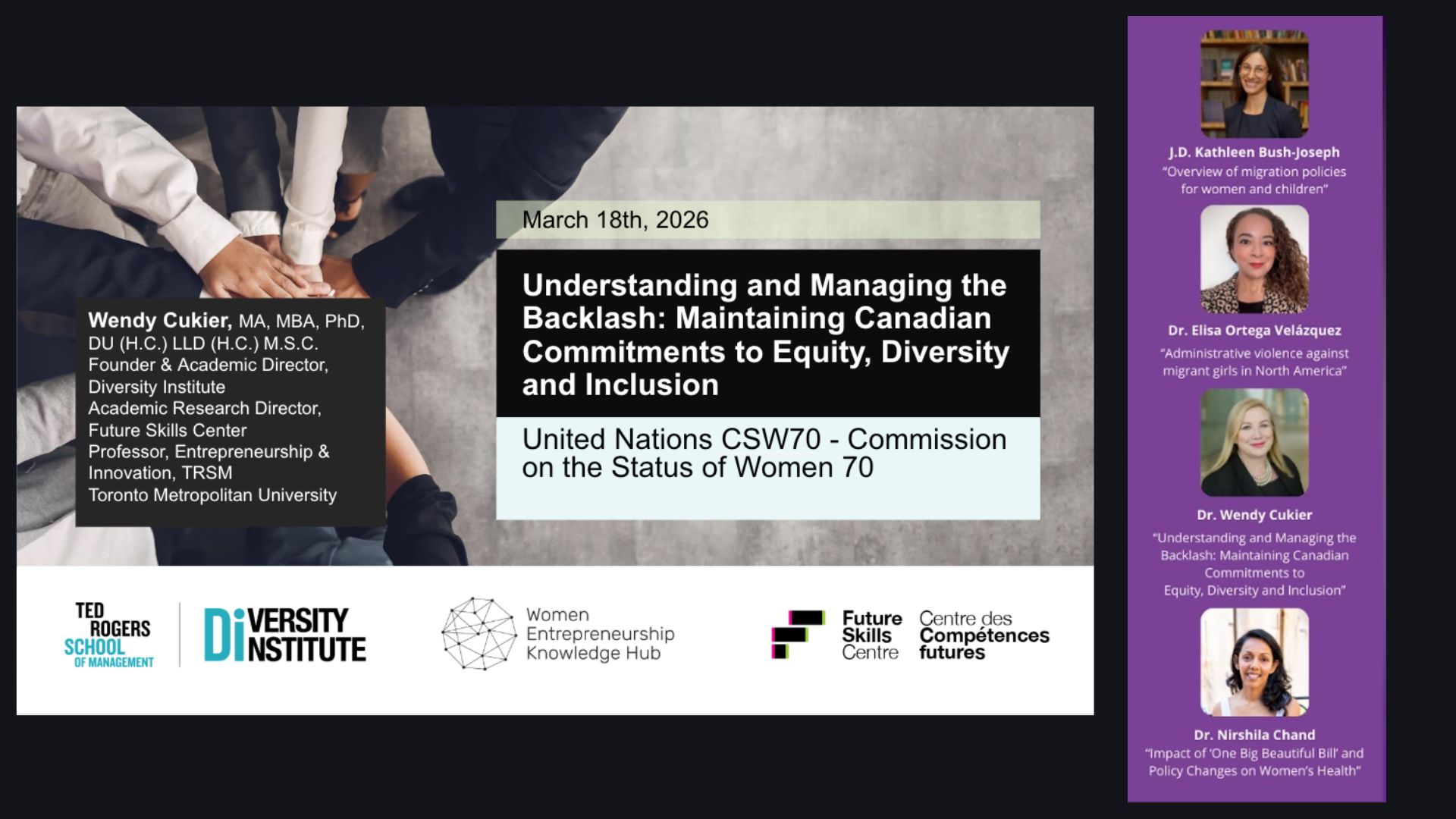
On March 18, 2026, the North American alliance of the Canadian Federation of University Women, Women Graduates–USA, and the Mexican Federation of University Women, hosted a panel as a side event of the United Nations 70th session of the Commission on the Status of Women.
At the United Nations 70th session of the Commission on the Status of Women (CSW70), March 18, 2026, the North American alliance of the Canadian Federation of University Women (CFUW), Women Graduates–USA (WG-USA), and the Mexican Federation of University Women (FEMU), hosted a panel titled Justice for Women Amid North America's Immigration Policy Shift. The discussion brought together experts from across Canada, the U.S., and Mexico, highlighting how shifting immigration policies are affecting women and girls across the region.
Moderated by Kathleen Laurila, CAMEUS Coordinator, the panel featured Kathleen Bush-Joseph, lawyer and Policy Analyst with the Migration Policy Institute, who shared insights on U.S. immigration policy and its impacts on women and children; Dr. Elisa Ortega-Velázquez, senior researcher at the Universidad Nacional Autónoma de México (UNAM), who examined the legal and lived realities of borders and migration in the Mexican context; and Dr. Nirshila Chand, a public health specialist, who highlighted the health implications of migration policies.
Representing Canada, Wendy Cukier, Founder and Academic Director of the Diversity Institute (DI), spoke to recent shifts in Canada’s immigration landscape, emphasizing the country’s global competitive advantage as an immigrant-driven economy while also underscoring the contributions, and ongoing challenges, faced by immigrant women. Together, the panel underscored shared regional challenges and the need for coordinated, evidence-based approaches to support immigrant women and girls across North America.
Immigrant women population in Canada
DI research supported by the Future Skills Centre(FSC) provides a picture of the realities facing immigrant women in Canada, highlighting both their strengths and the persistent gaps in outcomes. Immigrant women are, on average, highly educated (external link) , with a greater proportion holding a bachelor’s degree or higher compared to Canadian-born women, yet this advantage does not translate into equitable labour market outcomes.
In 2007, Canadian-born (66%) and long-term immigrant (66%) women had the highest full-time employment rates. By 2021, the full-time employment rate (external link) of Canadian-born women had climbed to 70% compared to little change in that of long-term immigrant women (65%). More recent data shows that in 2025, immigrant women faced an unemployment rate (external link) nearly double that of Canadian-born women (7.6% vs. 4.1%), and lower overall employment (75.6% vs. 83.5%) and labour force participation (81.9% vs. 87.1%).
Immigrant women entrepreneurs are key drivers of economic growth
Turning to focus on the Canadian economy, Cukier said, “Canada is a country of small medium enterprises. It's 90% of our private sector. Employment is with small businesses, unlike in the United States.” And this is important because DI research shows that immigrant women are key drivers of entrepreneurship and economic growth. Immigrants account for 32% of all business owners with paid employees (external link) , and 18.5% of immigrant-owned small and medium-sized enterprises are majority owned by women. Businesses led by immigrant women are also more export-oriented (external link) than those led by Canadian-born women (16.5% vs. 9%), underscoring their role in connecting Canada to global markets. Women represent a significant share of entrepreneurs in many communities, and immigrant women show higher interest in entrepreneurship than both immigrant men and the broader population.
“In the current environment where we lost our best friend,” Cukier said, referring to the U.S., “We are looking for new markets to enter and my argument is our immigrant diaspora is really a competitive advantage in terms of getting into those new markets.” Cukier noted that while immigrant women are more likely to export they also face high rates of discrimination.
Equity, diversity and inclusion (EDI) intersect with the experiences of immigrant women in both workplaces and broader society. Data from DI and the Environics Institute for Survey Research, shows that immigrant women are more likely than other groups to report positive impacts from EDI initiatives, with 58.9% saying their organization’s approach has improved their opportunities; about 12 percentage points higher than immigrant men (47.1%) and the overall sample (46.5%). However, these gains exist alongside persistent barriers: immigrant women often have smaller social networks than Canadian-born women, limiting access to opportunities and support, and face significant challenges accessing essential services due to legal, language, financial and discrimination-related constraints, often compounded by isolation and informal employment.
Shifting public attitudes around immigration
Cukier noted the spillover effects of U.S. discourse, legitimization of hate and foreign interference as well as anxiety in Canada about jobs and housing contributed to an unprecedented shift in attitudes to immigration levels. After decades of indicating that immigration levels were not too high, a recent survey found that seven in ten Canadians (70%) believe there is too much immigration, although more than half (58%) at the same time say immigration strengthens the Canadian economy. She highlighted how organizations operating across both countries have, in some cases, scaled back or reframed their EDI commitments, underscoring a broader trend of slow or cautious responses from industry leaders. This shift is particularly concerning in the Canadian context, where immigrants play a critical role in addressing workforce shortages and supporting economic growth.
At the policy level, there have also been changes including dramatic cuts to immigration levels and some legislative changes. Research done by DI highlights the role of misinformation in shaping public attitudes and the reactions. With our aging population, Canada needs immigrants. “Immigrants built this country,” she said, “Literally. The railroads, the houses and the businesses. Policy, both shapes and reflects values. We need leaders who stand up for Canadian values, which center multiculturalism and immigration as well as the commitments to EDI. We need to be making informed decisions based on evidence not overreactions fueled by deliberate campaigns of misinformation.”
The way forward
Taken together, this evidence highlights both the opportunity and urgency of a more inclusive path forward. Newcomer experiences are not uniform, women have specific needs and better intersectional, disaggregated data is essential to inform effective policy. Immigration policies and settlement services must be more closely aligned with labour market needs through a gender lens, while early supports, skills training, and wraparound services tailored to immigrant women can improve long-term outcomes. Employers also have a critical role to play, with EDI-focused hiring and retention strategies helping to reduce barriers and unlock talent. At the same time, entrepreneurship remains a vital pathway for economic inclusion, but immigrant women need improved access to capital, networks and tailored supports to succeed. Strengthening these areas will be key to ensuring that Canada’s immigration system continues to advance not only economic growth, but also equity, inclusion and shared prosperity.