Designing Infrastructure for Climate Resilience and Equitable Access
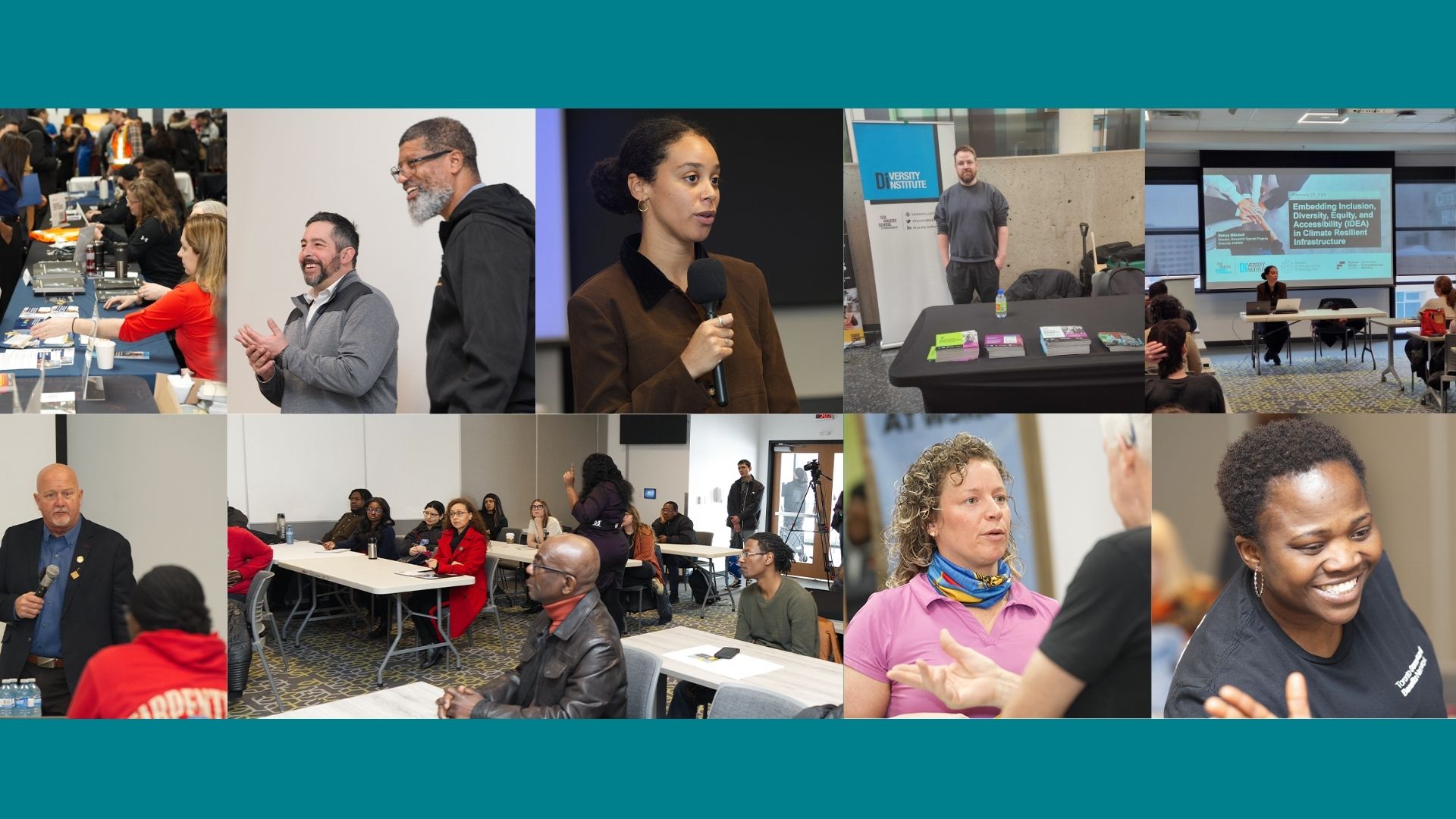
On February 25, 2026, Nancy Mitchell (top row, third from right), Director of Special Projects at the Diversity Institute (DI), spoke at the Build Green Symposium. The event also included a trade show where Liam Donaldson (top row, fourth from right), DI Research Assistant, shared DI research and projects with atendees. (Photo credit: Toronto Community Benefits Network)
Canada is investing billions of dollars in infrastructure, from housing and transit to energy systems and public spaces, reshaping communities across the country. While these projects promise economic growth and improved quality of life, they can also bring unintended consequences such as displacement, gentrification and the erosion of community identity. At the same time, climate change is increasing the frequency and severity of floods, wildfires and other extreme weather events, exposing vulnerabilities in the systems Canadians rely on. As governments accelerate infrastructure investments, the challenge is not only to build more, but to build in ways that strengthen community resilience and sustainability.
Recently, Nancy Mitchell, Director, Research - Special Projects at the Diversity Institute (DI), spoke at the Build Green Symposium hosted by the Toronto Community Benefits Network. The event featured a trade show, where Liam Donaldson, DI Research Assistant, shared DI research on green building practices and interacted with leaders, innovators and sustainability advocates in the sector. During the symposium, Mitchell highlighted the importance of embedding equity into infrastructure planning. “While everyone feels the impacts of climate change, the magnitude of impacts are unevenly felt by women, Indigenous Peoples, and equity-deserving groups,” she said. “Embedding equity, diversity and inclusion into the process ensures future investments benefit communities equitably.”
Embedding EDI into climate resilient infrastructure
Mitchell’s remarks reflect a broader body of work underway at DI Climate change and infrastructure development do not affect all communities equally. For instance, the Canadian Women Foundation reports 42% of wildfire evacuations impact Indigenous Peoples, higher heat-related health risks exist in low-income neighborhoods across Canada, and 75% of Canadian youth report experiencing climate anxiety. Persons with disabilities face challenges in accessing care and emergency assistance during climate-related hazards and disasters, and data from the 2022 Canadian Survey on Disability (external link) suggests they are two to four times more likely to be injured or killed in disasters compared to the general population.
The DI partnered with the Digital Governance Council, with support from the Standards Council of Canada, to develop the Guide on Applying Inclusion, Diversity, Equity and Accessibility (IDEA) Within Climate-Resilient Infrastructure, released in 2025. The guide outlines practical steps for embedding IDEA into the planning, development and retrofitting of infrastructure projects. The guide can be used to understand disaster risk, strengthen disaster risk governance to manage disaster risk, invest in disaster risk reduction for resilience, and enhance disaster preparedness for effective response and to “Build Back Better” in recovery, rehabilitation and reconstruction. While frameworks and guidance can help embed equity into infrastructure planning, implementation often depends on practical tools that ensure communities have a voice in how projects unfold.
What are community benefits agreements and why do they matter?
One way to formalize community participation in major infrastructure projects is through Community Benefits Agreements (CBAs). A CBA is a legally binding agreement negotiated with community participation that sets out specific benefits tied to a development project. Often described as an empowerment model, CBAs combine community organizing, coalition building, and negotiation to ensure local priorities are reflected in large-scale investments.
Community benefits can include targeted hiring for equity-deserving groups, job training and apprenticeships, procurement opportunities for local businesses and social enterprises, affordable housing, community amenities, and improvements to public spaces. By linking these outcomes to infrastructure spending already underway, CBAs aim to ensure that the economic, social, and environmental value created by major projects is shared more equitably with surrounding communities.
A forthcoming DI report, Business Case for Community Benefits Agreements in Publicly Funded Infrastructure Projects, developed in partnership with the Toronto Community Benefits Network, highlights the potential of CBAs when they are thoughtfully designed and implemented. The research shows CBAs can support employment and training pathways for equity-deserving groups, expand procurement opportunities for diverse suppliers, and deliver improvements to local public spaces. But equitable infrastructure and community-focused development also depend on the businesses and workers delivering these projects having the skills to support the green transition.
A green skills competency framework
Another area of focus for DI is strengthening green skills for small and medium-sized enterprises (SMEs). SMEs make up about 99% of Canadian businesses, employ roughly 64% of private sector workers, and account for nearly 30% of the country’s direct operational emissions. Supporting these businesses in the transition to more sustainable practices is therefore critical to Canada’s broader climate goals.
For many SMEs, however, the transition to net-zero presents challenges. Compared with larger firms, small businesses often have fewer resources, limited access to specialized expertise, and less capacity to invest in sustainability training or new technologies. Yet research shows that when businesses reduce emissions, they often benefit from cost savings, improved efficiency, and greater market competitiveness.
To help address these gaps, DI developed a Green Skills Competency Framework, building on earlier work created in collaboration with Oxford University with support from the Future Skills Centre. The framework outlines the technical and sustainability competencies businesses need to support the green transition. It begins with foundational knowledge of environmental systems and sustainability, before progressing to areas such as risk awareness, improved planning and post-disaster response.
Designed for the existing workforce as well as emerging labour market needs, the framework draws on industry expertise and international collaboration. Its goal is to guide training programs, support workforce development, and help SMEs integrate sustainable practices into their operations, strengthening both business resilience and Canada’s path toward a greener economy.
Through research, partnerships, and practical frameworks, the Diversity Institute’s work highlights how infrastructure investments can support both climate resilience and inclusive economic opportunity, ensuring communities are not only protected from climate impacts but positioned to thrive in a greener economy.