Thirty Years of Data Reveals Persistent Obstacles for Women in Engineering
Wendy Cukier, Founder and Academic Director of the Diversity Institute, presents research on the barriers faced by women engineers and how to tackle them at the 2026 Cannexus conference.
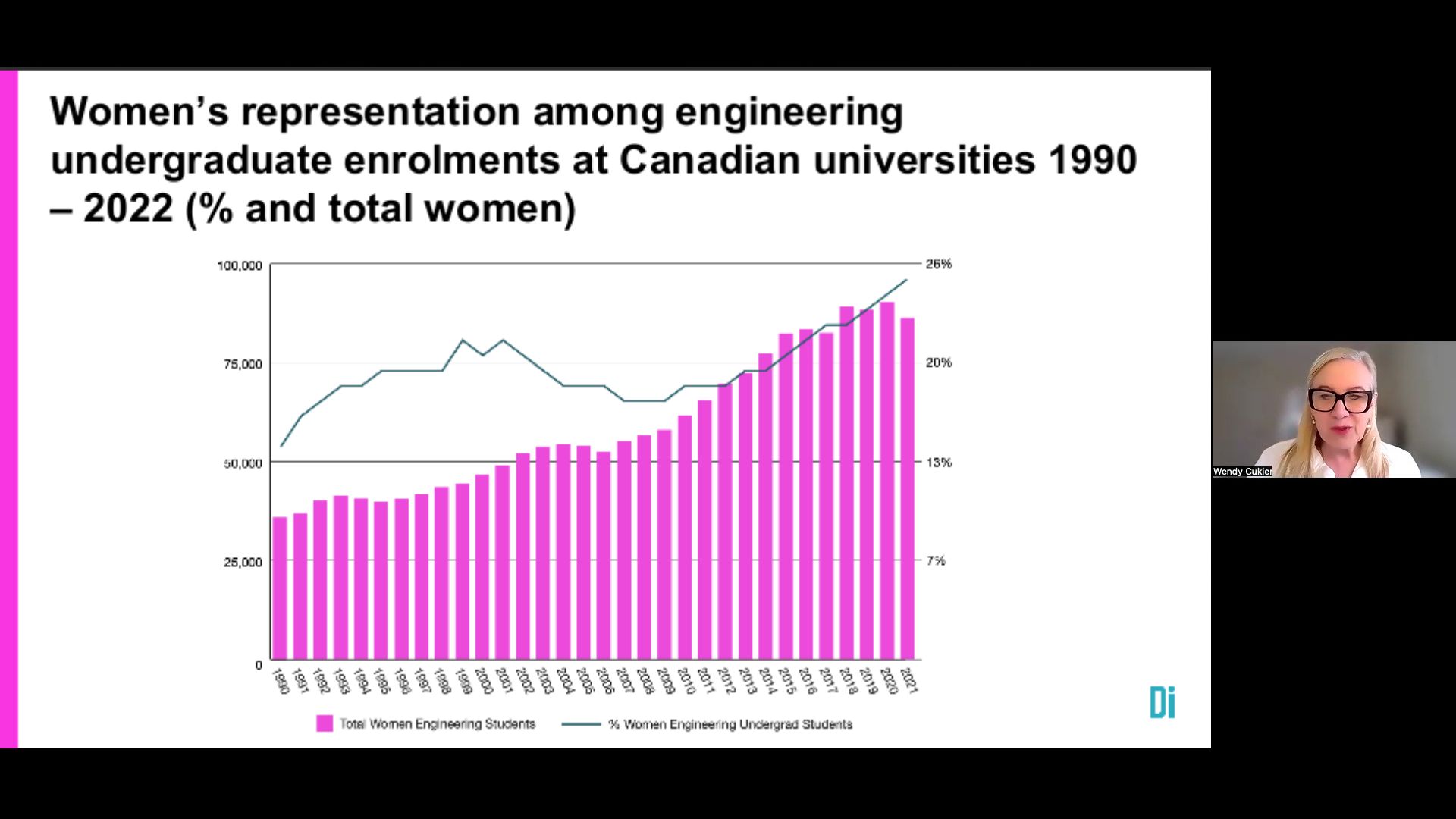
More than thirty years ago, a landmark report from the Canadian Committee on Women in Engineering (CCWE) named what many women in engineering already knew: that talent alone was not enough to overcome the structural barriers embedded in the profession. The 1992 report, More Than Just Numbers, explored those barriers and set out clear targets and recommendations to address inequities in access, advancement and workplace culture. Yet new data presented this month by the Diversity Institute (DI) reveals that progress has been uneven at best. As of 2022, women represented only 25% percent of undergraduate engineering enrolments, 15% of engineering professionals, and just 20% of newly licensed engineers. Behind those figures lies a persistent “chilly climate,” where gender bias in pay and performance evaluations, along with misogynistic attitudes and daily microaggressions, continue to shape many women’s experiences on the job.
These unresolved challenges returned to the national conversation at Cannexus, CERIC’s flagship bilingual career development conference, attended by practitioners, researchers and policy leaders from across Canada. Dr. Wendy Cukier, Founder and Academic Director of the Diversity Institute, presented findings from More Than Just Numbers Revisited, a report developed with the Ontario Society of Professional Engineers and supported by the Future Skills Centre. Revisiting the original study’s data, assumptions and recommendations, the report asks a pointed question: why, after decades of awareness and effort, do the numbers—and the lived realities behind them—still look so familiar?
In her presentation, Cukier revealed that many of the structural barriers identified in the 1992 research are still present. By revisiting the research in today’s labour market context, the report underscored the need for renewed, coordinated action across education, professional regulation and engineering workplaces.
Diversity in engineering matters for everyone
Limited diversity in engineering has consequences that extend beyond workplace inequities, affecting the safety, relevance and effectiveness of the products engineers design. Research consistently shows that diverse teams deliver stronger outcomes, from improved problem-solving and innovation to more relevant, inclusive design. As engineering shapes nearly every aspect of daily life—from the vehicles and medical devices to software and algorithms that influence decision-making—these gaps matter. Studies have found, for example, that female drivers experience higher rates of injury (external link) in car crashes in part because safety testing has historically failed to account for biological differences. Beyond its implications for safety and innovation, engineering is also a pathway to well-paid employment, meaning that women’s under-representation in the field contributes to the persistent gender wage gap.
Tracing barriers from education to employment
Barriers to women’s participation in engineering often begin long before students reach post-secondary education. Engineering pathways are shaped early by access to key courses, confidence-building opportunities and social expectations that influence how students are guided. In Ontario, physics continues to function as a critical gatekeeper: in 2016, girls made up just 34% of Grade 12 physics students, while outnumbering boys in Grade 12 biology. Because physics is widely treated as foundational for engineering readiness, these patterns narrow the pipeline early, not due to differences in ability, but because of pathways and expectations that steer girls away from engineering, even when their academic achievement is strong.
“One of the things that is really important for us is understanding where Canada sits in the global context. We're still quite far below the global averages. What we want to do is make sure that we can learn from best practices around the world and understand more about how policy and culture, as well as education and professional practices, have an impact on women in engineering and women in technology,” explained Cukier.
Discouragement and gender stereotypes continue to shape who sees engineering as a viable career option. While women’s representation in engineering academia has improved in early-career and non-tenured roles, little change is seen at the senior level, rising only marginally from 13% of full professors in 1988 to 13.5% in 2022. Employment outcomes also show a continued gender gap after graduation. In Ontario, 22% of women engineering graduates worked in engineering occupations, compared with 31% of men.
A system-wide approach to change
Cukier highlighted evidence from postsecondary institutions that shows change is possible when efforts are intentional and sustained. At the University of Toronto, women’s enrolment in engineering increased from 15.1% to 39%. McMaster University saw growth from 11.4% to 32.9% while other institutions showed little change. These changes show that it's not the pool of talent or the level of interest, it's the intentional commitment, leadership, evidence based strategies and accountability. Cukier emphasized that this change doesn’t happen overnight. “You need a strategic approach. You need leadership, and you need to set targets and hold yourself accountable. It’s hard to innovate in post secondary institutions” she added. Accreditation bodies, funders and employers have the levers to drive change.
Cukier highlighted that setting diversity targets supported by an intentional strategy makes a difference because “what gets measured gets done.” Cukier pointed to Stantec as an example, where women make up 38% of the senior executive team and gender parity has been achieved on its board and CIMA+ who has gender parity on its board.
“HR practices need to include an equity and diversity lens in the very design of the job, the postings in advertising and outreach, recruitment, selection and so on. Thinking about values and culture and how you set the tone at the top, how you communicate your commitments are also very important,” she added. A tool to support this transformation within organizations is DI’s Diversity Assessment Tool (external link) , which helps organizations self-assess across six pillars: leadership and governance, human resources, culture, performance indicators, value chain and community engagement. Following the tool’s assessment, it compares the answers to leading practices and helps develop a customized strategy to improve an organization's EDI strategy.
Addressing gender inequities in engineering will require coordinated action across the education system, workplaces and the broader policy environment. “We have to think holistically and at a system level in terms of how to move the dial,” Cukier said. This includes challenging stereotypes and strengthening role models for girls, setting clear targets with accountability and leveraging government policy, funding and professional standards to drive change. Schools and postsecondary institutions play a critical role in strengthening early pathways into engineering, while employers must address barriers in hiring, retention and advancement through more inclusive practices. The More Than Just Numbers Revisited report examines these levers in detail, outlining concrete strategies for moving beyond incremental progress toward lasting change in the engineering profession.