Building Inclusive HR Policies in the Non-Profit Sector
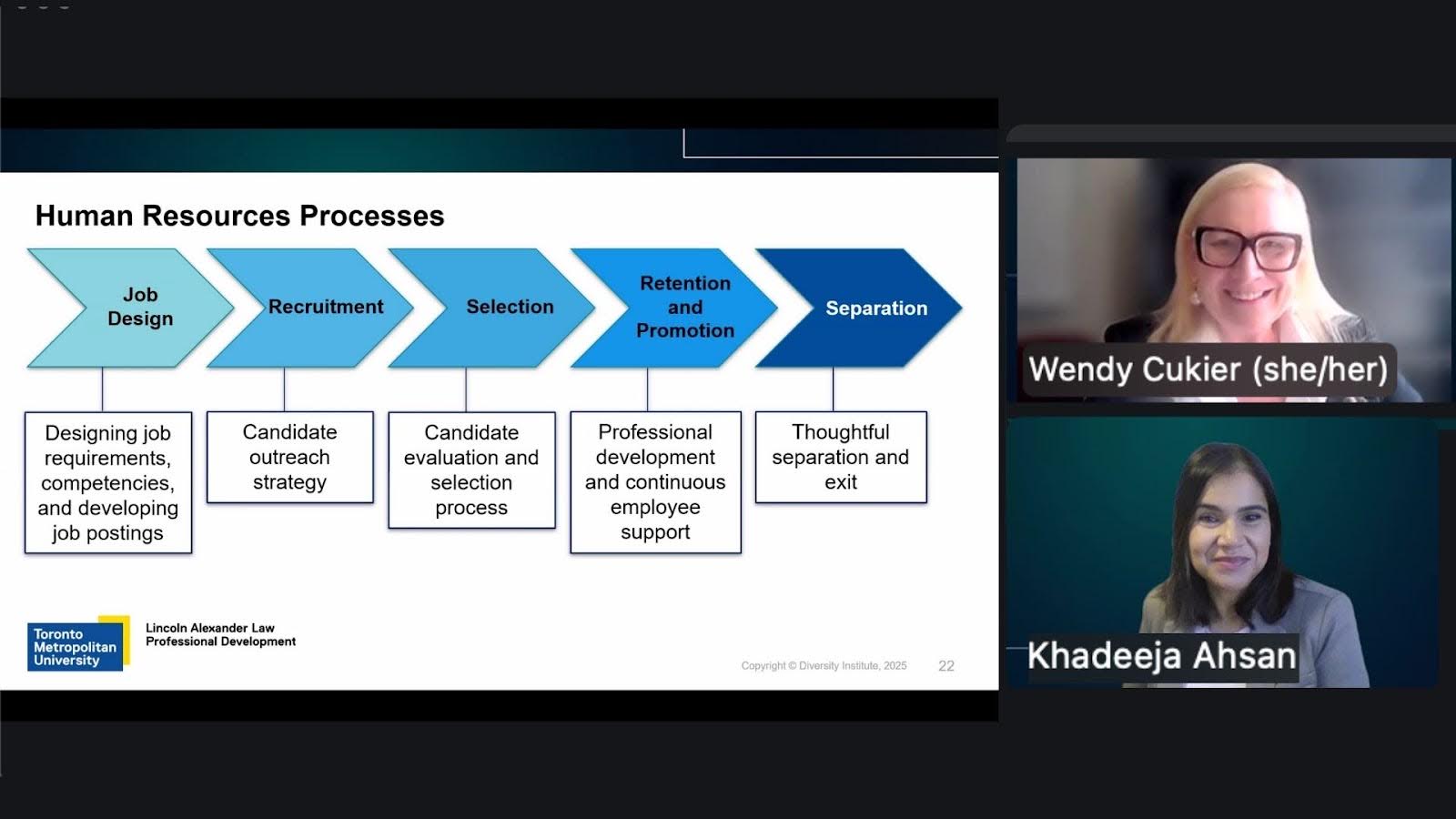
At the Legal, HR & Governance Essentials for Non-profits program, Wendy Cukier, Founder and Academic Director of the Diversity Institute, and Khadeeja Ahsan, Manager of Global Business Ethics and Compliance Investigator at Apotex Inc., presented on designing, implementing and disseminating effective human resources (HR) policies for non-profits.
The two-day program, Legal, HR & Governance Essentials for Non-profits, was designed to equip organizations with the practical tools they need to create inclusive workplaces and craft policies that align with their mission. Wendy Cukier, Founder and Academic Director of the Diversity Institute, joined Khadeeja Ahsan, Manager of Global Business Ethics and Compliance Investigator at Apotex Inc., in a workshop focused on inclusive Human Resources practices.
The Diversity Institute (DI) focuses on exploring ways in which equity, diversity, inclusion and accessibility (EDI) support organizational goals across sectors. Canada is changing, Cukier said, whether in the for profit, non-profit or government sectors, access to talent, understanding of markets and driving innovation remain important priorities. And while some of the rhetoric from the US spills over our borders, Canadian organizations ignore EDIA at their peril. Canada’s constitution, charter of rights and freedoms, legislative frameworks and judicial decisions make it imperative that organizations understand their obligations. As forthcoming research shows, the majority of Canadians remain in support of EDI initiatives (54%), there is a continued need for the development of inclusive workplaces. Despite the backlash, only 12% of Canadians surveyed say EDI has had a negative impact on their personal opportunities at work, 35% say it had no impact while 47% say it has had a positive impact. In the non-profit sector, support for EDI is the highest, with 69% of people surveyed reporting that EDI is a good thing, followed by 56% in the private sector and 53% in the public sector.
Cukier also drew on recent research based on DIs work with Environics Institute and Future Skills Centre (FSC) using the Survey on Employment and Skills. The Burden of Care: Addressing Challenges in Employment in the Non-profit Sector showed non-profit workers report lower job satisfaction, with 26% unsatisfied compared to 19% in the private sector and 17% in the public sector and less job permanency. Another DI, Environics and FSC report shows that non-profit workers are more likely to report discrimination in the workplace than those in the private sector. Together, these findings highlight the sector’s persistent precarity and the urgent need for stronger HR policies.
Embedding an equity, diversity, inclusion and accessibility lens into HR processes
Cukier emphasized that building inclusive workplaces starts with tone at the top. Leadership is critical, and so is embedding EDIA throughout organizational strategy. “Culture eats strategy,” she said, but it is harder to manage. Organizations need to think about their goals and values, and how they communicate them, as well as how every employee contributes to building an inclusive culture. “Policies are just words on paper if there are not strong and effective processes in place to promote compliance. Culture matters.” It also needs to include a deep focus on all HR processes, including how jobs are designed and how talent is recruited. Recruitment, she noted, should go beyond traditional channels to include partnerships with equity-focused organizations and diverse networks, while ensuring that entry-level pathways such as internships are genuinely accessible. “These practices help open doors,” she stressed, pointing out how they create opportunities for Indigenous Peoples and equity-deserving groups and bring more diverse, qualified talent into the pool of candidates.
Research shows that more diverse workplaces promote innovation (external link) by bringing multiple perspectives and experiences to bear on complex problems. Yet EDIA also needs to be built into promotion and retention. She underscored the importance of diverse hiring committees trained to reduce bias, fair and transparent performance reviews, and career development opportunities strengthened by mentorship and sponsorship. Just as importantly, Cukier said, leaders need to promote inclusive leadership practices and set the tone from the top. She pointed to the Diversity Assessment Tool (DAT) (external link) , created by DI, that helps organizations self-assess across six pillars: leadership and governance, human resources, culture, performance indicators, value chain and community engagement. Following the tool’s assessment, it compares the answers to leading practices and helps develop a customized strategy to improve an organization's EDI strategy. Further improvement is underway with DI currently working with Charity Village and others to customize the DAT for the non-profit sector.
To close, Cukier stressed that designing HR policies through an EDIA lens is not a one-time effort but an ongoing process. By applying EDIA principles at every stage, from design and implementation to evaluation and monitoring, organizations can set meaningful goals, track progress through key performance indicators, and embed accountability into their practices. She added that using inclusive and plain language ensures policies are accessible to all, reinforcing transparency and trust. Taken together, these measures not only attract and retain diverse talent but also strengthen organizational culture and improve the quality of service delivered to clients and communities.