Building Canada's Future: Addressing Workforce Gaps in Infrastructure Through Innovation and Inclusion
The Diversity Institute’s recent report, Infrastructure Trends and Innovations: Implications for Employment and Skills in Canada, highlights the need for innovation and upskilling to modernize the infrastructure sector.
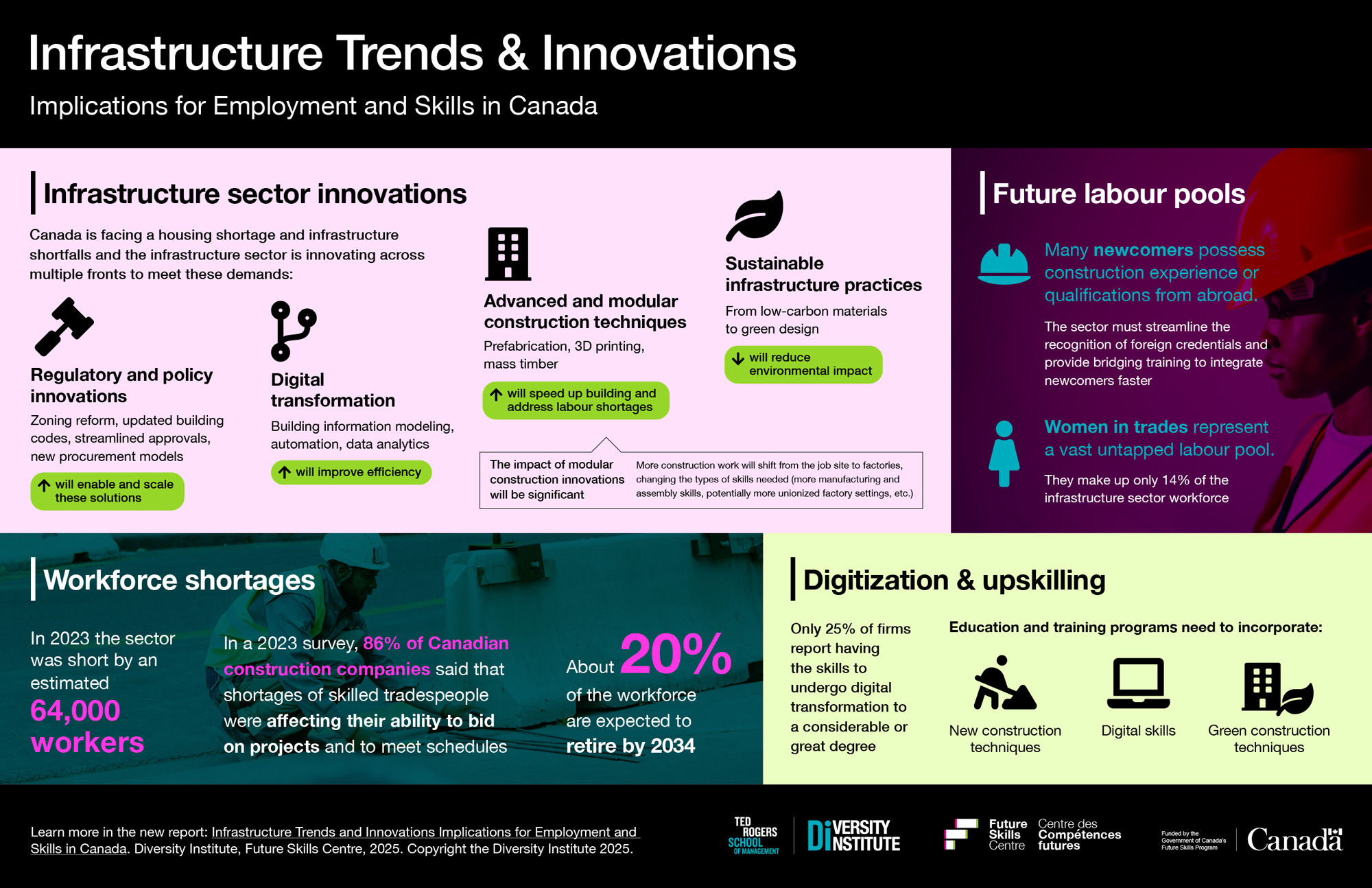
Canada is at a crossroads. With growing infrastructure and housing demands, and an aging population accelerating labour shortages, the country must rethink how it builds. All levels of governments in Canada understand that investment in infrastructure should be a priority. A further commitment of national building projects will require regulatory reform, digital transformation, new modular and construction technologies and climate resilient and energy efficient building. However, the infrastructure sector still faces critical workforce challenges that threaten progress. The Diversity Institute (DI), with its deep expertise at the intersection of workforce development, innovation and inclusion, is uniquely positioned to offer actionable, evidence-based solutions. DI not only analyzes complex workforce and inclusive innovation problems across sectors but it also pilots and evaluates scalable programs to equip diverse talent with the skills needed now and in the future.
Key Findings: What Industry and Government Should Do Now
Canada’s infrastructure sector, which includes the construction of buildings, transportation systems, energy grids, housing and more, is a cornerstone of economic growth, but it is facing a productivity crisis. Labour shortages, skills gaps and a fragmented ecosystem dominated by micro firms are slowing modernization just when innovation is most critical. DI’s report, Infrastructure Trends and Innovations, developed in partnership with the Future Skills Centre (external link) , reveals that a failure to adopt digital tools and address workforce gaps is impeding progress on national goals.
The report found workforce shortages across the sector. In 2023 the industry was short by an estimated 64,000 workers, and looking ahead, about 20% of the workforce is expected to retire by 2034. Furthermore, only 25% of firms report having the skills needed to undergo a digital transformation.
Technologies such as Building Information Modelling (BIM), robotics, modular construction, and green building are already being deployed globally to boost productivity and reduce emissions. Yet in Canada, scaling these innovations is hampered by a lack of coordinated strategy and a workforce that is not ready. The report warns that jobs requiring low to medium levels of education are at high risk of redundancy within the next decade, unless immediate investments in strengthening inclusive workforce development through upskilling, apprenticeships and training programs along with creating immigration pathways for tradespeople.
Driving Canada’s Inclusive Growth Through Innovation
The Diversity Institute leads with impact: its applied research and national partnerships focus on solving real-world problems through scalable, data-driven interventions. As Canada navigates this pivotal moment, DI’s work provides the roadmap to not only close labour gaps, but to build a more innovative, inclusive, and resilient economy.
Read the full reports to discover how innovation and inclusion can shape Canada’s next chapter of growth.