Disaggregated Data Seen as Key to Advancing Equity in Education and Employment
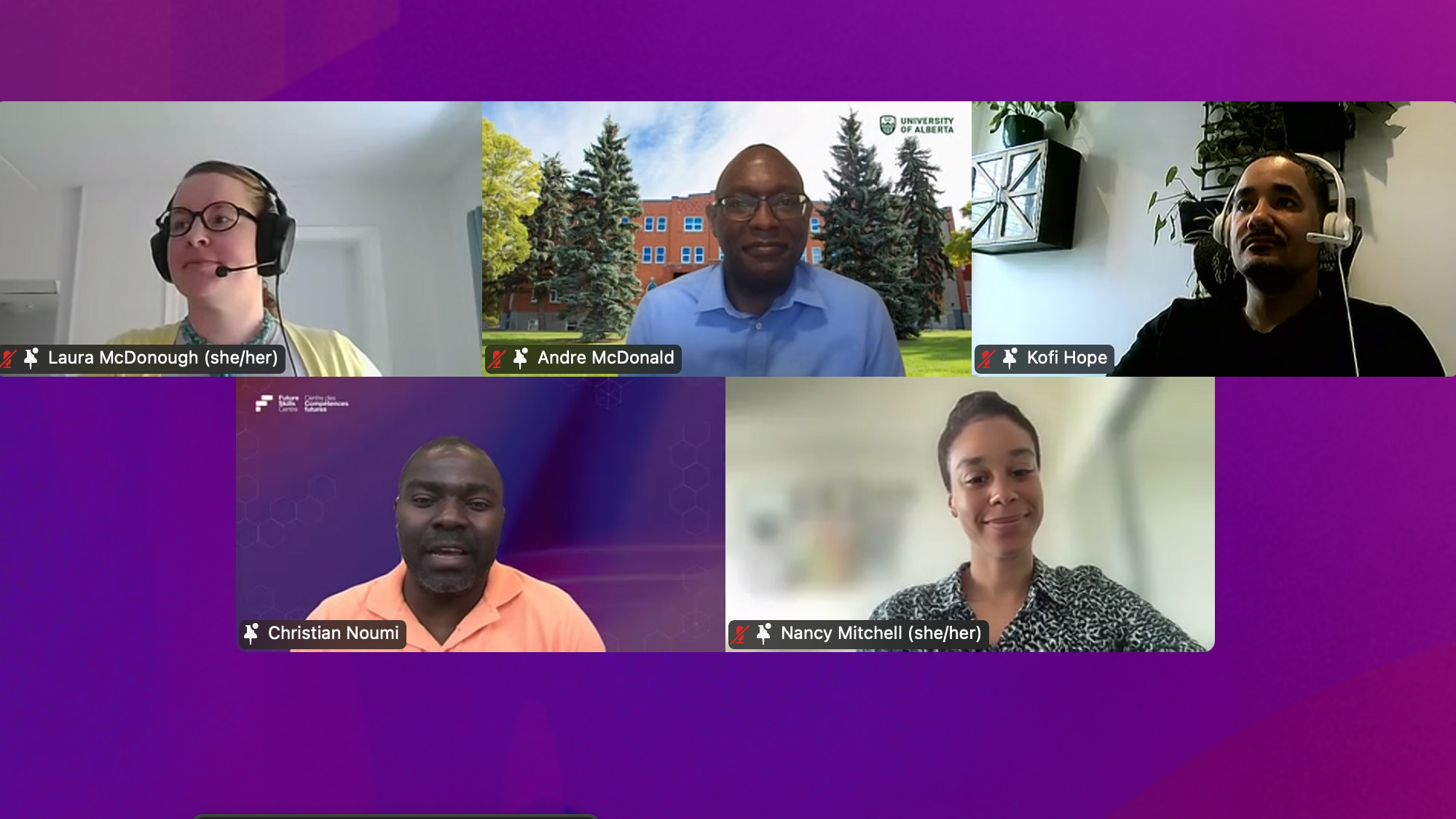
Panellists from the Advancing Inclusion webinar, hosted by the Future Skills Centre and Diversity Institute, shared strategies to address systemic barriers and emphasized the importance of disaggregated data in shaping equitable opportunities for Black youth.
Canada’s Black population has grown rapidly in recent decades, expected to double by 2041. Canada’s growing and increasingly diverse Black population is advancing economically, but there is more to be done. Despite this diversity, the enduring legacy of slavery and persistent anti-Black racism continues to shape Canadian institutions. In response to these systemic challenges, the June 3 webinar “Advancing Inclusion: Working with and Serving Black Communities” convened leaders and experts to explore more equitable approaches to engagement and service.
Hosted by the Future Skills Centre (FSC) in collaboration with the Diversity Institute (DI), the webinar brought together employer organizations, training providers, researchers and policymakers to examine how institutions can respond more effectively to systemic inequities. The event was chaired by Christian Noumi, Research and Evaluation Associate at FSC, who introduced Nancy Mitchell, Director of Research - Special Projects. Mitchell presented key insights from the recent State of Black Entrepreneurship Report (SOBER). The report was motivated by the barriers that Black people face securing employment and leadership and entrepreneurship which stems from education.
Black youth and the education system
Mitchell opened by highlighting both progress and persistent gaps in education for Black Canadians. While 56.3% now hold a post-secondary credential, comparable to the general population, many students still face inequities in the classroom and a curriculum that often omits Black history. Mitchell emphasized the power of representation in education, as well as the importance of inclusive curriculum. “We’ve made some great strides when it comes to education,” she said. “But we can’t forget these two really critical pieces: the curriculum we teach and the importance of educators, mentors and peer learning.”
Mitchell stressed the importance of wraparound supports that help move Black youth from education to employment. Child care, access to technology, mental health support, career counselling, networking and flexible training opportunities were cited as crucial elements for inclusive career pathways. Programs like Study Buddy, a free tutoring initiative, and ADaPT for Black Youth, which offers digital skills and job support, were highlighted as effective models.
In another project led by DI, FSC and the Peel District School Board, a support portal for youth aimed at dismantling systemic barriers for Black and racialized students by offering customized career-planning tools. The platform provided mentorship, digital skills training, and accessible guidance to support underserved students in navigating education and career pathways. In a feedback survey, 80% of users found the career information provided relevant and over 70% of respondents reported that the platform helped them understand career paths.
From education to employment
Mitchell underscored: “We need to ensure that Black youth have the full gamut of opportunities.” Disaggregated data, she added, helps identify where systemic barriers may limit access to a broader range of careers. “It’s only through robust, disaggregated data collection that we actually understand some of these structural barriers,” she said. She highlighted the ongoing DiversityLeads reports, which examine the under-representation of equity-deserving groups in leadership. The 2025 report found that Black people account for 4.2% of the Canadian population, but only represent 3.8% of boards of directors; this figure drops to 2.6% as senior managers across sectors of 10 major Canadian cities. “It’s a whole lifespan,” she said, emphasizing that collecting disaggregated data across the entire education-to-employment pipeline is essential to shaping programming that supports career outcomes and leadership opportunities.
Mitchell highlighted ongoing workplace discrimination, citing a report with the Environics Institute and FSC, which showed that 47% of Black individuals surveyed experienced unfair treatment or bias on the job. “Discrimination still exists in the workplace, and it can be hard to quantify,” she said. “Data helps tell the story—it validates lived experiences and makes them visible to those who might otherwise overlook them.” These range from microaggressions to exclusion from informal networks. The report also found that 38% of Black women and 30% of Black men faced gender-based discrimination compared to just 26% of women and 12% of men among all respondents.
Entrepreneurship as a viable path
Mitchell closed her presentation by spotlighting the need to support Black entrepreneurship, noting that Black business owners are less likely to employ five or more people and often face significant barriers to scaling, particularly in access to financing and networks. She linked these gaps back to youth, emphasizing the importance of early exposure to entrepreneurship as a viable path. Mitchell concluded by saying opportunities for change exist at every level: societal, organizational and individual.
Innovative programming to dismantle systemic barriers
Following Nancy Mitchell’s presentation, the discussion transitioned into a panel moderated by Laura McDonough, Associate Director of Insights and Knowledge Mobilization at FSC. McDonough guided a rich conversation featuring André McDonald of the University of Alberta and Kofi Hope, CEO of Monumental, each offering unique perspectives on advancing inclusion through youth development and workforce innovation.
Together, the panellists reinforced the importance of data, representation and community-driven approaches to dismantling systemic barriers and opening pathways to prosperity. McDonald spoke about the Experiential Learning in Innovation, Technology and Entrepreneurship (ELITE) Program for Black Youth, a STEM-based initiative providing paid work-integrated learning and wraparound supports to Black youth. “We want to take it from the perspective of strength and empowerment,” he said, noting the importance of wellness coaching and early exposure. Hope, drawing on his experience with Future Builds, emphasized the lack of Black representation in real estate development and the need to train young Black leaders to shape housing solutions: “If Black folks and people of colour are not at the table, it’s cutting them off from significant opportunities to build wealth and careers.”