Students get hands-on experience with Google AI tools at case competition
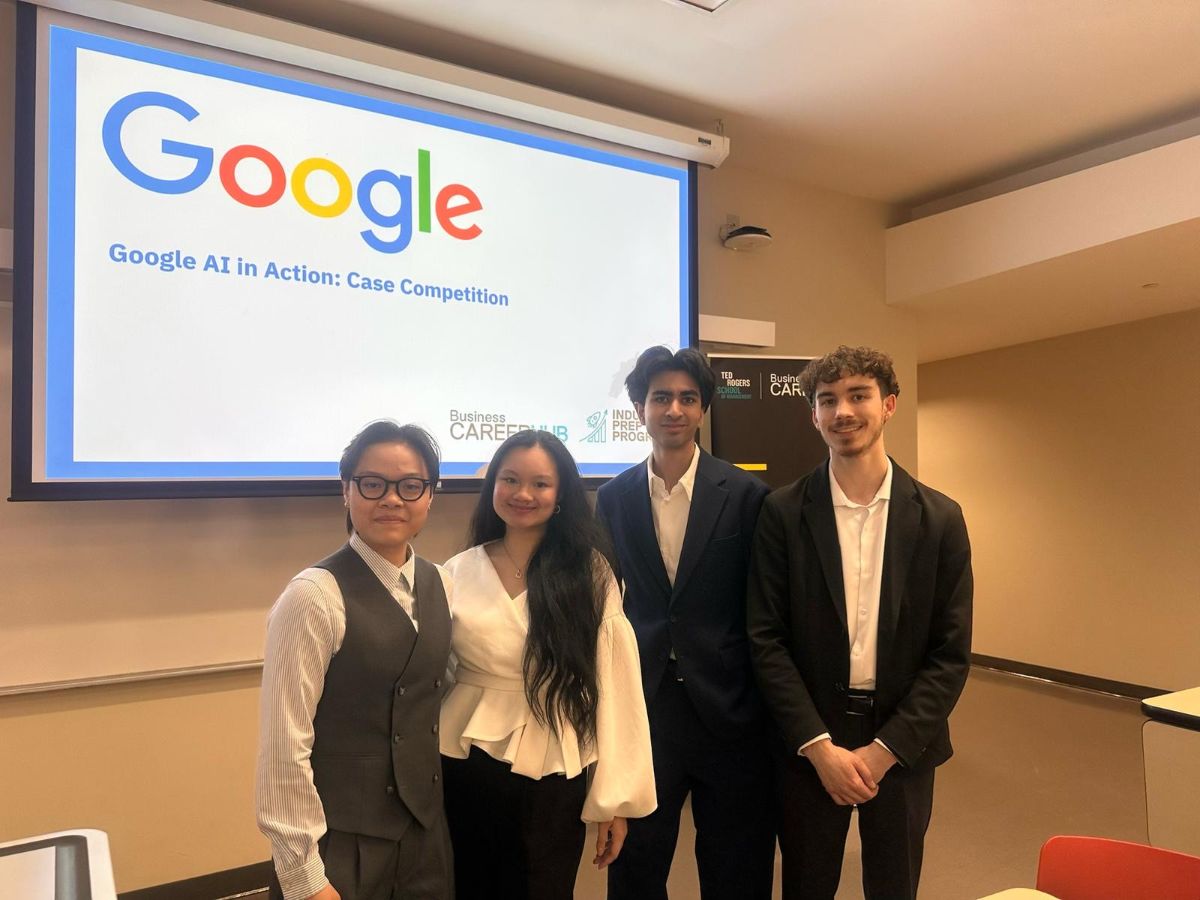
Ted Rogers School of Management students had the opportunity to use Google AI and cloud tools to solve a business challenge and present it to Google professionals thanks to a recent case competition organized by the Business Career Hub (BCH).
The Google AI in Action: Case Competition was part of BCH’s Industry Prep Program, and facilitated by Google employees and alumni. Following an in-person info session with Google professionals in late-February about how Google uses AI tools to solve real marketing and business problems, students were invited to apply to participate in the case competition.
The six successful teams were notified a few days later and sent the official case study to start working on. Teams had the opportunity to get direct feedback and pressure-test their ideas with Google professionals prior to presenting their solution to a panel of judges on the day of the competition, March 9, 2026.
Students were tasked with developing a scalable growth strategy for a B2B solar installation company, with the objective to leverage Google AI and Cloud Ecosystems to automate and optimize their sales pipeline.
The team made up of Milcah Pollentes (5th year, Finance), Krish Asher (2nd year, Business Technology Management), Ethan Dimech (5th year, Global Management Studies) and Alex Nguyen (2nd year, Computer Science, TMU) won the competition by developing an end-to-end growth engine for a B2B solar installer.
The group designed a scalable pipeline using a 100% Google products stack to modernize the company's inbound and outbound processes. Their strategy focused on three key pillars: deploying predictive modeling to identify high-propensity leads, optimizing digital conversion via AI powered web experiences, and implementing automated marketing at scale to deliver personalized messaging. By integrating these AI-driven tools, the students provided a roadmap for building a consistent, high-value customer pipeline through data-centric automation.
We would like to thank the Ted Rogers School alumni involved in helping to make this event happen: Jason Sue (Marketing Management '14), Jason Rodrigues (Finance '17) and Brian Baah (Law and Business '16), led by Carter Grant (Human Resources Management '17).