Slaight New Venture Winner Finds Home at Biomedical Zone
When an innovative product is born, it needs the resources and environment to grow. Artin Biomed, external link (external link) , a startup that has developed and patented material that mimics human bone, has the potential to revolutionize orthopedic technology by eliminating many of the problems of bone graft surgery. Now they’re getting a chance to thrive at Ryerson’s Biomedical Zone, external link (external link) .
“For bone repair, the current products on the market or metallic implants,” explained Samin Eftekhari, CEO of the company and a Ryerson chemical engineering graduate. “For instance, one of the treatments for bone fracture fixations is using metallic screws. They have to be removed from the body after the bone-healing process is completed. But this material is biodegradable and can be absorbed by the body after the bone-healing process has been completed, so it will degrade into the natural substances of the body, like lactic acid.”
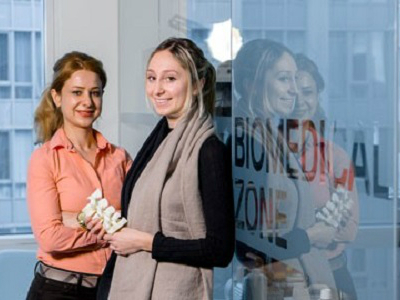
Samin Eftekhari (left) and Madlen Cumandra are developing a new technology that mimics human bone structure. (Photo by Clifton Li)
Since October, Artin Biomed has been based at the Biomedical Zone, a joint venture between Ryerson and St. Michael’s Hospital to foster healthcare ventures. The hub is part of Ryerson’s zone learning model, a network of business and social venture incubators that provide space and resources for student entrepreneurs, with disciplines ranging from fashion and law to design, energy, and social ventures.
“This is a huge idea, and we need to leverage as many connections as possible, especially with large institutions,” said Madlen Cumandra, the company’s chief marketing officer and a Ted Rogers School of Management graduate. “To try to take on something of this size by ourselves would just be too much.”
“It’s a physician-led, hospital-based healthcare incubator, and it’s a unique partnership between the hospital and Ryerson,” said Eftekhari. “We heard that there would be a zone that would be in a hospital, and that it’s the first in North America. We could connect with surgeons and clinicians, and identify the pain points, and have access to St. Michael’s facilities and research.”
Artin Biomed will take years to go through approvals, first for the veterinary market, then for human clinical trials. The $25,000 prize money from the Slaight New Venture competition will help fund them through the difficult early process of launching a business. “We want to get the company legally ready to incorporate, and we also need to fabricate the project with 3D printing, and that’s expensive,” said Cumandra. “We also have to start our animal testing, and that’s going to cost a lot of money down the road. … Winning this competition is going to push us really far because we’re just beginning.”
The annual Slaight New Venture competition, organized by student entrepreneur group Enactus Ryerson, is made possible through the generosity of the Slaight Family Foundation.
This year’s other winner is Kunal Arneja, Entrepreneurship ’15. His company CUCU provides a new avenue of branding and expression through do-it-yourself customization of consumers’ debit and credit cards. Using CUCU’s patented sticker designs, individuals can easily apply any design to their already existing debit and credit cards.
For more information on the Biomedical Zone, go to http://biomedicalzone.ca/ (external link) .
This story originally appeared in Ryerson Today.