Workforce Innovation and Inclusion Project

The Workforce Innovation and Inclusion Project (WIIP) brings together settlement agencies, diverse employers and nonprofits to address the employment needs of newcomers and produce a skilled and resilient Canadian workforce.
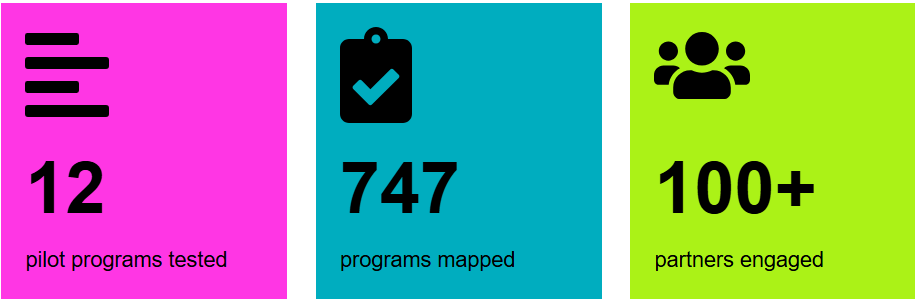
The WIIP contributes research insights to address gaps and needs of the settlement sector as well as results from testing of innovative pilot projects: we’ve tested 12 pilots between 2018-2021.
We’ve built an extensive partner network to collaborate on research and evaluate innovative tools, models and approaches to improve service delivery outcomes.
We’ve also mapped the ecosystem of service delivery in the settlement sector, looking for programming that supports newcomers’ skills for the workplace as well as provides entrepreneurship support.
- Identify proven methods for addressing economic and social challenges for newcomers
- Identify underserved newcomer groups and areas for program improvements
- Broaden the talent pool by scaling effective skills development programs
- Enhance partnerships between employers and the immigrant-serving sector
- Develop new models, partnerships, tools and programs that have high potential impact
- Increase employment and entrepreneurial opportunities for newcomers
We’ve conducted extensive research, engagement activities and solutions testing including:
Evidence review of relevant studies and reports
Interviews & surveys with stakeholders
Ecosystem mapping identifying close to 750 employment and entrepreneurial supports offered by organizations serving newcomers in the five target provinces of the project
Piloting innovative service delivery models, tools and programs
Creating an evaluation guide and a common measurement framework for pilot projects
100+ partners engaged
We’ve built strategic partnerships in British Columbia, Alberta, Saskatchewan, Ontario and Nova Scotia to engage partners in the settlement sector and across multiple industries, representing the needs of both employers and newcomers.
Our efforts created tools, insights and new connections to support best practices for sharing, evaluating, replicating and scaling innovative employment and entrepreneurship programming and innovations.
Research
Talent shortages have become a major challenge for Canadian businesses with organizations stressing the need for innovative strategies to address growing skills gaps. Despite the availability of programs that support the economic integration of newcomers, immigrant employment outcomes are still far below that of their Canadian-born counterparts.
We conducted research and analysis to drive innovation and understand user experience, focusing on research activities and service delivery improvements that support employment outcomes and the entrepreneurial spirit of newcomers.
Our team reviewed innovation in the settlement sector, spoke with diverse stakeholders to understand gaps, barriers and needs, mapped the landscape in our target regions and tested innovative solutions.
Highlights from our findings are below.
Collaborating with our partners Toronto Region Immigrant Employment Council (TRIEC) (external link) , Future Skills Centre (external link) and Association for Canadian Studies, we conducted an ecosystem mapping to identify close to 750 programs providing newcomers with skills development and work-related training, including entrepreneurship supports.
We’ve mapped programs across the WIIP target regions — British Columbia, Alberta, Saskatchewan, Ontario and Nova Scotia — and with the help of TRIEC, we were able to add a mapping of Manitoba’s service delivery ecosystem in the area of skills development and work-related training.
We spoke to stakeholders in the sector — employers, service providers, public servants — to understand the gaps in knowledge, barriers facing newcomers, strategies for improved cross-sector collaboration and potential areas for innovation.
We conducted a review of more than 600 reports, articles, studies, conference proceedings and grey literature, which has given us valuable insights about the current state of service delivery improvements.
Highlights from our review include:
- A need to clearly define “innovation” in the context of service delivery improvement
- Value in streamlining the user journey through settlement supports and services
- New challenges and unexpected benefits in service delivery brought by the COVID-19 pandemic
- Trends in innovative programing, tools and approaches show flexible supports like toolkits are a responsive approach to user needs
- Siloing and fragmentation continue in the sector but new strategies are minimizing duplication of services
- Addressing users excluded by the definitions of “newcomer” is a barrier from access to services for many newcomers
We created a WIIP Evaluation Guide, based on service delivery improvement priorities identified by the IRCC, and insights from project research and activities in British Columbia, Alberta, Saskatchewan, Ontario and Nova Scotia.
Our guide provides a common outcome measurement to enable us to compare and analyze the WIIP pilot projects.
Our guide is a pilot tool being tested with project stakeholders to address the need for cross-jurisdiction and consistent evaluation of programming, tools and services.
Pilot programs
Thirteen pilot projects were tested through The WIIP, including iterations like the PowerHack (external link) , which was piloted with five cohorts between 2019-2021 by our partner Immigrant Employment Council of BC.
The TMU Diversity Institute’s Advanced Digital and Professional Training (ADaPT) program facilitated a no-cost four week intensive certification on the Pegasystems software, to allow internationally trained workers to become Pega Certified Systems Architects. Those who passed the certification exam were connected directly to potential hiring partners. Additional workshops on professional skills such as Business Writing and Presentation Skills were also delivered to the participants.
Entrepreneur Exchange is a workshop series for newcomer entrepreneurs with the objective of promoting economic opportunities for business creation and sustainable jobs. Through online classroom sessions and presentations, newcomers gain valuable skills in ideation, research, team building, business and financial planning, fundraising, marketing, networking, and presenting business ideas among other topics.
Startup Challenge Halifax offers immigrant women entrepreneurs an opportunity to present their business ideas to business leaders and win $5000 in support of their business idea development. Newcomer women participate in a free training program and receive expert coaching and mentoring from successful businesswomen and entrepreneurs. The program includes three half-day workshops to help participants develop their business ideas and practice for the competition. These workshops offer business-building skills including: value proposition, pitching, marketing, branding and financial planning.
PowerHack offers an innovative way for employers to build their talent pipeline by connecting with internationally trained tech professionals. PowerHack is intended to address the pervasive immigrant employment barriers of no ‘Canadian experience’ and undervaluing of international training and experience by shifting the focus from credentials to competencies. Newcomers demonstrate their competencies – skills, knowledge and experience – by developing solutions to real-world problems identified by participating employers.
The pilot has been tested several times in British Columbia: between 2019-2020 four team-based, in-person PowerHacks were held; in 2021, one virtual PowerHack was held.
iiNTEGRATE NEXT tests, evaluates and prepares newcomers in Canada for workforce and entrepreneurial opportunities of the future. The program entails a comprehensive assessment of knowledge, skills and a measurement of participants’ skills, with a lens on Canadian entrepreneurship standards. The six-week, 12-class online, intensive integration program is designed for newcomer participants, with the opportunity for a post-event, personalized feedback and presentation sessions.
Taking place in February 2020, this event was modelled after the PowerHack BC events and scaled to include Halifax, utilizing a team-based in-person approach. Newcomers demonstrated their competencies – skills, knowledge and experience – by developing solutions to real-world problems identified by participating employers.
The KEYS Pilot consists of a training program that provides sector-specific professional training (i.e. WHMIS, cleaning workplace essentials, etc.) and sector-specific language training for Stage 1 learners (i.e. CLB 1-4). This initiative seeks to connect to existing cleaning businesses to improve employment opportunities for vulnerable newcomers in this sector and to establish a service provider and employer collaboration.
The Newcomer ToolKit is a training program that builds skills for entrepreneurship and employment and supports the economic integration of newcomers by addressing targeted challenges in the settlement services sector. The program combines four interactive workshops, access to one-on-one coaching and provides participants with a three-month membership to Impact Hub Ottawa as well as access to it’s Virtual Support Showcase, connecting participants to service providers in Eastern Ontario.
The Alberta Inclusive Innovation Initiative (AI³) supports current and aspiring entrepreneurs from diverse populations who are under-served by the existing entrepreneurship and innovation ecosystem in southern Alberta. In partnership with Mount Royal University, and supported by HSBC Bank of Canada, AI3 delivers entrepreneurship training, resources, and financial and digital literacy skill-building education to newcomer entrepreneurs.
Lead and Learn consists of three programs: the Pursue Coding Boot Camp, Awakened Learning, and Empowered to Lead with A Flourish Mindset. The three-part program is designed to support students: enhance their academic enrichment and academic resilience, practice and expand leadership skills, deepen their career interest through STEM-related activities, and improve their “learning to learn” strategies so that they become successful learners.
NS Startup Challenge NS builds and further tests the Startup Challenge Halifax pilot by expanding the pilot to include women throughout the province of Nova Scotia.
Startup Challenge Halifax offers immigrant women entrepreneurs an opportunity to present their business ideas to business leaders and win $5000 in support of their business idea development. Newcomer women participate in a free training program and receive expert coaching and mentoring from successful businesswomen and entrepreneurs. The program includes three half-day workshops to help participants develop their business ideas and practice for the competition. These workshops offer business-building skills including: value proposition, pitching, marketing, branding and financial planning.
The Dream to Reality event is a series of workshops that aims to help newcomer women build confidence in their business ideas and businesses. Designed around a pitch competition, the program helps newcomer women build networks with other women entrepreneurs, build brand awareness and become a part of the entrepreneurial business ecosystem in Saskatchewan and Canada. The competition brings together immigrant entrepreneurs, seed-stage companies as well as investors and business organizations from across Saskatchewan.
The Sew TO Collective is an aspiring social enterprise created and run by a group of newcomer women entrepreneurs who have been sewing masks throughout the COVID-19 pandemic. Since 2020, the women have sewn thousands of masks, using donated and recycled fabrics, for use by various communities across Toronto. The success of the initiative prompted women from the group to start an employment social enterprise named Sew TO Women’s Collective. The group aims to create stable, fairly-paid and home-based work for the women of Thorncliffe and Flemingdon Park.
TNO seeks to determine ways to formalize the collective as a social enterprise that will continue to support local women facing barriers to employment who can work from home and earn money. TNO is piloting an evaluation of the Sew TO Collective for the purposes of strategic decision-making, learning and improvement.
Our Funders and Pilot Partners
This project is funded by the Government of Canada’s Immigration, Refugees, Citizenship Canada (IRCC), and focused on five provinces: British Columbia, Alberta, Saskatchewan, Ontario, and Nova Scotia.
With strategic partnerships in British Columbia, Alberta, Saskatchewan, Ontario and Nova Scotia, we created national dialogue around innovation to increase capacity building in the settlement sector and beyond.
We engaged over 100 partners in our work — service provider agencies, not-for-profit organizations, employers, and industry associations — to develop solutions that address newcomers’ skills and employment needs as well as employer needs.
Our partners acted as project hubs, helped us test innovative pilots, participated in research activities, cross-sector collaboration and knowledge dissemination, and provided input on how to measure success in service delivery.
As Steering Committee members, judges, panelists and volunteers on pilot projects as well as interviewees in our research, our partners provided critical feedback and support to gauge the gaps and barriers in the sector.