AI Adoption: A Series of Events
Canada leads in the development of AI technologies but lags in adoption. There is a focus on developing AI tools and infrastructure without addressing the processes of linking AI to organizational goals and objectives, of addressing real concerns about risks and responsible use and providing practical support for implementation is limiting our ability to harness the power of AI for good. With more than twenty five years of experience focusing on digital skills, inclusive innovation and technological transformation, the Diversity Institute (DI), in partnership with the Future Skills Centre (external link) (FSC), is continuing to lead practical research on programs to inform evidence-based strategies for responsible AI adoption. A sectoral approach is critical to understand the use cases for AI in business. DI is leading a number of research initiatives to understand the forces that drive and constrain AI adoption across sectors, with a particular focus on small-and-medium sized enterprises (SMEs) Medium Enterprises which dominate the Canadian economy.
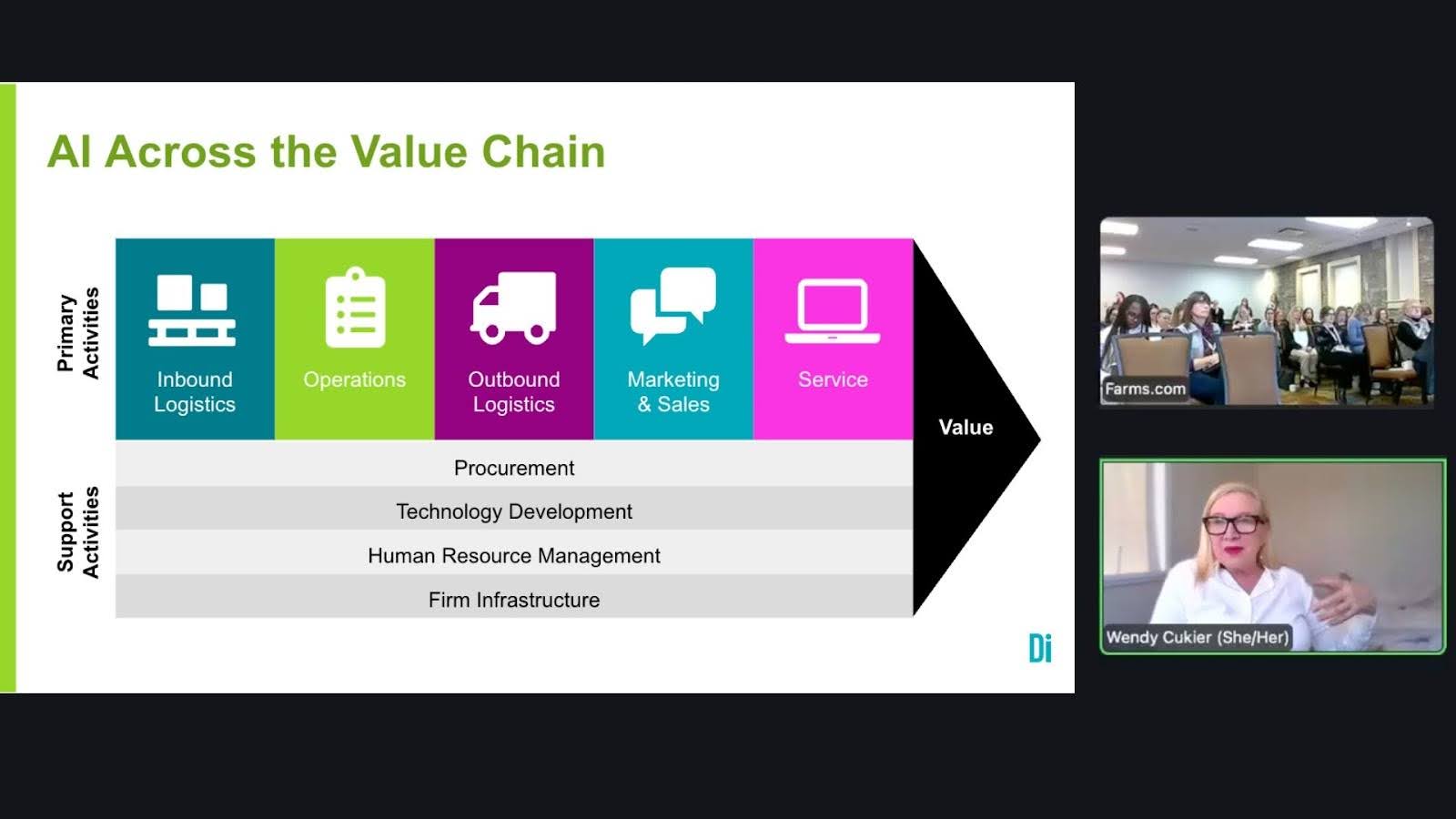
At the Advancing Women in Agriculture Conference WEST in Calgary, Wendy Cukier, Founder and Academic Director of the Diversity Institute and Professor of Entrepreneurship and Strategy, shared DI research on the potential of AI.
AI in agriculture
At the Advancing Women in Agriculture Conference WEST in Calgary, (external link) Wendy Cukier, Professor of Entrepreneurship and Strategy, shared DI research on the potential of AI. The technological transformation of agriculture is often under the radar although it arguably has led for decades in the adoption of internet of things (IOT) and data driven solutions. AI adoption across the agricultural value chain is growing, it remains uneven: 81% of large operations use digital tools compared to just 36% of smaller farms, reflecting broader gaps affecting SMEs and rural organizations. Bryant Serre, Senior Research Associate at DI, also joined a panel on how AI is transforming agricultural business strategy.
These disparities are unfolding alongside significant workforce pressures. Canada’s farming population is changing; the average farmer is now 56, and faces a succession planning crisis with up to 142,000 job vacancies by 2030. AI can help reduce administrative burdens and improve efficiency, but adoption is most effective when training is practical and job-specific. As the sector becomes more diverse, including more women leading farm operations, ensuring inclusive access to tools and training will be critical.
AI in healthcare
Drawing on decades of experience researching technology in healthcare, Cukier shared her perspective on the opportunities AI presents to address the crisis in care. At an event hosted by Beamdata AI (external link) , a company that specializes in supporting organizations with tailored AI solutions, and OBIO (external link) , a not-for-profit that supports early-stage and venture-backed companies across therapeutics, medtech, diagnostics, digital health and consumer health sectors, Cukier delivered a presentation. The event brought together leaders from across the sector, including doctors, researchers and health care workers. Cukier described ways in which AI is being used responsibly around the world to transform clinical practices, patient support, as well as research and education. “And we cannot get rid of fax machines, even at the lowest levels of service, booking patient appointments or patient record management, many Canadian institutions have not entered the 21st century” she noted.
Cukier highlighted the importance of anticipating the risks associated with AI, while reaping the rewards, particularly given its potential to reinforce existing biases and create new vulnerabilities around privacy and security. She stressed that responsible AI in healthcare requires keeping humans in the loop and emphasized that progress will depend on moving beyond siloed tools toward integrated, system-wide approaches, alongside modernizing outdated administrative infrastructure. At the same time, she underscored the need for decisive action, warning that “we have to figure out how to move quickly, because right now, the uncertainty is creating a certain measure of paralysis.” Central to this path forward, she emphasized the need for coherent regulation. “Canadian health tech companies tell me over and over again how much easier it is to operate internationally. Having worked with health care organizations large and small it's clear we need the kinds of system changes that we have seen in the past,” she said, adding that long term care may offer some immediate wins given the desperate needs and lower institutional barriers.
AI in higher education
A former Vice President of Research and Innovation, Cukier highlighted that one of the sectors most in need of transformation is higher education at a recent presentation at the AI in Higher Ed Professional Development Group (external link) , an AI-focused professional development group representing almost 200 institutes of higher education. “Canadian post secondary institutions like to talk about innovation but often do not want to change” she noted. “While we have a certain level of regulatory protection, we are also seeing big shifts in how students and families view our relevance” citing a research survey with the Environics Institute (external link) which indicated that people are more likely to recommend entering trades than pursuing a general university education.
“In my view it is tragic as education is foundational to Canada’s development and global leadership. We are also seeing an assault on arts and social sciences education at exactly the time they are needed most,” she said, referencing the recent comments by Anthropic cofounder, Jack Clark who emphasized the importance of liberal arts majors (external link) as valuable skills in the future of AI. Cukier shared research showing examples of leading applications of AI in postsecondary education in terms of curriculum, teaching and learning, research, student services and administration. In the U.S. and Canada, student use is already widespread, and institutional adoption is accelerating (external link) , 91% of administrators report some AI use, 66% say their institution is actively using it, and 88% expect growth over the next two years.
Researchers are increasingly using AI (external link) to discover and synthesize literature, draft grant proposals, analyze data and generate early versions of academic papers. At the same time, cutting-edge applications are transforming teaching and student experience: medical schools are deploying AI-simulated patients (external link) , with institutions like Okayama University reporting measurable improvements in student performance, while others such as Coventry University are developing responsive virtual patients (external link) that allow students to practice clinical interactions in low-risk, scalable environments. Beyond the classroom, AI is also driving institutional outcomes, universities like the University of West Florida have leveraged AI-powered engagement platforms to significantly boost enrollment, retention and graduation rates (external link) without expanding staff capacity.
Building AI skills for the future
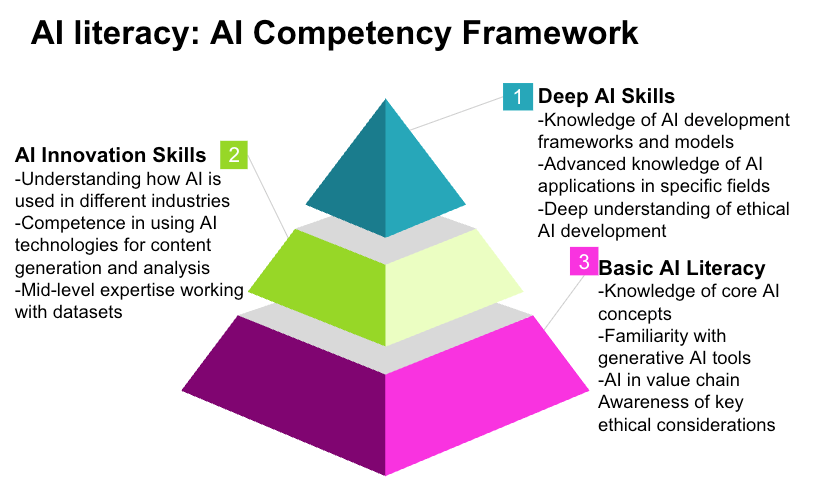
The Diversity Institute has developed an AI Competency Framework, supported by the Future Skills Centre (FSC), which highlights the need for different levels of AI capability across organizations; from advanced technical skills for building machine learning models, to applied skills for using tools like ChatGPT and Microsoft Copilot, to foundational literacy that includes understanding AI systems and their ethical implications, such as bias and privacy.
At the foundation of advancing responsible AI adoption is ensuring Canadians have the skills needed. While there is considerable attention focused on the importance of deep technology skills, and indeed these have helped Canada punch above its weight globally in AI development and helped Geoffrey Hinton win the Nobel prize, they are necessary but insufficient. All Canadians need AI literacy skills, regardless of their roles, to ensure they are not only using them appropriately but protected from AI enabled harms. But the skills most in demand, according to AI research, are AI Innovation Skills, the skills needed to match solutions to organizational needs. This has long been a barrier to digital adoption, technology specialists often embrace the capability of technology without attention to the ways in which it can support organizational goals and objectives. This has long fueled the productivity paradox, some investments produce significant results and others are a waste of money. Failing to identify through the goals of the implementation, the organizational and human factors, the potential risks and the skills needed for responsible use often lead to spectacular failures, or worse, doing nothing.
Across sectors, the message is consistent: AI adoption is accelerating, but systems, skills and governance are struggling to keep up. Canada has a window of opportunity to lead in responsible and inclusive AI, but doing so will require faster action, stronger coordination and sustained investment in people, infrastructure and policy.