Promoting Security through Economic Prosperity
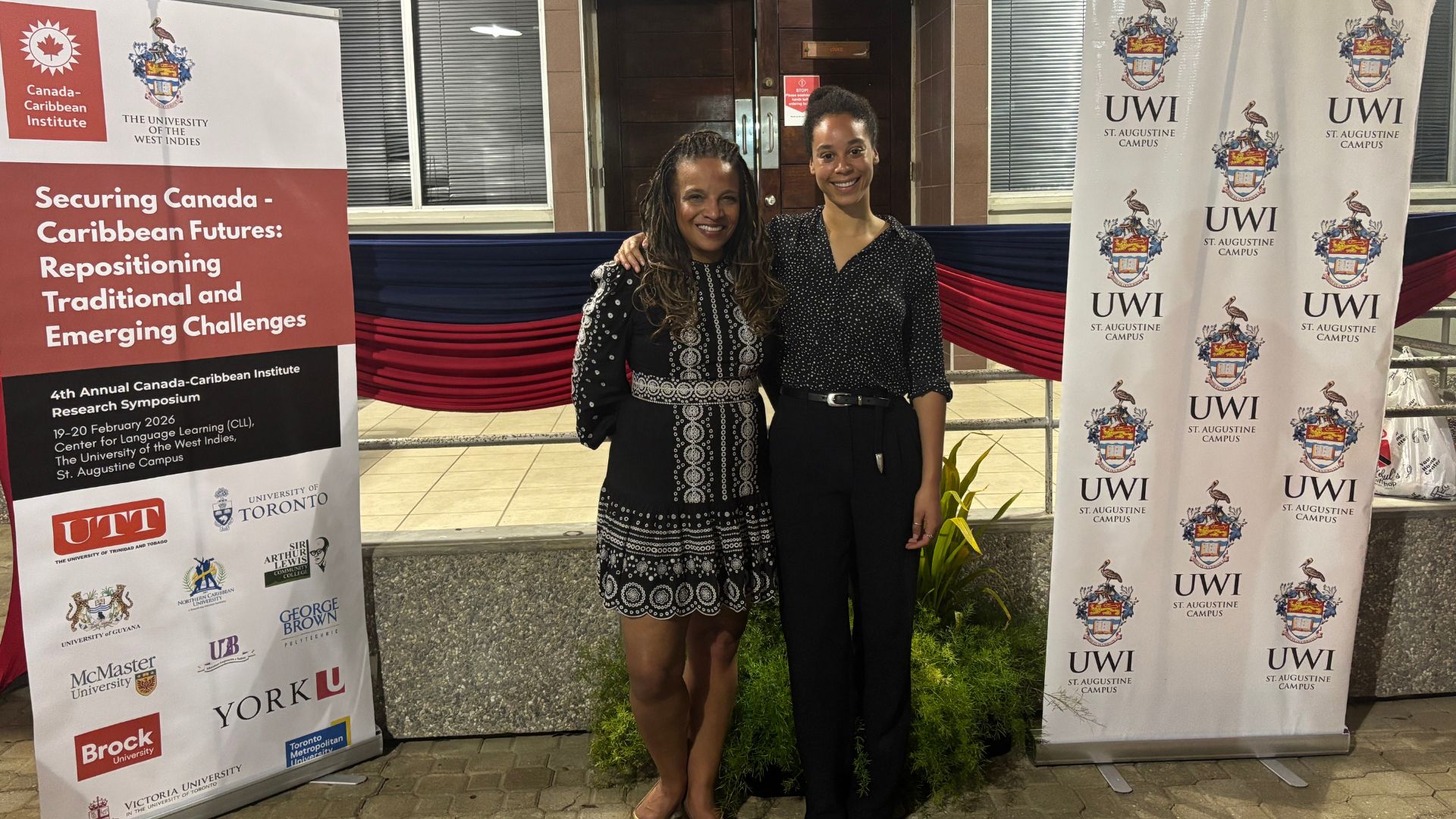
At the 4th Annual Canada-Caribbean Institute Research Symposium, hosted at the University of the West Indies in Trinidad, Nancy Mitchell, Director of Research - Special Projects at the Diversity Institute, and Tamara Thermitus, Senior Boulton Fellow McGill Law Faculty (2023-2025) and Special Advisor to the Diversity Institute, presented, “Promoting Security through Economic Prosperity: Shared Learnings and Futures between Canada and the Caribbean”.
This month, leaders from the Diversity Institute (DI) joined leaders, scholars and policymakers at the 4th Annual Canada-Caribbean Institute Research Symposium. Hosted at the University of the West Indies in Trinidad, the 2026 symposium explored collaboration between Canada and the Caribbean to address evolving security issues and build more sustainable, inclusive futures.
The opening ceremony featured remarks from Dr. Talia Esnard, The UWI, St. Augustine and Chair of the CCI Research and Scholarship Committee and Professor Rose-Marie Belle Antoine, Pro-Vice-Chancellor and Campus Principal, The UWI, St. Augustine.
Speakers included Canada-Caribbean Institute leadership: Professor Sir Hilary Beckles, Vice-Chancellor, The UWI; Dr. Rhonda McEwen, President and Vice-Chancellor, Victoria University U of T; Professor Erica Sturridge for Professor Lincoln Edwards, President Northern Caribbean University; and Dr. Gervan Fearon, President, George Brown Polytechnic. This was coupled with remarks from the Honourable Senator Dr. Natialie Chaitan-Maharaj, Government of Trinidad and Tobago; and Mr. Michael Callan, High Commissioner of Canada to Trinidad and Tobago, along with a keynote from the Honourable Bob Rae, Canada’s former Ambassador to the United Nations.
Nancy Mitchell, Director of Research - Special Projects at DI, and Tamara Thermitus, Senior Boulton Fellow McGill Law Faculty (2023-2025) and Special Advisor to DI presented, “Promoting Security through Economic Prosperity: Shared Learnings and Futures between Canada and the Caribbean”. During their session, Mitchell and Thermitus emphasized that economic prosperity rests on a solid foundation of education as well as the development of employer-driven skills, a sustained commitment to removing barriers to employment, and intentional support for entrepreneurs whose ventures drive job creation and growth. As noted by Mitchell: “A strong economic foundation is the foundation of a safe, secure, thriving, and healthy population"
Persistent racism remains a barrier to full participation
DI research shows that education and skills training are critical enablers of economic inclusion, supporting pathways to both employment and entrepreneurship.Yet Black communities in both Canada and across Caribbean nations continue to face barriers in access and outcomes. Reports including DI's State of Black Economics Reports (SOBER) 2025 and 2026, supported by Future Skills Centre, reveal persistent gaps in employment, income, leadership representation, and entrepreneurship, even alongside evidence of resilience and innovation.
“Economic inclusion is a one of the United Nations Sustainable Development Goals," said Thermitus, a legal scholar who led the development of Canada’s Residential Schools settlement agreement as well as the Truth and Reconciliation Commission which highlighted commitments on education, employment and business for Indigenous Peoples. These principles apply to other populations as well, noting "economic empowerment helps address the legacies of colonialism and ensure meaningful participation in the economy."
While contexts differ between Canada and the Caribbean, there are shared legacies in the history of colonialism, slavery and anti-Black racism. In Canada, more than half the Black community (50.9%) are also immigrants, including 21% who are Caribbean-born (2021). Black talent is playing a growing role in Canada’s labour market (4.3% of population, projected 3M+ by 2041, 41.9% under 25). Yet while the Black community in Canada now has comparable levels of post secondary education, their employment outcomes are very different. According to 2025 data, while Black Canadians demonstrate high labour force participation (74.3% compared to 62% for white Canadians), unemployment remains significantly higher (11.9% versus 5.8%), with youth aged 15 to 24 facing particularly stark disparities (22.2% versus 12%). Black university graduates are far more likely to be employed in jobs requiring only high school education when compared to other racialized groups and the average of the Canadian-educated population. Findings from the Survey on Employment and Skills from the Diversity Institute and the Environics Institute shows that nearly half (47.3%) of Black individuals report experiencing workplace discrimination, which is more than double the rate in the overall population (18.5%), with important intersections between gender, 2SLGBTQ+, immigrant identity, and disability. Those experiences begin early: a review of the 10 largest school boards in Ontario found lower graduation rates, and disproportionate academic streaming and disciplinary actions affecting Black students and persistent under-representation of Black teachers and administrators, despite evidence of progress.
Education is the foundation of social mobility and economic inclusion
Addressing these inequities starts in the classroom. Post secondary education is still a strong predictor of social mobility, employment and income. In addition, more work is needed to ensure graduates are employment ready. Innovative practices including work integrated learning, microcredential and non credit skills bootcamps and workshops can help create pathways to employment. And despite the stigma, skilled trades are an important, in demand, well paid career option.
"While the contexts between Canada and countries across the Caribbean differ, what is apparent is the need to bridge the gap between education and employment; essentially, between what's taught and what the labour market actually needs," said Mitchell. This alignment is increasingly urgent as artificial intelligence reshapes the nature of work, requiring new competencies even in non-technical roles.
Wraparound supports are also vital to overcoming employment barriers
Barriers to and within employment persist despite high rates of post-secondary completion. Understanding barriers and compounding experiences of racism and sexism, among others, is key.
"Unlocking both educational and employment opportunity requires intentional action across societal, organizational, and individual levels," said Mitchell. "A particular emphasis on dual-focused programs—those that train job seekers while also building capacity in employers—will help drive impact in both Canada and across Caribbean communities."
Reimagining entrepreneurship to fuel growth
Small and medium-sized enterprises and entrepreneurs are the backbone of both the Canadian and Caribbean economies, contributing to the GDP, job opportunities and workforce development. Yet Black entrepreneurs in both regions face persistent barriers tied to gender in accessing financing, networks, and markets.
"Unlocking a vibrant and diverse entrepreneurial community means we collectively need to re-conceptualize entrepreneurship," said Mitchell. "That means making intentional efforts to fund the ventures of Black communities which may be outside of traditional notions of what, and who, an entrepreneur is."
Supporting this shift requires embedding entrepreneurial training and opportunities across programs, as well as supporting digital and financial literacy, intentional procurement practices, and stronger international trade connections. Mentorship and representation also foster participation across education, employment and entrepreneurship.
"It remains critical for Black communities and youth seeing themselves reflected in leadership and across sectors," adds Thermitus. The DI has collaborated with many community organizations to provide career counselling and awareness upstream, and spotlighted Black excellence and success through awards programs and social media campaigns to highlight role models and leaders.
Advancing EDI among employers to foster participation
Equity, diversity and inclusion are not simply moral imperatives, Mitchell emphasized; they are essential for innovation, productivity, and competitiveness. Even accounting for differences in how EDI is understood in different communities, “what’s clear is that supporting Black employees and specifically Black women across levels is key for economic prosperity and public security,” she said.
“It’s not only about cultivating future employees; it’s also about ensuring that workplace environments are inclusive - so it’s both sides of the coin.”
Mitchell also cited the role that external tools and resources can play in fostering EDI. For example, DI’s Diversity Assessment Toolkit (DAT) (external link) helps organizations identify gaps and set priorities across leadership, governance, human resources, culture, providing a practical pathway for employers committed to building more inclusive workplaces.
Throughout the rest of the symposium Mitchell and Thermitus engaged in lively discussions with participants, showcasing DI’s evidence-based research and programs that advance inclusion in education, employment, leadership, and entrepreneurship.