From Innovation to Adoption: Preparing Canada’s Workforce for What Comes Next
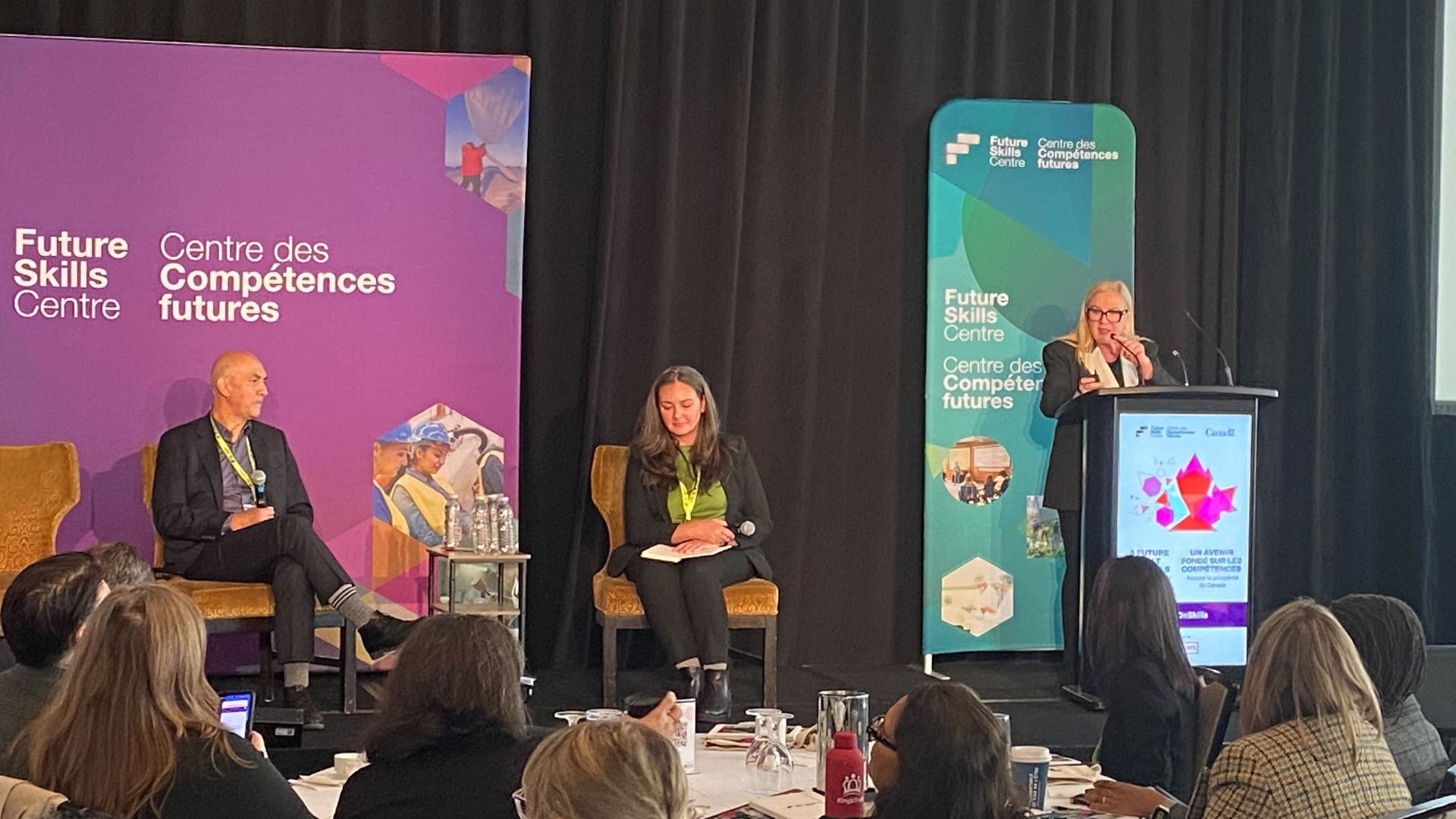
On October 15, 2025, at the A Future Built on Skills event hosted by the Future Skills Centre, Wendy Cukier, Founder and Academic Director of the Diversity Institute, discusses AI adoption and the evolution of Canada’s workforce.
Canada’s labour market is in the midst of rapid change and uncertainty. Entire industries are being turned upside down by trade wars but the ripple effects will be seen across sectors. The race for responsible AI development and adoption coupled with real concerns about risks and the need for sovereignty as well as access to global players create challenges to moving quickly and smartly. The aging population, cuts to immigration and new commitments to building infrastructure are also creating labour and skills shortages in many regions, particularly in the skilled trades. At the same time as there is vocal backlash against equity, diversity and inclusion. As these forces converge, research with the Diversity Institute (DI), Environics Institute and Future Skills Centre (FSC) reveals that 83% of workers are worried about the effect of U.S. tariffs on the economy and 47% are worried about the effect of tariffs on their job.
The Diversity Institute is working with government policymakers, industry partners, community organizations, labour unions and post secondary institutions across the country to address these concerns and develop evidence-based solutions to strengthen the skills and employment ecosystem. As part of the consortium that created the FSC, DI participated in the Future Built on Skills Summit, held in Toronto on October 15, 2025, which brought together more than 200 experts and leaders to share insights and chart the way forward.
Among them was Minister of Jobs and Families, the Honourable Patty Hajdu, who framed the current moment as one of both challenge and opportunity. “There is opportunity in making sure that Canada can diversify who we trade with and can actually grow the kinds of infrastructure that's going to help us trade with each other… and make sure that Canadians have not only the skills to be able to seize that work, but the spirit of adaptation that's going to allow them to continually evolve.” She also highlighted the impact of FSC’s work, alongside their partners like DI, noting that since its launch, the centre has partnered with more than 1,000 employers and 2,000 organizations across 20 sectors, leading over 400 innovation projects and helping more than 100,000 Canadians access skills training and jobs.
Understanding the shifting landscape of work
As part of the opening panel, Wendy Cukier, Founder and Academic Director of DI, emphasized that the context of Canada’s workforce is rapidly changing. Technological disruption, the trade wars, political uncertainty and demographic shifts have created massive uncertainty. While some sectors face greater risk from automation and trade disruption, she noted that “all Canadians are worried about their jobs, and that's partly because of the multiplier effects of job loss in certain sectors, which will eventually ripple through the whole economy.” She pointed to Canada’s economic structure as a key factor in productivity challenges: more than 90% of private-sector employment is in small and medium-sized enterprises (SMEs), compared with about 50% in the United States. Larger corporations can invest heavily in technology and training, she said, while smaller firms often lack the same resources to adapt to changes while keeping pace with innovation.
Racialized people are more than a quarter of the population overall. In Toronto, more than (PDF file) half the population (external link) identifies as racialized and across Canada 27% identify as persons with disabilities (external link) . More than half of university graduates are women and they make the majority of purchasing decisions. Indigenous youth are the fastest growing segment of the population and increasing proportions of young people identify as 2SLGTBQ+. “In this context, equity, diversity and inclusion is not about political correctness or wokeness, it's marketing 101,” Cukier said. As Canada changes so do the talent pools and customer profiles and preferences. The evidence is clear that diversity drives innovation and that our immigrant diaspora is a global competitive advantage, as entrepreneurs creating jobs but also with deep knowledge of the new markets we need to enter. And more importantly, DI research with the Environics Institute and FSC shows despite the hateful rhetoric and backlash, Canadians who support EDI outnumber those who oppose it 3 to 1. Cukier also doubled down on the need for evidence-based competency frameworks, cautioning that often we make assumptions about who is needed to do the job based on historic practice rather than skills.
Cukier said Canada’s Skills for Success provides a solid foundation: adaptability, collaboration, communication (including social and emotional intelligence), creativity and innovation, numeracy, problem solving, reading, writing and digital skills. But she highlighted the importance of the entrepreneurial mindset such as critical thinking, creativity and adaptability as keys to weathering the current storm. Increasingly bridging technical skills with an understanding of organizations, human behaviour as well as ethics is key. She noted that despite the preoccupation with coding and Science Technology Engineering and Math (STEM) disciplines, the rise of generative AI, often referred to as “the English major’s revenge” has shifted the focus. Cukier argued that we need AI literacy for all, adding “It doesn’t matter what job you’re in, because you’re going to be targeted by deepfakes and cybersecurity threats.” While deep technology skills are also needed, so are AI adoption skills, such as the skills to apply technology effectively and ethically. “We have spent too much time, in my view, focusing on developing technologies, whether it's green tech, AI tech, you name it, and not enough attention on how to use those technologies to achieve benefits for all Canadians.”
Magnet (external link) , also a critical part of the FSC Consortium, hosted a round table in Edmonton on October 23, 2025, which was attended by 100 senior leaders. At the event called, Magnet Network Live (external link) , which explored workforce transformation, Cukier discussed the potential of AI to drive productivity improvements as well as the threats it poses. She highlighted the urgent need for a coordinated effort to advance responsible AI adoption and to upskill and reskill Canadians in the face of certain disruption. She shared some of the insights from recent research including Bridging the AI Gap in SMEs in Canada which highlights the AI paradox: Canada leads in the development of AI technologies but lags in adoption. Surveys show wide variations in adoption rates, from 12% in Statistics Canada data to over 70% in private-sector studies. Part of this is a result of lack of focus on the application of the technology to achieve organizational goals. The Diversity Institute’s recent Artificial Intelligence in Action for Small and Medium-Sized Enterprises provides insights into real-world success stories across the value chain, highlighting how SMEs are using AI to improve productivity
To move forward we have to recognize that our existing systems and approaches will not get us where we need to go. Post-secondary institutions have to learn not just to talk about innovation but to actually practice it, training organizations need to focus on employment outcomes and working together to reduce fragmentation. Employer needs should be central but employers also have to challenge bias and barriers embedded in their hiring practices. And the urgency for action cannot be ignored given the pace of change.
Closing the gap between invention and innovation

On October 22, 2025, The Canadian Internet Society hosted an event titled AI Infrastructure & Governance Policy in Canada. A panel discussion on legal and governance foundations for sovereign AI, included Ulrike Bahr-Gedalia, Emily Laidlaw, Wendy Cukier and Elnaz Kanani K (left to right).
In a related discussion, Wendy Cukier, joined The Canadian Internet Society’s event in Ottawa on October 22, 2025. The event, AI Infrastructure & Governance Policy in Canada, brought together senior voices from government, industry and academia to examine the policy, legal and operational dimensions shaping Canada’s rapidly evolving artificial intelligence ecosystem.
Insights from the timely conversation helped to inform a submission to the Government of Canada’s open consultation on the Canadian Sovereign AI Compute Strategy. The first panel addressed the legal and governance foundations for sovereign and trusted AI, examining jurisdictional challenges, privacy, the CLOUDAct, standards and public trust. It included Cukier alongside, Prof. Emily Laidlaw, Canada Research Chair in Cybersecurity Law at the University of Calgary; Elnaz Kanani Kuchesfehani, Partner at Deloitte Data Science & AI and Adjunct Professor, Telfer School of Management (uOttawa); and was moderated by Ulrike Bahr-Gedalia from the Canadian Internet Society.
Cukier said that understanding legal considerations helps to develop enforceable regulations, while providing clear guidelines for mitigating AI-related risks and uncertainties. But, it is difficult to balance innovation and regulation. And AI adoption must be inclusive, aligning innovation with equity. She also noted that Canada faces a critical moment for AI sovereignty, underscoring the need to strengthen supercomputing infrastructure, support Canadian researchers, organizations and of course SMEs, while also ensuring control over national data and reducing reliance on foreign companies.
Our message across all these conversations remains consistent: to build an inclusive and resilient economy, Canada must combine innovation with equity, ensuring that workers and businesses of every size and background have the tools, confidence and support to thrive in an AI-driven future.