New Guide Offers Equity-Centred Infrastructure Solutions For Infrastructure Planning

On May 28, 2025, the Diversity Institute hosted a launch webinar for the Guide on embedding inclusion, diversity, equity and accessibility within climate-resilient infrastructure with the collaborators on the project.
As Canada commits to investments towards national infrastructure projects, the Diversity Institute (DI) at Toronto Metropolitan University, in partnership with the Digital Governance Council (external link) (DGC), with support from the Standards Council of Canada (external link) (SCC), has introduced a groundbreaking (PDF file) guide. The new guide embeds Inclusion, Diversity, Equity and Accessibility (IDEA) into the planning, development and retrofitting of climate-resilient infrastructure, ensuring that future investments benefit communities equitably. This first-of-its-kind guide will help the end-users of the infrastructure (asset owners including private sector organizations and government, specifically municipalities) with decision-making and risk management; Including guidance on how to prioritize construction, operation and retrofit in the context of climate change adaptation, based on the services the infrastructure offers, the users and their needs, who would be most affected by climate impacts and hazards, and how to address needs through portfolio management and project design.
At the webinar focused on the Guide on Applying Inclusion, Diversity, Equity and Accessibility Within Climate-Resilient Infrastructure, Nancy Mitchell, Director of Research - Special Projects at DI, opened the event by highlighting the benefits of using the guide. She offered actionable strategies for asset owners and municipalities to embed IDEA within climate-resilient infrastructure. Mitchell emphasized its scope, providing foundational steps to robust actions that are truly relevant. She said, "[It’s for] no matter where you are on your journey." Mitchell also stressed the pivotal role of community input: "Community engagement really informs all aspects of designing, retrofitting, climate-resilient infrastructure."
Benefits include increased return on investment, inclusive community engagement and innovation
Mitchell underscored the significant advantages of applying an IDEA lens. For governments and asset owners, it can help mitigate legal risks, build trust, and drive innovation and increase returns on investment. For communities, especially those most vulnerable, it can enhance social justice and lessen the financial burdens of climate events.
The guide was developed over a year through extensive research, expertise from the steering group, and public consultation. The document reached consensus after a public review, which drew over 4,000 views. The result is a framework that not only addresses how climate impacts different communities but also outlines benefits, barriers, and strategies for project design, community engagement, and accountability.
Stephanie Poirier, Senior Policy Analyst at the SCC, explained that the guide was developed to fill a critical gap in infrastructure planning: the absence of clear standards for integrating equity-focused tools like Gender-Based Analysis Plus (GBA+). While many organizations are encouraged to consider GBA+ in their work, there has been no concrete framework for applying it specifically within the context of infrastructure resilience. “Climate resilience is ultimately about people,” Poirier emphasized, underscoring the guide’s practical purpose as a foundational resource for any organization seeking to incorporate Inclusion, Diversity, Equity and Accessibility (IDEA) principles into climate adaptation strategies.
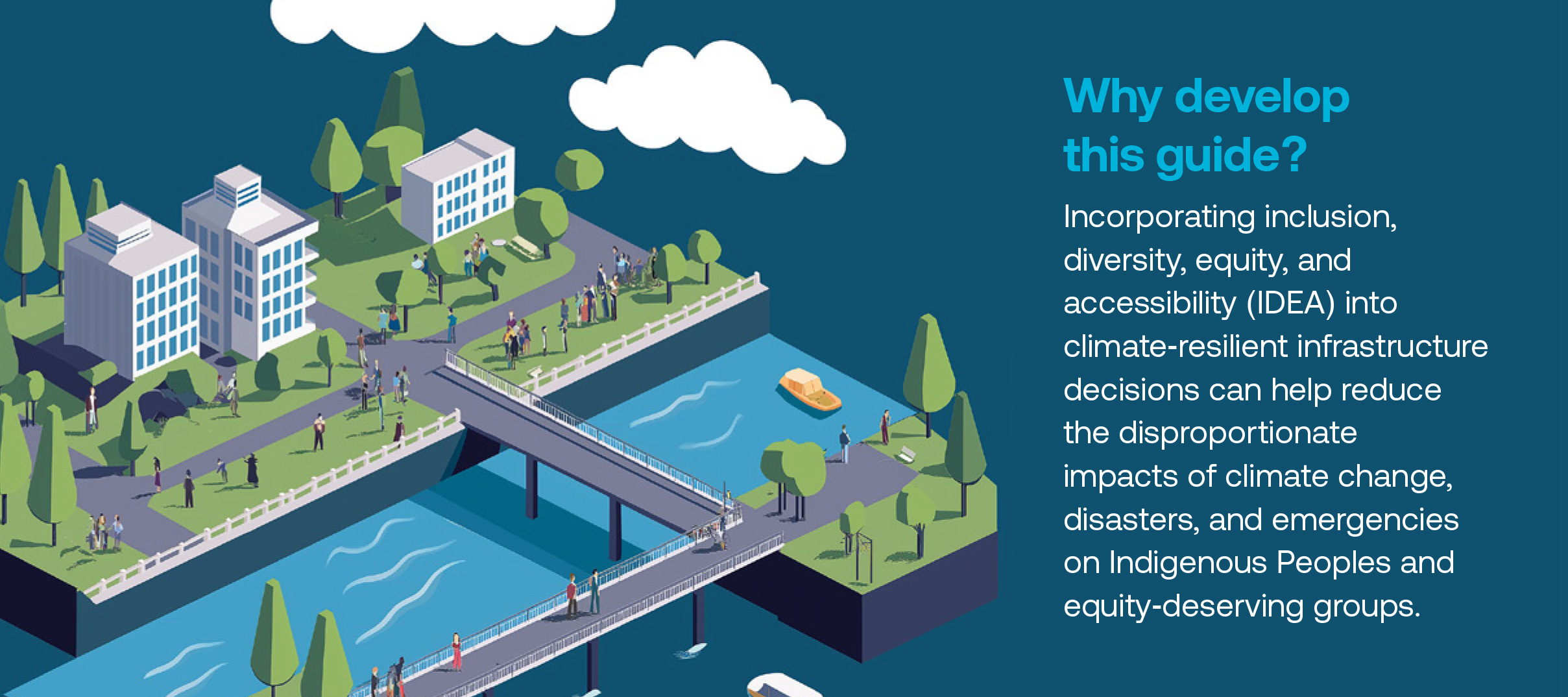
How equity is connected to infrastructure
Ericha Moores, Senior Policy Analyst at Housing, Infrastructure and Communities Canada, addressed the connection between climate, infrastructure and equity. She highlighted the growing severity and frequency of climate impacts across Canada, noting $25 billion in losses last year from floods, fires and hail. Beyond monetary costs, she said, the health and social impacts of displacement, evacuations and service loss, can be more challenging to quantify yet are equally as important, stressing that resilient infrastructure is vital for safety and economic stability.
Moores stated that building long-term climate resilience for infrastructure requires addressing those disproportionately affected. She added, "Climate change is a threat multiplier," that exacerbates existing social issues. Moores pointed to the 2021 British Columbia heat dome, where there were over 600 deaths, primarily among the elderly and socially isolated, and 98% occurred indoors, demonstrating the interaction of climate, social inequity and infrastructure.
During the question and answer portion of the event, Zakiah Kassam, President of AirVironment Canada, was asked about the timeliness of the guide. She highlighted increasing evidence of climate change's disproportionate impact on equity-deserving groups, citing the B.C. coroner's report and increased gender-based violence during Alberta floods. She said, "This is the perfect time for us to be having these discussions in a really structured way."
Moving beyond traditional town halls
Arshad Akhtar, Lead for Asset Management at the Federation of Canadian Municipalities, highlighted key challenges for municipalities in embedding IDEA into infrastructure, including limited resources, capacity and understanding of how to apply these principles. The new guide offers a vital solution, he said, "It gives you a simple, easy-to-follow framework that's going to align with your infrastructure processes," helping municipalities navigate these complexities and make ethically, legally and socially informed decisions.
Echoing Mitchell’s point on community engagement, he said organizations must move beyond traditional town halls to reach diverse populations effectively. "You have to be creative. You’ve got to go to where they are and be approachable," Akhtar said. This involves accessible engagement methods such as attending community events and fostering informal conversations, ensuring that outreach genuinely reflects the needs and realities of all residents.
To close the event, Mitchell asked the panellists where users should start their journey in using this guide for building climate-resilient infrastructure. Akhtar urged them to consider the intended beneficiaries of infrastructure, identify who might be excluded or face barriers, and assess which community members would be most impacted by a major climate event. He then advised, "Use this guide to help you dig deeper."