Why SMEs Hold the Key to Canada’s Low-Carbon Future
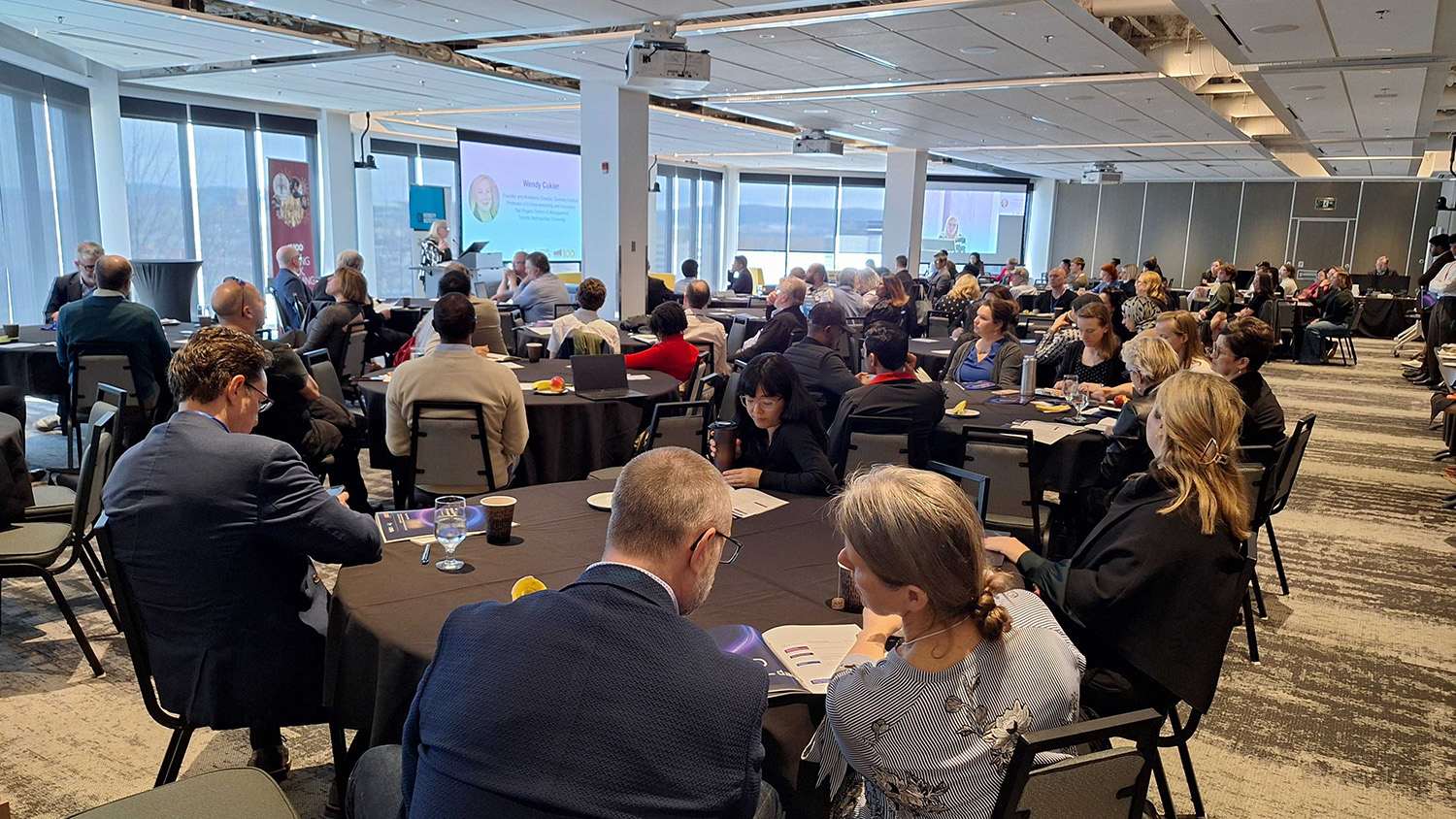
Attendees gather in St. John’s for AI, Remote Work & Productivity: An International Conference, co-hosted by the Diversity Institute and the Memorial University of Newfoundland to explore how emerging technologies are shaping the future of work, sustainability, and innovation.
This May, the Diversity Institute and the Memorial University of Newfoundland co-hosted Artificial Intelligence (AI), Remote Work & Productivity: An International Conference in St. John’s. Supported by the SSHRC Connection Grant, Bridging Divides Research Program and the Future Skills Centre (external link) (FSC), the event brought together more than 150 experts in-person and more online, to explore the intersection of AI, innovation and economic transformation. One session, titled, Technology Trends in GreenTech and Sustainability, chaired by Dr. Wendy Cukier, examined how emerging technologies can accelerate climate action and support Canada’s transition to a low-carbon economy.
David Sawyer, Principal Economist at the Canadian Climate Institute, opened the panel by discussing Canada’s emissions. He said that while emissions may appear stagnant, modelling shows policies are having an impact. “Legislative policy, governments’ current policies in the country are driving down emissions in the projection.” AI is accelerating emissions analysis—compressing month-long processes into hours—but Sawyer cautioned against overreliance, describing AI as a powerful but error-prone tool.
Scaling clean technology
Sawyer pointed to oil and gas and large industrial sectors—responsible for nearly half of national emissions—as crucial targets for clean technology. To stay competitive and resilient, he highlighted the need for a national shift toward scaling clean technology, expanding advanced manufacturing and investing in workforce training. He emphasized that these must become core components of Canada’s climate and industrial policy—not afterthoughts, but central to building a future-ready, low-carbon economy.
Jeanette Jackson, CEO of Foresight Cleantech Accelerator Centre, underscored the organization’s role in driving clean tech growth through venture and adoption acceleration programs. She shared new research mapping sectoral strengths across Canadian provinces, highlighting opportunities for collaboration and supply chain integration. Jackson emphasized the power of AI in reducing procurement timelines—from seven months to just seven days—through tools like generative AI. She challenged the notion that government purchasing alone drives growth adding: “Having companies scale at home is definitely what sets you apart when you go out to export markets.”
The role of small and medium-sized enterprises
Sam Hampton, Senior Policy Fellow at the University of Oxford, emphasized that while innovation remains essential, the greater challenge lies in scaling the adoption of existing clean technologies—particularly among small and medium-sized enterprises (SMEs). Despite representing 99% of UK businesses and 60% of private-sector employment, SMEs have been slow to decarbonize and are often overlooked in climate policy. Hampton noted that SMEs contribute roughly half of the industrial and commercial emissions, highlighting a significant but neglected component of national climate targets. While eco-innovation is helping drive economic growth—especially in rural regions—Hampton pointed to research showing that technology alone will not meet net-zero goals. “Technology and innovation is, of course important, but it is insufficient alone,” he said. Broader adoption and diffusion are critical.
The Skills Bridge project
Hampton’s reflections on the UK’s SME landscape echo many of the challenges faced by SMEs in Canada, where SMEs make up 99.7% of employer businesses and employ 7.8 million people. Research from DI’s Skills Bridge project—launched in partnership with Magnet (external link) and the Ontario Chamber of Commerce (external link) —reinforces the urgent need for accessible, scalable training to support innovation and competitiveness. The project, funded by the FSC, piloted a national learning management system tailored to SME needs, with a focus on digital skills, management training, and equity, diversity and inclusion. The platform engaged over 1,500 learners from nearly 900 SMEs, reporting high satisfaction rates and measurable skill gains. Like their UK counterparts, Canadian SMEs often face barriers to recruitment, upskilling and innovation—challenges compounded by limited resources and capacity. Furthermore, DI research has also shown that women entrepreneurs play an important role in the push toward net zero because they are more likely to prioritize sustainability goals, and are leading innovations across sectors and the value chain. The research underscores that while innovation matters, ongoing support for adoption, training and inclusive capacity-building is essential for sustainable growth.
Alison Joutsi, Director of Sustainability Strategy & Transformation at PricewaterhouseCoopers, discussed the growing complexity businesses face in navigating sustainability. Working closely with SMEs, Joutsi emphasized that clients are seeking practical strategies as investor expectations and supply chain standards demand clearer sustainability performance. Joutsi framed sustainability not as a marketing add-on, but as a fundamental business concern tied to risk management and long-term value. She encouraged companies to integrate AI governance into core operations and highlighted a pressing gap in evidence-based tools. “We really do need more research demonstrating and quantifying the business value for organizations when they invest in sustainability, and that includes responsible use of AI,” she urged, calling on academics to help bridge this knowledge gap.
The panel made clear that while innovation is vital, the path to a sustainable future depends on accelerating adoption, supporting SMEs and integrating sustainability into core business strategies. From policy to procurement, data to training, the green transition requires coordinated action across sectors. As climate risks grow and expectations rise, equipping businesses with the tools, research and capacity to lead is essential.