Episode 06: Integrative Week: A Ted Rogers MBA experience
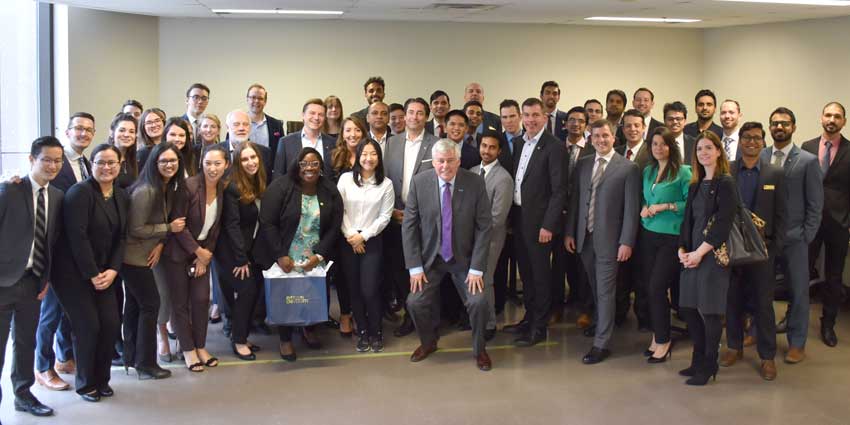
Every year, Ted Rogers MBA students team up with a major Canadian company to help solve some of their toughest problems. Only at TRSM do MBA students get the opportunity to participate in a week-long consulting competition to help impact real change in an organization.
MBA students, Ashwin Sinha and Martha Currie, talk about their experience and give some tips for tackling Integrative Week.
| Integrative Week: A Ted Rogers MBA experience |
|
|---|---|
Nadine Habib: |
From the corner of Bay and Dundas in downtown Toronto, this is Like Nobody's Business, a podcast of thought leadership and business innovation. I'm your host, Nadine Habib. What if while you were a student, you got the opportunity to work with one of the country's major banks, to solve one of their toughest problems? Under the leadership of Professor Dale Karl, Ted Rogers' MBA students got that chance. I attended and witnessed a week-long consulting competition, called Integrative Week. Students had one week to come up with a solution to a challenge facing CIBC. They had to figure out how one of Canada's largest banks could better leverage their digital capabilities to gain market share. On today's episode of Like Nobody's Business, we speak to Ashwin Singha and Martha Curry. They participated in Integrative Week and join us now for a glimpse into their world. Thank you for joining us on the show today. We're really excited. So you are in Integrative Week. Well, it's one of the biggest highlights of the Ryerson MBA program. I'm sure you've heard a lot leading up to the event. So what had you heard before? What were you expecting? Martha, why don't we start with you? |
Martha Curry: |
Sure. Thank you so much for having us. We're excited to talk about this. Leading up to it, we'd heard from Dale kind of the overview, that it was going to be with CIBC. It was going to be a really exciting problem that's facing, not just the CIBC but all banks at this time, and it was going to be a very real-life consulting job, that we'd get the problem. You have to really dive into it within a week. It's a very short timeframe, but you need to get a lot out of it. Most of what we heard leading up to it was very exciting and that it was going to be a really fun week, and we were going to learn a lot and give a lot to the company that we were consulting for at the same time. |
Nadine Habib: |
Mm-hmm (affirmative). Okay. Ashwin, what were you expecting? |
Ashwin Singha: |
Well, I've never worked in Canada before, and working with CIBC on a live Canadian project was truly exciting. I've come from the UK, but I've done work with other banks, but then coming here, understanding a problem from the Canadian perspective, for an international student was really valuable for me, and slipping that in, right into my MBA program, mixing us up with all the students was a lot of fun. |
Nadine Habib: |
And so, let's start with day one. So you get there. The CIBC executives are there. They're briefing you. You get the case question, or the competition question, and then you get your teams. You're assigned your teams, and you go back to your rooms to work. Where do you even start? I mean, what is the strategy behind getting there? I guess Ashwin, want to go? |
Ashwin Singha: |
So since it is our second semester of the MBA, and then we've learned a few things in the previous semester. So first gut feeling is always to fall back on that. Try to structure it. Try to break it up into teams, but then we also try to look at it from a macro perspective. So what we do is, we just list down some of the key points that we've read in the case, or understood from our discussion in the case. Then we try to see, okay, what can be the best way to solve this problem? If we had all the money in the world, we had all the access in the world to all the technology, how would you solve this problem? That was the first thing our team did, and it got you got everyone going, got the creative neurons firing, and that was a lot of fun. Those first two hours were lot of fun, just brainstorming. |
Nadine Habib: |
Mm-hmm (affirmative). Okay. |
Martha Curry: |
Yeah. I mean, I think we had the same kind of experiences, Ashwin, in terms of the technical piece there. I think my first thought was, "Oh my gosh, these are high level people and a really big problem." So it was kind of exciting, but also very much like a reality check. This is something real. This is something big, and we really need to do our best on this and learn as much as we can, but also give them as much as we can. One of the first things that my team actually did, because they were a group of five other people who I'd never worked with before, so it was a really interesting experience in that way. We actually sat down and we kind of talked about where we came from, what skills and experiences we had and where our strengths were and looked at how those would fit into the week coming up, and where people would be able to give the best results. Then we dove into the piece that Ashwin was talking about, in terms of brainstorming, looking at the problem, looking at solutions and getting really excited about such an interesting case. |
Nadine Habib: |
So the question itself was about the digital economy and how CIBC can compete against other financial advisors. So did your team have expertise or experience in that, or do you personally? Or were you guys kind of just doing all the research all at once? |
Martha Curry: |
It was some of both. So I come from an engineering background. So financial services was something that I was not comfortable at all with, besides my own personal banking, before this started. But then I had another member of my team who had actually worked for CIBC in the past and then moved to another bank. So he had experience, which was really beneficial moving forward for us, and kind of even just some of the intricacies of financial services and working in a bank that you don't understand, if you haven't actually been in it, so we found that really beneficial on our team as well. Then we had other people from a whole bunch of different backgrounds, international students, like Ashwin, who were doing their first kind of Canadian experience, with a Canadian company. So all those different backgrounds really helped us with our overall solution. |
Nadine Habib: |
Wow, and so did you find that same thing with your team, in terms of different backgrounds coming together? |
Ashwin Singha: |
Oh yeah, and that really helped in our analysis, actually, was someone who used to develop websites. So he went and he opened all the websites for all the banks and then tried to get the source code and see, analyze how each bank is doing. With that, there was someone else who was heavily into marketing before. So he knew how to market products and give customers value, especially in the digital only channel way. So that really came out when we were doing our research, and it also came out then, in our breadth of ideas and what we were looking at, what experiences we had before, and what our own personal experiences were in banking, because we had some people who were looking at small and medium enterprises. So we had some people on our team who ran their own company before. So they know what it is, what are the paying points and actually working with the bank? How do you do your payroll, or how do you do your taxes? They knew that. So that was really helpful that we could get that real anecdotal feedback from them. |
Nadine Habib: |
Yeah, yeah, that's super beneficial. And I guess, had you experienced anything like this before? I know case competitions are really, a lot of MBA students do those. A Lot of business students do those in general, but had you experienced anything that was like this before? |
Ashwin Singha: |
Never a week long case, especially with a live company. That was really challenging, because we had midweek calls with them. So we had the opportunity to actually work like a real consulting project, where it's iterative consulting. You build your knowledge as the client gives you information, and then when you present to them you get feedback within 10 minutes, because usually after the meeting the feedbacks' in real time. So we could do that, in this case. We got those opportunities, which in some of the other case competitions you don't get live feedback. And also the case competencies are much smaller, in terms of actual length of time to analyze the case. So if we could really focus on our ideas and then work on it. If we had a clarification, get it from the client, and then work on it again. So it was really good fun to be able to integrate the live feedback of the client and our ideas. |
Martha Curry: |
Yeah, I mean I think I echo everything that Ashwin has said. I've done a number of case competitions that have been both with an actual company and some that use the company as a case, but have judges who aren't from the company. But this is kind of its own caliber, in terms of having really senior level executives and a really new, innovative problem. Oftentimes when you do case competitions, there's a couple of kind of clear steps that you take, that you know that they're going to want to see. But this was very open-ended and creative, and you could really come up with whatever kind of solution that you wanted and know that they were going to be interested in. It was going to be accepted, so it was very unique in that way. And again with the kind of week long integration, when you do case competitions, you have your classes. You have your extracurriculars and other things going on. So we were really able to dive into this in a way that you aren't always able to dive into other case competitions when you have other things going on. |
Nadine Habib: |
Yeah. And I just wanted to go back a little bit. So you said that your background is an engineering, right? |
Martha Curry: |
Yeah. |
Nadine Habib: |
And so when you are presented with a problem like this, I mean, do you right away, is it all about research, like your strategy going into trying to understand what the problem is? Is it all trying to find online resources? Or was it a lot of counting on your teammates, who maybe had background information on working at a bank? |
Martha Curry: |
It's interesting, because I've actually found a lot of my engineering experience, in terms of problem solving, is very applicable here in terms of both a business case or an engineering case. What it really comes down to is understanding what your consumers want or what your clients want and not giving them a product, but fulfilling a need. So for CIBC, it was fulfilling the need for their clients with small businesses. So I'm able to kind of some of that engineering framework and look at it from a problem solving perspective. From a research perspective, I would say that it's kind of 50/50. You obviously have to back it up with some concrete numbers and research if it's available. But a lot of it kind of comes from people's experiences. I mean, banking's something that everyone's done, whether it's personal or business. So you can kind of leverage those experiences that people have and talk to people and get that insight as well, because the numbers don't always show what the anecdotes show, and the anecdotes don't always show what the numbers show. So being able to kind of marry them together provides a really complete picture. |
Nadine Habib: |
Okay. I guess, maybe what was the most challenging thing about the week? Because I was there when the week was going on, and I saw some pretty stressful moments. I saw people, they were up all night. It seemed like it was intense. I guess for you, Ashwin, what was the most challenging thing? |
Ashwin Singha: |
For me, I wanted to do like 50,000 things on this. I wanted to make a model. I wanted to do something on Excel. I wanted to do five things on Excel, and then something else on PPD and make it look cool. But you got to pick and choose your battles to fight and see what will deliver not only the most value to CIBC, but also for their own customers. So see which part of the strategy works and what tools can you use to show that, okay, this solution that our team has developed is actually really good. So it's actually figuring out how to manage your time, work with the team and also manage your ideas, because actually targeting and focusing on your ideas is very important, and that's what we learned from this. |
Nadine Habib: |
How about you, Martha? |
Martha Curry: |
Yeah. I think kind of building off of that idea of point, one of the key things that I've taken away, as I've done case competitions, and this one as well, is that going for something solid with a lot of detail, or with a significant amount of detail, is going to be better than kind of giving them the world, but not providing enough detail for what they can actually do with it. So I think that's one of the most kind of stressful, or things that you have to manage during the week, is kind of understanding what you can actually present to them in 30 minutes and have them come away going, "That's a really practical, feasible idea, with an implementation plan that we're actually going to be able to do." Then, like the other things that Ashwin said, in terms of you're working with people that you've never worked before on something that's high pressure because you want to do well, and you have these executives that are coming, and you want to impress them, and you want to do well for the program, and do well for yourself, and really feel proud of what you've done. So being able to kind of manage all those things and work with people successfully is a challenge and really, really worthwhile learning experience through this week. |
Nadine Habib: |
So you're working the entire week, up towards the presentation day. So that was the very end of the week. So I guess take me through, how did you feel about the presentation? What was the feedback like? Were you nervous? |
Martha Curry: |
I mean, I'm always nervous going into a presentation, no matter how many times I've practiced. You get in front of people, and the lights are on you, and you're talking too fast, and nothing's ever as comfortable as doing it in front of your mirror. So, I mean, I think one of the big things, especially for me, is that I worked with everyone the whole week, and we works together, and I really trusted that we were going to pull together and do what we had practiced. I mean, going in, CIBC I think was excited to have our solutions. So we knew going in that this was something they were really open to. They wanted to be there. They wanted to hear what we had to say. So that went a really long way to making us feel comfortable, in terms of being able to give our best presentation. Then another thing, I was just kind of supporting your teammates and making sure that everyone feels ready and supported and has everything that they need from everyone else, in order to feel the most comfortable going into their presentation as well. |
Nadine Habib: |
Right, and so were you guys practicing all night? I mean... |
Martha Curry: |
Yes and no. I mean, we practiced a little later than we had intended to. On Thursday, we're here until about eight 8:00 PM, but we were also one of the first presentations in the morning. |
Nadine Habib: |
Yeah, that's right. Yeah. |
Martha Curry: |
But I'm also a big believer that a solid nights sleep is going to help synthesize it in your brain. So we did go home and get a good sleep before we presented. |
Nadine Habib: |
How about you, Ashwin? |
Ashwin Singha: |
So our team, because we were all just doing this for the entire week, I actually think that anyone in our team could have gone and done the entire presentation themselves. Everyone, they knew the entire concept, the entire analysis and the solution. Everyone is really confident, and trusting each other is a big part of it, and trusting each other and also realizing which parts, say when you are presenting, that if someone misses over something you can come in later on and reiterate a point that someone else missed over. So knowing the gaps and also knowing the fills. So everyone is really attuned to that. In the morning, before the presentations... We were a little later. We were at 10:00 AM, so it wasn't as bad, but before the presentation we did a couple of run-throughs. If it's more of just correcting and making sure our story, we stuck, and we were all singing the same song. |
Nadine Habib: |
You did singing your presentation, Ashwin? |
Ashwin Singha: |
Oh, well. |
Nadine Habib: |
And dancing. |
Ashwin Singha: |
And dancing and singing. |
Nadine Habib: |
It's the whole show. |
Ashwin Singha: |
It was the whole show. It was a lot of fun, and we all knew each other's steps. But yeah, so, but nervous, everyone's always nervous before presentations, I think. But once you get on there, they don't know what you know. So just be confident, and I think everyone was confident, which was amazing to see. |
Nadine Habib: |
Yeah, I feel like they probably sensed that right up. Right when you walk into the room, that confidence. And what was the kind of feedback that you got back? Was it mostly positive? Was there a certain things that you had missed, maybe in your researcher or in the preparing that maybe you feel like, oh, you should have spent more time on that? |
Ashwin Singha: |
Sure, so they loved our research, actually. The feedback we got was constructive, as in that when we were showing them the light at the end of the tunnel, but not through the clear path to get there. So they were able to point out, "Okay, find your implementation, has these competence. These three work. The fourth one is a little where you have too much. Just get it another 10% and finesse it." They liked our research. So that was good. That was good. It also helps validate, okay you've put in an effort. You've gone in a direction, and you've deduced something from the research, and they validated that, which is great to hear from anyone. |
Nadine Habib: |
How about you, Martha? |
Martha Curry: |
Yeah, I mean, the feedback was fantastic, to actually get feedback, because oftentimes in a case competition you kind of leave and you don't know what they liked and what they didn't like. So it was great from that respect to even get it. I mean we got really positive feedback in terms of them liking our recommendation, liking our implementation plan. Again, they provided some valuable constructive feedback, in terms of making sure we filled in some of the holes in the story, like Ashwin was saying, in order to kind of make sure that we touched all of the aspects that they wanted us to touch. Again, it's always hard in 30 minutes to fit the whole idea in there, because you've got so much going on in your head, right? But no, it was good feedback from both constructive and and positive, on what they liked about our recommendation as well. |
Nadine Habib: |
Nice, and so I know that your team, I know there's two rooms and there was a winner of each room, and so your team was one of the winners. What do you feel you guys had done differently that maybe sets you apart? Or what had you guys done that led to the success of being crowned the winner? |
Martha Curry: |
I think, based on the feedback that they gave us, there was a couple of things. One of them was kind of really focusing on the recommendation and where they're at now, and kind of where they need to get to, and what are the pieces that need to fall in place that are going to help differentiate them from their competitors? And I think what really aligned is, it was some of the things that they had been thinking of themselves but hadn't seen it as an integrated package, and we were able to give them an integrated package. The other thing is, we came up with a marketing plan that they really, really liked. It was funny, because it was actually one of those things where we were sitting in a room, and we got really excited about it, and we came up with this idea. We were, "This is amazing. Let's keep going with this," and it ended up panning out for us. So they really liked our marketing plan as well, which is another thing that I think kind of allowed us to be successful in our room. |
Nadine Habib: |
Wow, and so I know that you're going to actually... They afterwards, they wanted you to present to CIBC into, I think their other colleagues, right? So what was that experience like? Did they just come to you afterwards and tell you that, or... ? |
Martha Curry: |
So they actually told us in the feedback, and then we chatted with them afterwards as well. Then I've been on an email chain with them. We're getting set up to chat with their CMO, their Chief Marketing Officer and some other people in the marketing department, to actually show that marketing plan that I just spoke about. |
Nadine Habib: |
That's amazing, yeah. |
Martha Curry: |
Which is pretty exciting for us, for CIBC, all my team members, to kind of keep going with this thing that we were so excited about to begin with. So... |
Nadine Habib: |
So that's nice. It starts like a school project, almost, and then leads somewhere. Yeah. |
Martha Curry: |
Yeah, absolutely, and it would be exciting to see your ideas kind of turn into a real thing as well. It's not just a school consulting project. |
Nadine Habib: |
It's like, be on the subway to your marketing campaign. |
Martha Curry: |
Fingers crossed. |
Nadine Habib: |
I guess, maybe what was your overall feeling towards, or about the experience, about Integrative Week? I mean, would you like to see more of it? How did you feel about it? Maybe, Ashwin, we can start with you. |
Ashwin Singha: |
I loved it. I love the concept. This case could have been a marketing case, finance case, customer acquisition strategy. It could have gone anywhere, and CIBC knew that. That's why I think they loved the breadth of ideas as well. The one week concept works very well. It's a little smaller than one week. It's actually like four and a half days. Four days. |
Nadine Habib: |
Oh, sorry. |
Ashwin Singha: |
You have a submission, and then we present on Friday mornings or Friday, and then you pour [inaudible] after the presentation. But yeah, it's a lot of fun, and if any student gets a chance to do it, they should really do with it. |
Nadine Habib: |
Wow. |
Martha Curry: |
Yeah. I agree. I thought it was a fantastic experience, especially this Integrative Week, working with an actual company on a live case. Sometimes when you're doing cases in school or at a competition... I was just at a competition recently, where the case was from 2012, so it was something that you could actually look up what happened, which doesn't have the same satisfying feeling when you present it as like, you could actually do this. So from that perspective, it's fantastic as well, because we're working on something that's relevant, that's high tech, kind you can see where it's going in the industry. So it was a fantastic experience to be able to do it in kind of a live setting. And I agree, four days is the perfect amount of time. |
Ashwin Singha: |
The perfect amount of time. |
Martha Curry: |
Any longer, and it would be a very long time, a very long time. |
Ashwin Singha: |
When you spend a lot of time with your own team, like you're spending 15 hours a day together, 16 hours a day. So it's, yeah. |
Martha Curry: |
No matter how much you love them. If I had to spend 15 hours a day with Ashwin for many weeks... |
Ashwin Singha: |
Oh yeah, exactly, so... |
Martha Curry: |
It was a fantastic experience. I would highly recommend it to anyone in an MBA program or anything like that. It's a really valuable learning experience, and it's really fun also. |
Nadine Habib: |
Yeah. Do you feel like, after spending 15 hours a day with your team members, do you feel like after that you just have a bond that you just cannot break? |
Ashwin Singha: |
Yes. Yes. Completely. So the weekend, so this is on Friday, the presentation ended, and the weekend, you feel a little like there's like a void.. |
Nadine Habib: |
Did you get a big letdown syndrome? |
Ashwin Singha: |
Yeah, and you come back with Monday, and you enter class, as did everyone, and not your team. Like, "Wow, okay. There's so many more students at school." |
Martha Curry: |
I was sending messages over the weekend to people in my team. "I miss you." |
Nadine Habib: |
I was having withdrawals? |
Ashwin Singha: |
Yeah. |
Martha Curry: |
Yeah. |
Nadine Habib: |
Wow. Well, that's great. Thank you so much for giving us a peep into the integrative world. |
Martha Curry: |
Yeah, thank you for having us. |
Ashwin Singha: |
Yeah. |
Nadine Habib: |
Like Nobody's Business as a presentation of Ryerson Universities, Ted Rogers School of Management. For more information about TRSM, visit ryerson.ca/tedrogersschool. Thank you for listening. |