TMU members come together to display birch bark canoe at Ted Rogers School
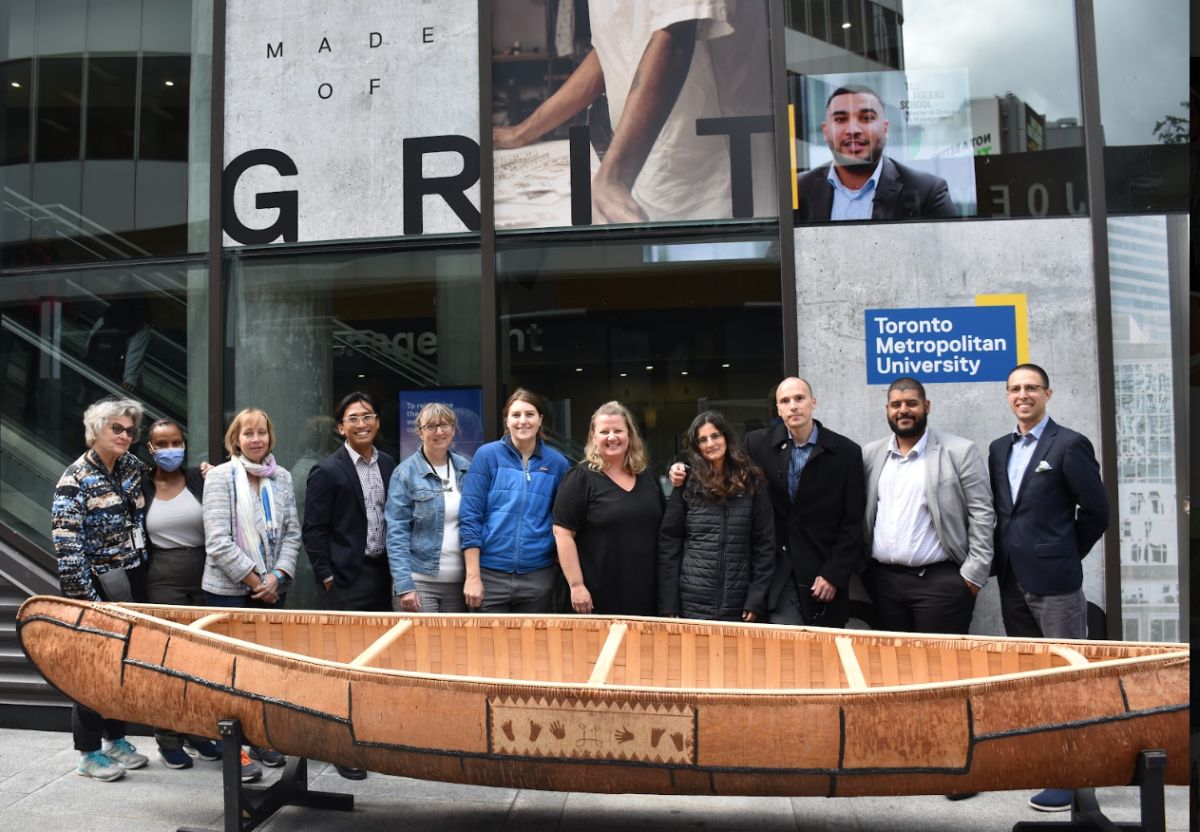
Thanks to a collaboration between many members of the Toronto Metropolitan University community, a birch bark canoe – symbolic of the early development of commerce in Canada – has a new permanent home at the Ted Rogers School of Management.
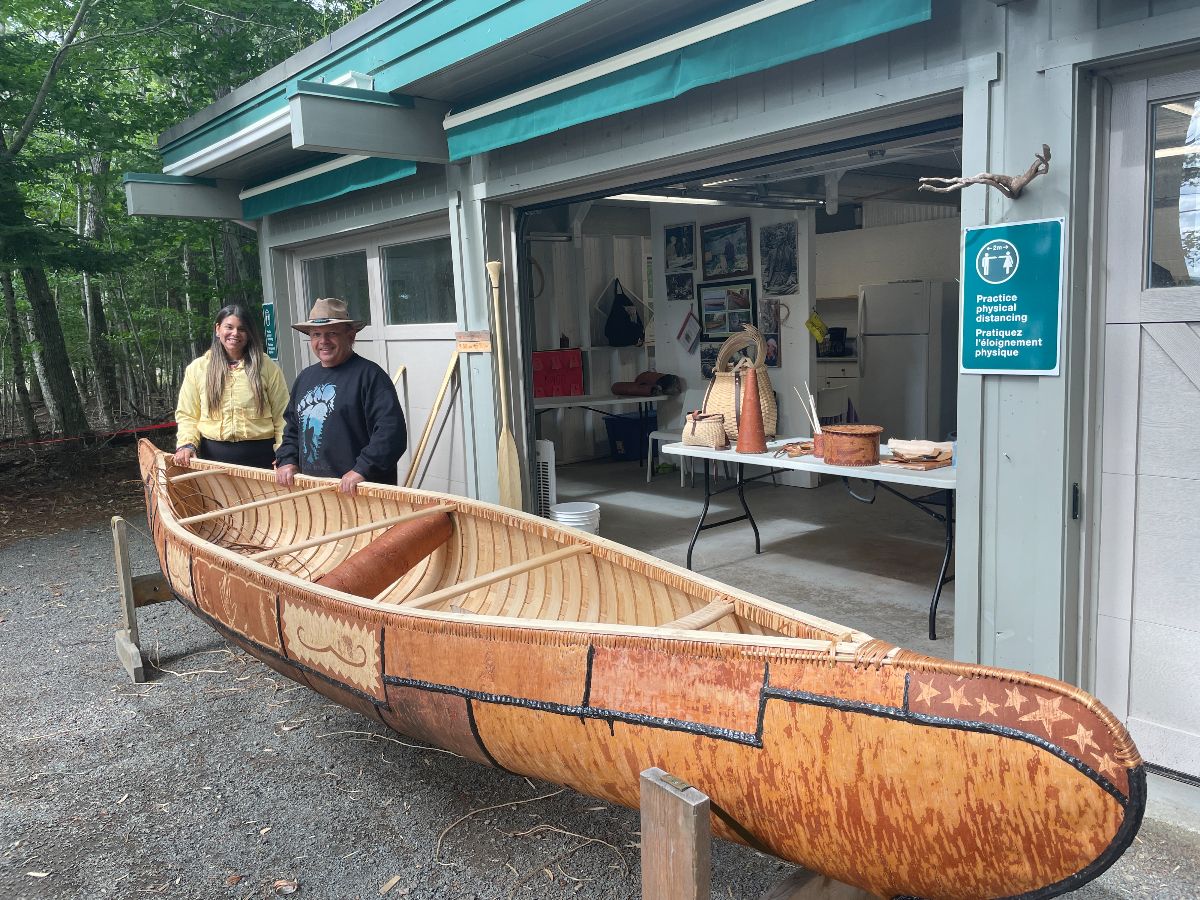
The birch bark canoe is culturally significant in the history of Indigenous entrepreneurship in pre-colonial North America, which went on to shape trading relationships across Turtle Island. As part of Ted Rogers School’s Indigenous Art Installation initiative, a 16-foot birch bark canoe was commissioned from Todd Labrador, a Mi’kmaq craftsman and cultural archeologist, which arrived from Nova Scotia in 2021. The Canadian Canoe Museum was a generous caretaker of the canoe until its arrival at the school in 2022. The canoe is now being relocated to a new permanent display on the 8th floor of the building (located by the east-facing windows across the 9th floor escalators).
The birch bark canoe is not only consequential for its connection to Indigenous entrepreneurship, but it is intended to be a learning tool for the school to understand the roots of the Canadian economy.
“I am immensely proud that Todd Labrador’s beautiful birch bark canoe will now have a permanent display in the Ted Rogers School building for everyone to see,” says Cynthia Holmes, Dean, Ted Rogers School.
“This initiative continues our school’s commitment to Truth and Reconciliation by expanding respectful, reciprocal partnerships with Indigenous communities,” she adds. “It also provides opportunities for students to learn with, from and about Indigenous communities, and support community-led projects.”
Collaborating with TMU teams
This project provided the unique opportunity to collaborate with other groups on campus on an initiative that connects TMU with the heritage of Indigenous culture and entrepreneurs.
After a visit to the Canadian Canoe Museum in Peterborough, Ontario, extensive online research and consultation with Labrador, the decision was made to create a glass display case with a wood frame that would be positioned in the north west corridor of the 8th floor of the Ted Rogers School building. In January 2025, the TMU Maintenance and Operations team began a successful collaboration with the Ted Rogers School on creating a permanent home for the canoe constructed by Labrador.
The decision for Maintenance and Operations to become involved in this initiative was based on their team having a full-time, on-site carpenter and painters with professional workshops, and the ability to use a large amount of untreated red oak that was designated for a project that had been cancelled. A generous timeline allowed for work to be done on the canoe case in between work assignments associated with servicing the rest of the campus.
After group consensus was achieved on the display case design, The Creative School’s Creative Technology Lab was engaged to create the shop drawings that would become the foundation of the design. The pillow that the canoe rests on in the display case was made by By the Six Clothing, a TMU alumni company, following Indigenous protocols, on Six Nations of the Grand River Territory.
This project was led by Daniel Care (Supervisor) and Ken Ozdemir (Manager) from TMU Facilities Management and Development’s (FMD) Maintenance and Operations. It also involved Sana Mulji (Senior Advisor, External Relations and Inclusion), Michael Mihalicz (Indigenous Advisor, Office of the Dean), Habibah Haque (External Relations and Inclusion Coordinator) and Rita Lingner (Director, Space Planning & Special Projects) from the Ted Rogers School, as well as Dominic Brifoglio (Carpenter), Terry Bennell (Staining and Varnishing/Glass Installation), Dino Sorge (Staining and Varnishing/Glass Installation) and Adrian Kenny (CAD Drawings, Creative Technologies Lab).
“It was very meaningful for FMD’s Maintenance and Operations team to collaborate with the Ted Rogers School to create this display case,” says Glenda Mallon, Assistant Vice-President, FMD. “We appreciated this opportunity to learn about Indigenous culture and birch bark canoes, and build something beautiful together that honours the canoe and the Indigenous traditions behind it. With the completed installation of the display case, students, faculty and staff can enjoy the canoe in its new, more visible home.”
The role of the canoe in commerce
The Indigenous population were the original entrepreneurs on this land and nations actively developed trading networks between each other. “Long before there were roads and railways, transportation across present-day North America relied on a system of waterways and cutting-edge Indigenous innovations,” Michael Mihalicz, Indigenous Advisor, Office of the Dean, explains. “Durable lightweight canoes made primarily from birch bark were designed to connect the farthest reaches of the continent and bridge geographic divides amongst distant nations and communities.”
He points out that canoes made traversing the landscape not only possible, but practical. “In doing so, they facilitated the diffusion of ideas, beliefs and traditions, and played an important role in the development of common languages and infrastructure as well as the social, political and cultural alliances which served as the basis for many complex societies and helped shape the cultural landscape of prehistoric North America,” Mihalicz explains. Some reports indicate that between 40 and 60 million people inhabited the Americas prior to contact with European nations.
Mihalicz says that post-contact, these same canoes were used to transport furs over a million square miles of wilderness to the ports in Montreal and York Factory. “They made trade possible by granting access to areas that would have otherwise been inaccessible,” he adds. “More than that, and because of this, they’ve come to symbolize knowledge sharing between Indigenous peoples and settler Europeans.”
“At the Ted Rogers School, the canoe reminds us of a time when there were true trans-cultural collaborations built on intercultural understanding and grounded in principles of co-learning, reciprocity and mutual accountability,” Mihalicz says. “They are a testament to the trail-blazing Indigenous innovators and entrepreneurs that laid the foundation for what is now the Canadian economy.”
Commemorating National Canoe Day
To celebrate Ted Rogers School’s new birch bark canoe display and commemorate National Canoe Day and Indigenous History Month, an event will be held at the school called “Trade & Tradition: The Birch Bark Canoe at TMU (external link) ” on June 26, 2025 from 1-3pm. This event is presented in collaboration with The G. Raymond Chang School of Continuing Education's Programs for 50+ as part of the annual 50+ Festival.
At the event, Mihalicz will be sharing the importance of the birch bark canoe in trading relationships on Turtle Island. You will also learn about the canoe-making process from Todd Labrador, how you can connect with the canoe and how we as a community can take care of it.
For more historical learning, watch Todd Labrador in conversation with TMU’s Dr. William Michael Carter (Director, Creative Enterprise Hub and Creative School Pro, The Creative School), in the second episode of the Ted Rogers School's Indigenous Initiatives Knowledge Keeper Speaker series, titled Birch Bark Canoes and the History of Indigenous Entrepreneurship (external link) .