Indian Residential School Records Project launches
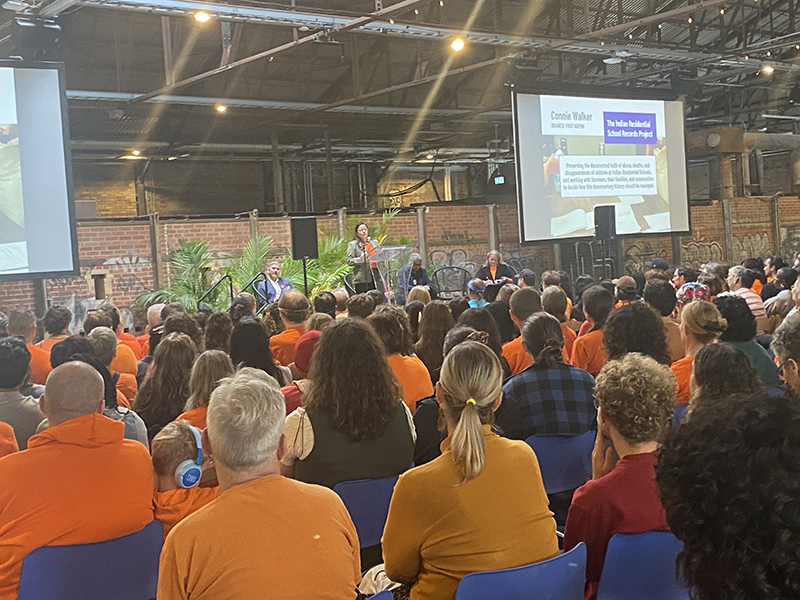
On the National Day for Truth and Reconciliation, over 300 people gathered at Evergreen Brick Works to mark the IRSR project’s official launch at the panel discussion “The Right to Truth: Protecting Indian Residential School Records."
“I'm just so grateful to [residential school survivors in my family] for their strength and perseverance, and I want to remember and honour them today,” said Connie Walker, assistant professor and Velma Rogers Research Chair at the School of Journalism and co-lead of the Indian Residential School Records (IRSR) Project (external link) .
Hayden King, executive director of the Yellowhead Institute (external link) , hosted the discussion. The panelists included Walker and and fellow project co-lead Kimberley Murray, former Independent Special Interlocutor for Missing Children and Unmarked Graves and Burial Sites Associated with Indian Residential Schools, as well as Stephen Kakfwi, former premier of the Northwest Territories, and Marie Wilson, co-commissioner of the Truth and Reconciliation Commission of Canada.
The IRSR is a joint collaboration between the Creative School, Yellowhead Institute and Lincoln Alexander School of Law. It was created in response to the Supreme Court of Canada’s announcement that over 38,000 survivor testimonies, collected as part of the 2006 Indian Residential School Settlement Agreement’s (IRSSA) Independent Assessment Process (IAP) (external link) , can be destroyed after September 2027.
During her remarks, Walker said that, so far, only about 100 people out of the 38,000 have requested that their records be preserved.
“Does that mean that survivors don't want their records preserved, or does that mean that they don't know about this decision? That's a question I have, because there was meant to be a robust notice program that was supposed to reach out to survivors to inform them of their rights, to let them know the different options they had for their records. They could be preserved at the National Centre for Truth and Reconciliation (NCTR) (external link) , they could request a copy for themselves, they could be redacted. Anecdotally though, I have been speaking about the work that I've been doing over the last few years, and I have met survivors who have no idea that this is happening,” said Walker.
The inspiration for the IRSR project arose when Walker was making her Pulitzer Prize-winning podcast Stolen: Surviving St Michael’s (external link) about the abuse her father suffered at St Michael’s Indian Residential School in Duck Lake, Saskatchewan.
“Learning about what happened to [my father] at St. Michael's as a boy unlocked something in me. It made me want to get closer and to understand him better. It made me realize how little I knew about his experience,” said Walker.
Walker was unable to access her father's IAP records while making Stolen. Still, she and fellow journalist Chantelle Bellrichard decided to file access-to-information requests for lawsuits filed before the IAP process began. In doing so, they uncovered 485 lawsuits and 200 allegations of abuse related just to St. Michael’s.
“What we did for Surviving St. Michael's, creating these archives of the court documents that tell the story of what was happening and what children had to endure, should happen at every single residential school. So that's how the Indian Residential School Records Project began, and that's the work that we're attempting to do to try to preserve as many survivor records as we can,” said Walker.
Going forward, the IRSR project has two goals. First, to raise awareness about the impending destruction and make survivors aware that they can request that their records be preserved. Second, to create an archive of survivor testimony from the thousands of lawsuits filed by survivors before the creation of the IRSSA, working collaboratively with survivors and their families to decide how these records are kept. Journalism and Law students at TMU will be heavily involved in creating the archive.
“I didn't get all of the answers to all of the questions that I had about [my father], but what I came away with was a much deeper understanding,” said Walker.