There’s More to Think About with The Review of Journalism
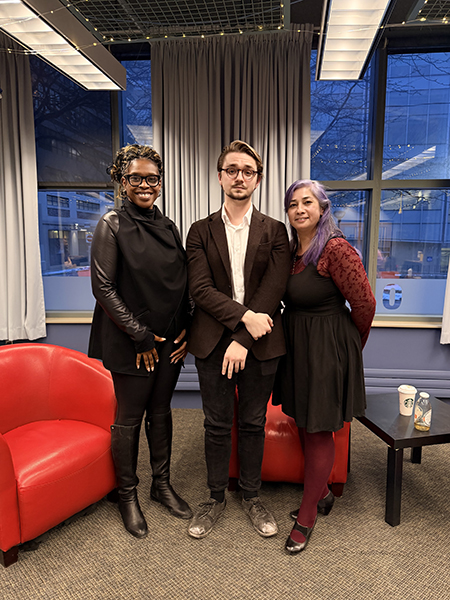
The panelists for The Review's disinformation panel: Dr. Kisha McPherson, Assistant Professor in the School of Professional Communication, Charlie Buckley, Lead Researcher and Producer, Big [If True] on TVO, and Angela Misri, Assistant Professor at the School of Journalism.
The Review of Journalism is bringing Journalism students together through a series of events designed to encourage critical thinking about the media landscape.
There will be two upcoming events; a zine workshop (external link) on March 31 and a launch party later in April.
So far, the publication has already hosted a film screening (external link) on Feb. 10 and a panel on disinformation (external link) on Feb. 24.
According to Hailey Ford (external link) , The Review of Journalism’s conference editor, the events aim to complement the publication’s broader mission of examining journalism practices through a critical lens.
“The Review of Journalism…is very much focused on issues of journalism. It's taking a critical eye, examining what it is that we do as journalists and how we can better our practices,” Ford said.
The upcoming zine workshop will be held in collaboration with Living Hyphen (external link) and will explore how independently produced publications play a role in storytelling and journalism.
“It will be a hands-on workshop as well as a discussion,” Ford said.
“We will be talking about the importance of zines and the role that sort of handmade magazines, handmade small things can play in the news media landscape, especially when it comes to sharing the stories of marginalized people, sharing things that maybe mainstream publications, the major ones, aren't always willing to talk about,” she explained.
Towards the end of the term, The Review of Journalism will also be hosting a launch party, where the team will distribute copies of the final magazine, which will cover six themes: climate, corruption, labour, disinformation, press freedoms, and reconciliation.
Based on turnout and feedback from previous events, Ford said the discussions have been meaningful.
“People within the class have been very happy with the actual messaging of the events,” she said. “People come away from it engaged and interested in the work we're doing.”
She hopes students leave the events with a stronger ability to deeply examine journalism practices beyond the classroom.
“It's about the people who do show up and about the messages that they take away from it,” Ford said. “It was really nice after the disinformation panel to see the panellists smiling and glad to have shared and to have participated. That's really what makes me feel good about the work that we're doing.”