What’s up with live journalism?
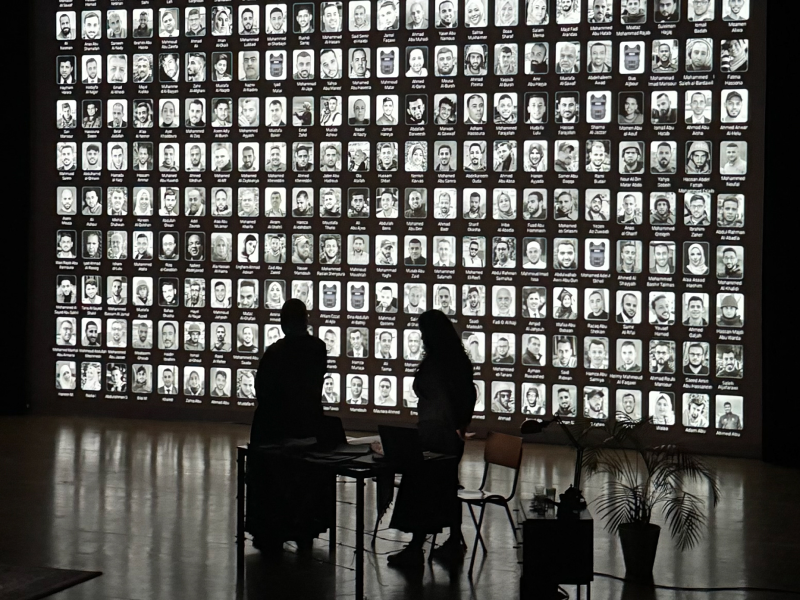
stitched! had an eventful production year (external link) with its show “Living with Drones.”
The interactive live journalism show toured across Ontario, the U.S. and Europe.
Attendees learned about the “devastating and traumatic impacts of Israel’s use of drones in the besieged Gaza strip.”
stitched! shows this, “By tying together personal narratives and documentation about the on-the-ground reality of this genocide.”
“Living with Drones weaves a compelling narrative that asks audiences to engage with violations of humanitarian and international law in Gaza since October 2023,” as self-described on its website (external link) .
The show returns (external link) on Monday, March 30, 2026 and is being presented at the University of Toronto, Scarborough campus at the invitation of the Department of Historical and Cultural Studies in collaboration with the Departments of Language Studies; English; Anthropology; Geography; and Arts, Culture and Media.
Tickets are available for purchase (external link) .
All proceeds from the ticket sales for this performance will be donated to PSSAR (Palestinian Students and Scholars at Risk) to support more students from Gaza securing fully-funded opportunities for graduate studies in Canada.
Journalism at Toronto Metropolitan University sat down with the stitched! crew, Hania Noor ‘25, social media editor and stage manager; Kinza Zafar ‘25, visual designer and fact-checker; and Skye Anderson, technical director and a fourth-year Performance Design and Production student, to learn what it meant to be involved with stitched! in 2025.
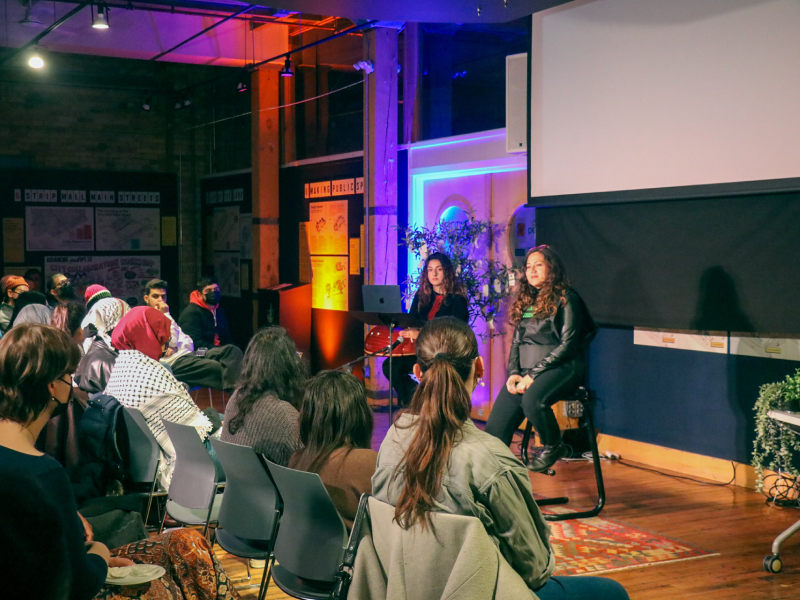
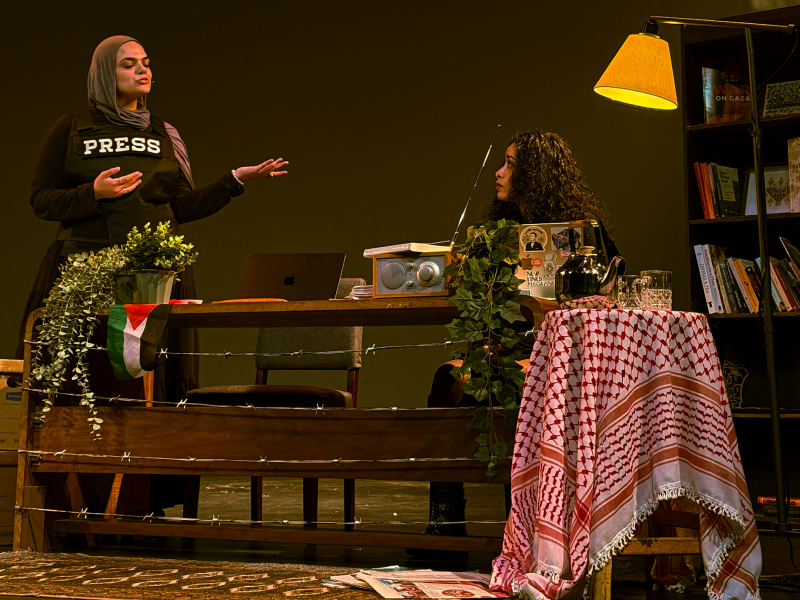
Photos by Hania Noor and Kinza Zafar
Noor got introduced to live journalism through JRN 555, where she worked on a show called Childhood Interrupted.
After the semester, she worked with Journalism professor and stitched! founder Sonya Fatah, who taught the course, learning more about live journalism and researching how audiences interact with the format.
Noor continued to work with Fatah and stitched! through Living with Drones, in various different roles- from social media to stage management
"It's important to figure out the balance of how we're going to present audio elements and lighting elements and if we're going to have any props, how are they going to help and elevate the stories that we're sharing rather than distract from it," she explained. "What's very interesting is that we're doing journalism, so figuring out the right way of incorporating theatre elements, but still being able to tell a journalistic story has been really interesting and fun."
The project became a lot bigger than Noor had anticipated.
The first show of Living with Drones was in London, “because London is this epicentre of colonialism historically and the effects of that colonialism are still very pertinent…that was a smart decision that Sonya made very early on.”
Each space the crew performed had a unique audience, from their first friends-and-family show in Toronto to Washington and London audiences to the International Live Journalism Festival in the Netherlands, where they performed in front of journalists, journalism educators and students.
She said the group feels very lucky to perform a show like this in so many different places.
“[The genocide] is something that is happening right now in the world today, and the show is constantly evolving every time,” Noor said, of the shifting story based on the continuing crisis in Gaza. “The show that we’ve presented [at] the friends and family show [compared] to what it is now is so insanely different, it’s a completely different show.”
The changes felt natural for the show, Noor shared.
Coming from a theatre background, Anderson said she gained a lot of experience working on the journalism-focused production, "it's always a work in progress."
Fatah and Anderson met when she would come into JRN 555 to help with technical aspects from time to time.
After a while, Fatah asked her to join stitched! on tour.
Reflecting on her experiences so far, Anderson said, “you learn a lot on your first tour.”
"Getting that experience of working with the venue crew at each different house, we went from an 800-seat theatre to a 50-seat performance space." For her, working with stitched! during the school year is homework—she is always learning new skills and adapting to new environments.
“It's just understanding why we have been taught the things that we've been taught, and then what are the things that we can change to suit the particular needs of this project,” she said.
Noor said some of her favourite parts of working on the show is when people come up to them to share how much they learned about the situation in Gaza after the show.
Noor hopes that the audiences are "engaging with [the story] emotionally…breaking down barriers a lot of people have of [ignoring the] news because it can be a lot."
Zafar engaged with live journalism for the first time while watching Living with Drones last March.
"I was in my graduating semester, and it opened my eyes to what's possible through journalism," Zafar said. "We've seen more journalists die in the ongoing genocide than in any other war since the 1800s combined, so it was really important to see faculty step up and fill in that role of advocating for our colleagues in the global South, specifically in Gaza."
After expressing her interest in getting involved with Fatah, they were able to work Zafar into the crew. She said, "Put me wherever, coach."
First, Zafar started by helping with visual sourcing, fact-checking numbers, and is now taking the editorial lead on social media.
"[We are] building an online community and using our social platform as a hub for conversations to continue outside of the [live] shows."
One show that stuck out to Zafar was at Carleton University.
“Seeing the audience reactions, everyone coming up to Laila, Christin and Sonya sharing how much it meant to them to see stories about Palestine done this way.”
She said, “you could tell this is not what they had expected when they walked in.”
Zafar would like to urge journalists at all levels of their careers to recognize the role they have.
stitched! shows present attendees with calls to action (CTA) that give them a range of ways in which they can engage more deeply with the issue on which the show focuses. We encourage readers to view the CTA (external link) s to see what you can reflect on, do, and/or support.