Striving for the Impossible with Mark Medley
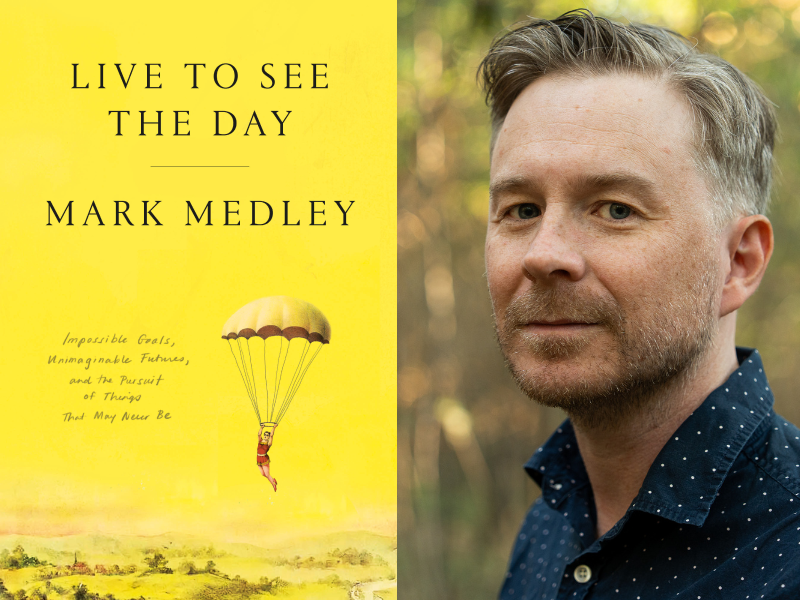
Alumni Mark Medley (external link) '07 published his debut book, Live to See the Day (external link) , that showcases impossible goals and how people around the world are still working to achieve them.
Medley wanted to write a book since he was seven years old, but never found the time to write outside of work, until he became an editor at the Globe and Mail.
“I decided if I’m not going to do it now, I never will,” he said. “I was in my late 30s when I started this book…you start thinking about what you want to accomplish before your career is over, and I knew I’d kick myself if I didn’t write something.”
We sat down with Medley to learn about his writing and research process after deciding to start writing Live to See the Day over five years ago.
This interview has been edited for clarity and length.
--
How does this book pull from your decades of experience as a journalist?
The reason the book exists is because of a profile I wrote for the National Post almost 20 years ago.
I was a reporter, and it was the 2008 federal election. I wanted to explore what causes somebody to run for office, knowing they're not going to win.
I was living downtown, I lived almost on campus at the time. Bill Graham was the MP at the time, and there was no way he was going to get defeated. I remember looking at the list of candidates, and there was a woman named Liz White, who is the leader of what is now known as the Animal Protection Party of Canada. It had a different name at the time.
It was a fairly new political party. It had only been formed a couple of years earlier. She had run for office a number of times.
I was curious about what makes somebody spend two months of their time on the campaign trail, money, energy, knowing that there was no way in hell that they were going to be sent to Ottawa. She agreed to let me shadow her, so I followed her on the campaign trail.
She got a handful of votes; she was tens of thousands of votes behind the ultimate winner of that election.
It remained one of the favourite things I ever wrote. What was interesting is I kind of kept tabs on her in the years that followed. Every time there was an election, I would look her up because I knew she was running, just to see how she was doing. It struck me that here was this woman who had been doing this for, at this point, a decade or longer, and she wasn't quitting.
There was something really admirable to me about that. I remember talking to my [publisher], and I was like, ‘what do you think about a book that finds other people like Liz White around the world?’ I'm paraphrasing, but he wrote back like five minutes later, ‘that's a book.’
So, I went out in the world to find more people like Liz.
What was the process of finding these people and choosing them?
I really didn't know what the book was going to turn into beyond the overarching theme of impossible goals.
It was one of those things where you start to see it everywhere, as you do your research, and you start to research people and talk to people. They would say, ‘Well, did you think of this?’ And I would say, ‘No, I hadn't thought about that.’
I remember a search for alien life outside our solar system, which was one of the first chapters I knew I was going to pursue. In the course of my interviews with those folks, they said, ‘Have you thought about looking at people who are pursuing interstellar travel? Have you thought about looking at people who are pursuing planetary defence? ‘And that hadn't been on my radar.
It was in the course of talking to people that, oftentimes, an interview would lead to a subject I was completely unfamiliar with.
At the end of a couple of years of research, I probably had like 30-35 chapters I was mulling over. I sat down with my editor, and we shaped it into 10 areas we're going to focus on. So there's like a completely other book out there that I could have written.
How were you and your editor selecting people to include?
There are some people who are willing to be interviewed, and then when you say, ‘Okay, I'd like to include you as a featured character in a book,’ they might get cold feet. There were a couple of people who I would have loved to include, but they decided they didn't want to go forward with it. That was part of it.
As we settled on the chapters, we wanted a variety of geographies. I wouldn't have thought I would go to Indonesia for this book. But, my editor was like, ‘that would be great, if you can go to Sumatra and spend a couple of weeks in the rainforest.’
It was partly who was willing to let a stranger into their lives. Because I would spend days with these people at a minimum.
It was also a matter of money as well. I couldn't afford to go everywhere I wanted.
Anytime you're putting together a project as big as this, you're going to have to make hard decisions, and some people are going to have to be left on the editing room floor.
Were there any moments that stood out to you while writing the book?
Going to Sumatra, a part of the world I had never travelled to before, was completely life-changing. Not only was Jeremy one of the most remarkable people I had met in the course of my research, but just getting to spend a week in the rainforest…
I remember paddling across this lake at the top of a mountain, a volcanic lake, no one else around except for the two fishermen and the four of us in our party and surrounded by mountains, fog, mist and rainforest…looking around and being like, ‘oh, this is why I became a journalist.’
When I'm 95 years old and losing my memory, that's the memory that I'm going to keep.
There were others as well. I'm a space geek, and I got to go to a rocket launch of a NASA mission, the first ever planetary defence mission in the agency's history.
I've watched countless countdowns on CNN over the years, and to actually be at Vandenberg Space Force Base, in the viewing area with all these engineers and people who had spent, in some cases, upwards of a decade working towards this mission, was a special thing.
Every chapter has its own memories associated with it.
Do you have any advice for students or alumni who want to take that leap from journalism into publishing?
You need to make sure it's a project you want to do, because it is a tremendous amount of work. I had a pretty good idea of what to expect, because I covered the publishing industry for a long time at the Globe, and the Post and I'm friends with a ton of writers.
You need to feel like this was the book, not that you were born to write, that sounds a little bit hokey, but a book that you really want to write. You also need to prepare yourself for a lot of frustration along the way, you need to prepare yourself for a lot of solitude.
This was my own impossible goal, and somehow I realized that it could become a possible goal.