Congratulations to J-Schools Canada student winners
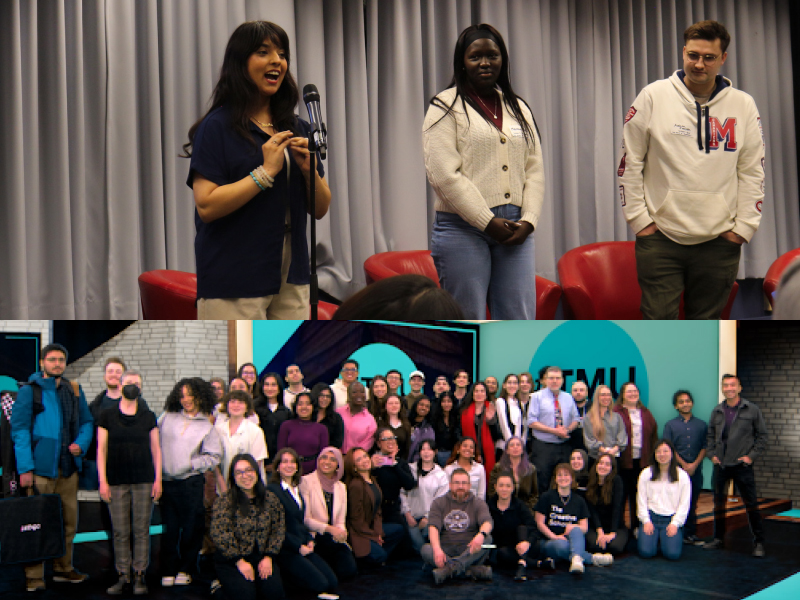
Congratulations to the students, staff and faculty involved in the production of TMU Votes (external link) and “We Met U When S3 E1: Power of Chantelle (external link) ” for winning and being named honourable mention of J-Schools Canada’s Student Group Project of the Year (external link) category.
Journalism chair Ravi Mohabeer said this achievement, “demonstrates the impact of being part of a community of extraordinary journalism and media professional students."
TMU Votes wins 2025 Student Group Project of the Year
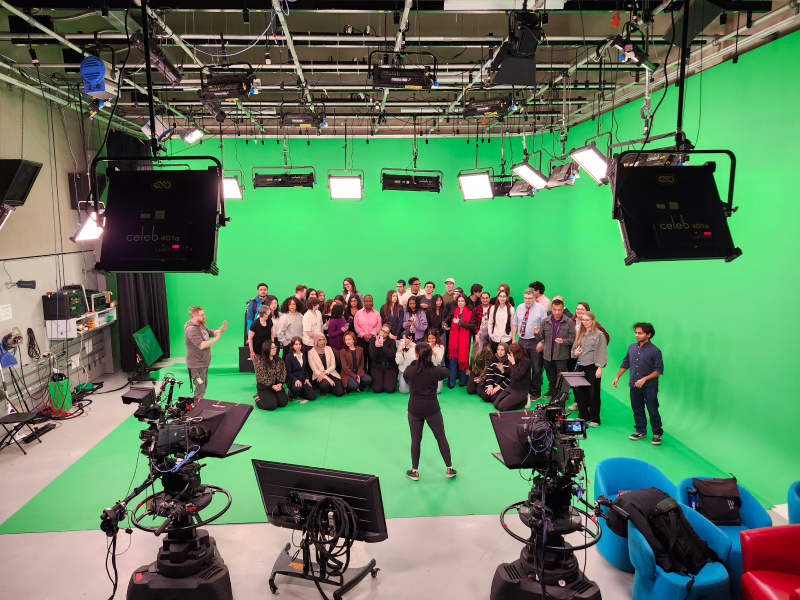
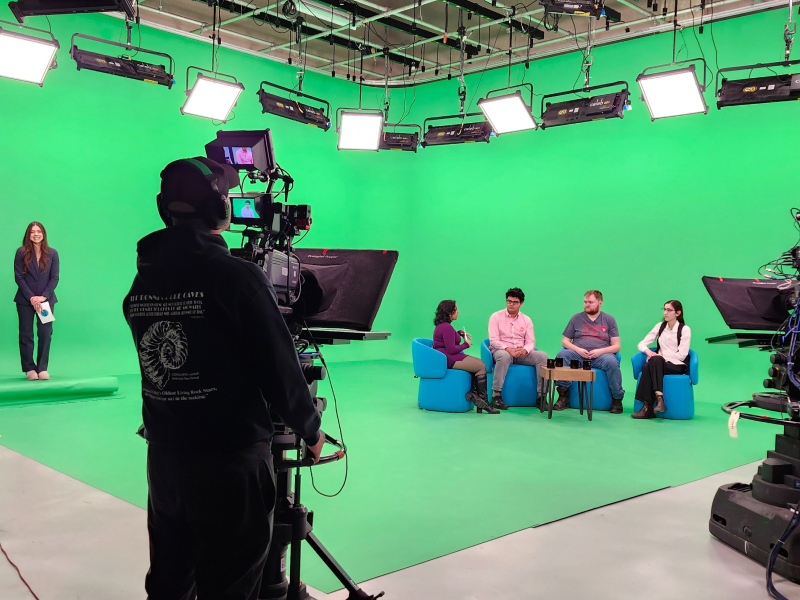
“TMU Votes was chosen for its sheer magnitude of ambition, [covering] an entire election with a crew of dozens of highly skilled and passionate students, faculty and staff,” said Mohabeer.
Associate professor Nicole Blanchett, executive producer of TMU Votes, knew during and after the show that something special had happened.
“The students had stepped up in ways beyond what we might have imagined,” Blanchett said. “This was the type of production that was worthy of recognition.”
Reflecting on the moment, Blanchett said that as an educator and producer, "It was one of my best experiences ever."
"Seeing these students absolutely shine, it is such a reward as a teacher to see your students step up like this."
Haley Sengsavanh ‘25, the producer of TMU Votes, submitted the broadcast for this award, with support from Blanchett.
She thought that the project shone through the category because it was clear how hard everyone worked.
"Everyone saw this as an opportunity to expand their knowledge," Sengsavanh explained.
Lindsay Hanna ‘04, manager, technology infrastructure at technology, planning and innovation, who was the technical director for Studio D during TMU Votes, remembered how everyone jumped on board when the idea was brought up.
"The opportunity doesn't come up very often, so let's see what we can do," Hanna recalled. "All of a sudden, we're creeping up to a crew of 40 to 50 people involved."
She said that everyone was out of their comfort zone that night as they were using a new studio for its first live production and bringing students from RTA and Journalism together.
For Hanna, this was something special. "It was truly seeing that when we bring everyone together, we're capable of doing things that are going on in the industry...that's great for our students and for our school."
Fourth-year Nageen Riaz, co-host in Studio D, described the night as the favourite thing she's done so far at the university. "It felt like the most calm, fun space to be in, even though what we were doing was so much pressure."
Her biggest takeaway was learning that she enjoyed being on camera. "I always wanted to do camera work, but when TMU Votes happened, I was like 'I kind of love being on camera,'" she said.
Adriana Fallico '25, Nageen's co-host, agreed with the description of the fun atmosphere as everyone was there to support each other.
She said, "We all had one thing in common, which was to get this production going and have it go as seamlessly as we could."
The award shows the team worked together. “If you put any amount of people into one room with the same passion, the same goal, you can achieve what you really want to do.”
Fourth-year Aisha Shabeese said it takes a village to do a production like TMU Votes.
Being in the control room as the switcher, Shabeese was in the middle of the action, making fast decisions and reacting to Hanna’s instructions for what to put on air.
Although it was stress-filled, Shabeese emphasized how accomplished everyone felt.
"It felt so fulfilling to work alongside my fellow students and learn from what they're doing and [what] I'm doing," she said.
Ryan Sykes, production technician, video, technology planning and innovation, was proud of the experience they created.
“My hope is that this is just the beginning of building new frameworks for collaboration and cross-disciplinary experiences for students in The Creative School,” he explained of how this award could affect future collaborations.
He said this was a great example of teamwork and experiential learning.
“Seeing RTA students from different years of the program, who all have had unique experiences, come together to support their Journalism colleagues, who were focused on the editorial coverage.”
After being in game show and sports broadcast environments, working in news and elections was refreshing for fourth-year Media Production student Connor Fortin. "[A] different multi-cam studio environment was a good experience to have before heading out into the workforce."
Fortin had been in the new Studio A (opens in new window) because of his classes, but being on this team made it a different experience for him.
"It's something that TMU Votes, especially for the RTA side, can wear as a badge on its sleeve of being the first major production to come out of The Arthur Smith Virtual Production Studio."
Vanessa Tiberio ‘25, results host for TMU Votes, remembered the night fondly as she finished off her final year with something she had always wanted to do. "Being in that role and to be in front of a camera and have that live dynamic...was an achievement."
Tiberio is currently a digital broadcast journalist for Global News in Saskatoon, and when she was applying for jobs, TMU Votes was there with her. "Different clips from TMU Votes are in my demo reel for when I was applying...it definitely helped propel me to this path and left those doors open."
"It was so well achieved," she said about winning the award. "Thank you to all the professors and instructors who gave us their time to do that project...they put a lot of heart and soul into it."
We Met U When named Honourable Mention for 2025 Student Group Project of the Year
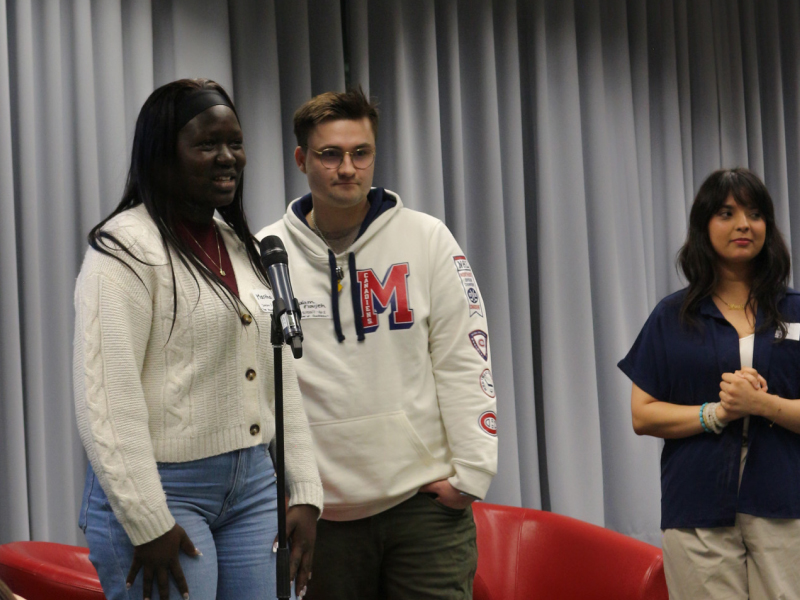
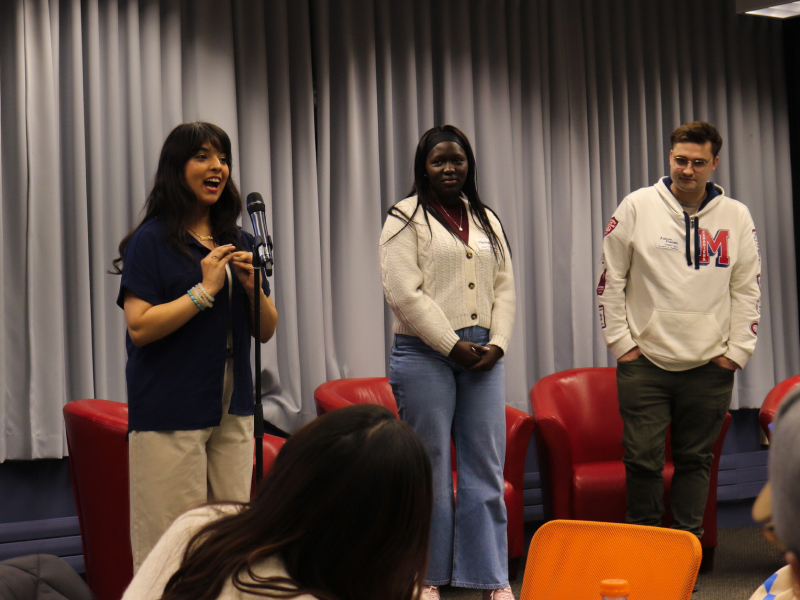
Mohabeer said, “We Met U When is a great example of a collaborative effort that was so much more than a class project.”
“A powerful way to highlight how journalism can be done differently for the good of society.”
Angela Glover, production technician, news and multimedia, production technology planning and innovation, said that with audio, it becomes a more powerful experience than when you’re handed a picture.
“For a listener, when they’re hearing it, their imagination fills in those blanks, their imagination starts to picture that person, starts to be emotionally connected in a way that you aren’t with just visuals.”
“We Met U When S3 E1: Power of Chantelle (external link) ” paints an intimate picture of Chantelle Krupka’s story of being tased and shot by police outside her home on Mother’s Day in 2020.
Martha Gai '25, Adam Floujeh '25 and Yanika Saluja '25 wanted to showcase the resilience and strength of Krupka through their episode and give her a platform to share her story.
Assistant professor Shari Okeke was happy to hear about the honourable mention noting it meant people listened and valued Krupka’s story as well as the students’ work.
Okeke emphasized how the students were practising duty of care and respecting the interviewee's wishes for the personal story.
"This is not an accountability interview; this is a gift that they're giving us, insight into the experience, into a certain lived experience," she explained. "Watching the students practise this level of care was really amazing to me."
“We Met U When,” produced by JRN 801 students, exemplifies what Okeke is doing as a professor, equipping students with the skills to be good journalists.
“I'm trying to teach the next generation of journalists how to practise a high standard of care in the work while maintaining journalistic rigour."
Gai wanted her pitch to focus on addressing the racial biases of 2020, such as George Floyd and the Black Lives Matter movement.
She didn't know about Krupka's story before looking for pitches, so she researched what happened and what was still developing. Gai pursued the story and reached out to Krupka to secure an interview.
Later, when Krupka and her partner came to the RCC for the group interview, Gai remembered, “You could tell that her life clearly changed,” from that moment years ago, because she had to walk with a stick.
She said that going into an interview, she had an expectation of what she’d hear, but in this case, once they heard everything, it was different, heavy and has stuck with the student group since recording the episode.
"Each time that you're trying to write something, you're like, 'I hope this one line that I'm writing is not adding to silencing her, but to amplify her voice."
To Gai, this story and the honourable mention are why she chose journalism. "I had stories that I wanted to tell for my community, about me, people around me...and it felt like this one story that we did, people are listening."
Saluja remembered how the lessons on trauma-informed reporting from her early years in the program came back to her during the episode's production.
The group knew Krupka had not had the best experiences with journalists in the past, and they kept that in mind during the recording sessions.
"We were not just skipping from question to question; we were always asking her if she needed anything," she explained.
"After our first question, it was a very heavy conversation, and she would occasionally tear up. Her [partner] was in the room holding her hand; we could see how connected those two were through everything that happened."
Saluja hoped people felt the same things they did while listening to the episode, and that more people hear after being named an honourable mention.
"If you (the listener) understand even a little bit about how she felt, we succeeded in what we were trying to do."
Floujeh reiterated how their episode was a platform for Krupka to share her story.
"The credit goes to Chantelle because she is so open to talking about her story," he shared.
The group worked with Okeke to revise questions again and again before meeting with Krupka to ensure they were incorporating trauma-informed reporting into their interviews.
"You have to do a balance of making sure you hit the right points, you want to make sure you're asking things that are respectful," he said. "At the same time, you need to let the person you're talking to tell their story."
Learning about the honourable mention signified for Floujeh that they had done something right.
"I feel like we did her justice and that's all that matters," he added, hoping that more people will now learn about Chantelle’s story.
Floujeh said it will have more people listening to Chantelle’s story, “which was the whole damn goal.”