Bringing the court into the classroom

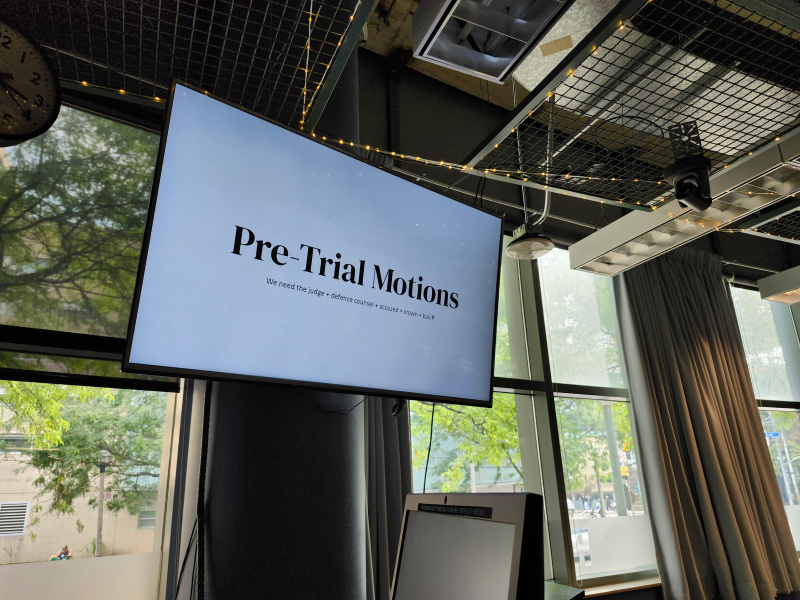
JRN 344 Law, Ethics and Evolving Journ. Standards students participated in a mock trial experience during their labs on Sept. 22.
Assistant professor Angela Misri is teaching the course for the first time this semester.
She said, like many of her academic experiences since leaving the newsroom, that, “teaching this course came with a learning curve.”
Over the summer, she immersed herself in law textbooks, university syllabi and listened to a few podcasts to feel confident in teaching the course. This was all in addition to her industry experience reporting from court and how legal considerations shaped her stories as a writer, producer and editor.
The mock trial had students taking on roles like the crown, bailiff, accused, jury members, while the rest reported on the case, working on possible ledes.
Misri hoped that the students would become less intimidated by courtrooms.
While reflecting on what students should have taken away from the experience, she hoped students now knew “...where the key players are and some basics of how the room operates, and that they grasped that, despite getting a lot of information and legalese thrown at them.”
“Our job in news is to sift through and find the most important parts to report on,” Misri said.
Journalism student Saturn Steel-Mendez thought having a live mock trial was the best low-stakes way to learn court reporting.
She felt that having Misri as the judge and volunteering to be the crown prosecutor in the trial helped her get a sense of the etiquette required in a courtroom.
“We also got a feel for the rhythm and the sort of respect that the atmosphere would demand via how the prof runs the courtroom,” Steel-Mendez said.
The routine that courtrooms follow was also a big takeaway for Kristian Tofilovski, who acted as the lab section’s bailiff.
“We practised listening to specific details in both arguments. It helped me learn how to catch those key details in their arguments,” he shared. “I know that when I actually go to the courtroom, I'll look out for those things too.”
Tofilovski is excited to learn more about media law after dabbling in it during other classes in the first two years of J-school.
“As young journalists, it's important for us to have this knowledge, so that we can actually go into the industry hoping to bring about positive change,” he said.
Peyton Andino, a journalism student, took away from the trial the reminder that through “every single step, you need to approach it (the case) with the least amount of bias as possible.”

In addition to court reporting, the course teaches students the tools and skillset necessary to apply ethics and law in their careers.
“There's so much stuff that can happen now in terms of our presence online and what we post …what we consume online,” Andino explained. “What we take away from the course is vital to our future careers."