Students Step into the Journalism Industry with Summer Internships

Moyo Lawuyi (top left), Daniel Opasinis (bottom left) and Isabella Soares (right) all found internships or fellowships in the journalism industry this summer.
Students across different years in the journalism program are finding their footing in the industry through summer internships.
Isabella Soares, a student heading into her fourth year, started freelancing for She Does The City in her second year, covering film and TV, while looking for more arts and culture-focused outlets to pitch to.
When she started researching internships this summer, she looked to her connections at She Does The City and found the perfect opportunity.
“I just reached out and said, ‘it's been really cool to work with you guys as a freelancer, but I would love to get to intern over the summer and learn more about different areas of the site that I didn't get to work on yet,’” said Soares.
After a Zoom call with two editors, she was quickly brought on board.
Through her internship she says she has been able to cover a wide range of arts. She spends her days attending events, writing content, visiting galleries, recording interviews, capturing footage and editing videos.
The internship has allowed her to do things she’s always wanted to do, including covering two red carpets — the Departure Music Week Festival and the Canadian Film Centre Gala, where she interviewed actress and producer Jennifer Podemski.
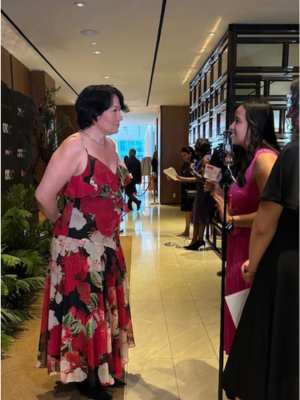
Isabella Soares interviews Jennifer Podemski at the Canadian Film Centre Gala
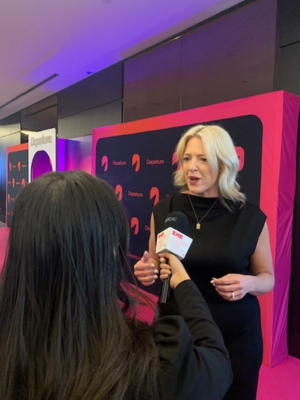
Isabella Soares interviews Sarah Cummings at the Departure Music Week Festival
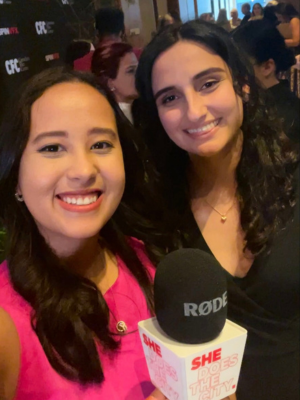
Isabella Soares and Annemarie Cuttruzola at the Canadian Film Centre Gala red carpet
“Usually I do interviews over Zoom, or maybe we'll do it in person. But I've never done red carpet interviews before. And it's a whole different ballgame,” she said.
She’s also been able to interview artists such as Canadian playwright Hannah Moscovitch, dancer and performance alumna Carleen Zouboules, and actress Marlee Matlin, the youngest Academy Award winner for best actress and first deaf performer to win an Academy Award.
Soares was transported back to her ballet recitals while filming an IG reel of Zouboules’s dance rehearsal for She Does The City’s “artist of the month” feature. Spending a few hours watching Zouboules get prepared, put her costume on and do some exercises made her want to continue exploring different avenues of arts and culture.
With She Does The City, she got the opportunity to do her first in-person junket for the movie "Sorry, Baby," where she interviewed director, screenwriter and actor Eva Victor.
She’s most proud of her interview with Matlin as she grew up watching her in "Switched at Birth," and now, years later, she got the chance to interview her for Matlin’s recent documentary, "Marlee Matlin: Not Alone Anymore."
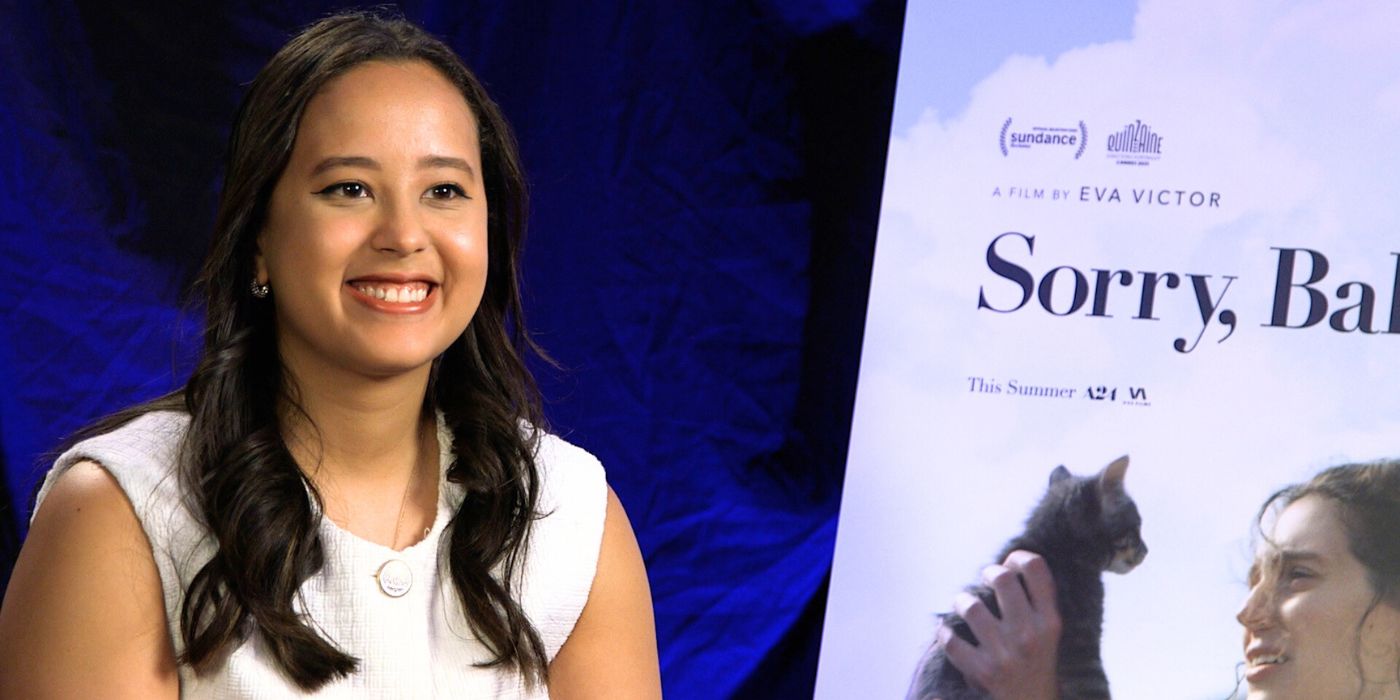
Isabella Soares at her first in-person junket interviewing Eva Victor for "Sorry, Baby"
She says taking the “Journalism and The Arts (opens in new window) ” course in her third year was extremely helpful in providing a basis for arts and culture in Toronto and how the Canadian art space works.
Some advice she has for students looking for internships is “don’t be afraid to ask.”
“Think a little outside of the box and think about the outlets that you really like as a reader … the biggest thing in this industry is a lot of positions are not there written out for you. But if you're interested in them, they might open up for you,” said Soares.
Moyo Lawuyi, an upcoming fourth-year student, is one of three Local Journalism Fellows (external link) at The Local.
In Lawuyi’s JRN 303: Feature Writing Workshop class, lecturer Hayley Watson invited Inori Roy, associate editor at The Local, for a guest lecture on feature writing. Lawuyi found the lecture intriguing and struck up a conversation with Roy at the end of class.
“[We] built a rapport and she suggested that I apply for the fellowship,” said Lawuyi.
With Watson there to go over her pitch, and assistant professors Eternity Martis and Shari Okeke’s encouragement, she applied and was accepted.
Her days at the fellowship involve going to editorial meetings, attending seminars and working on her feature story.
Editorial meetings take place on Monday afternoons, where they discuss ideas for issues, pitches, and potential images for the issue. The story meetings also serve as a space where they can discuss how published stories are doing, goals that the team has and update each other on the stories they’re working on and if they need any tips or advice.
Writers and editors in the magazine industry are invited to guest speak at seminars on topics ranging from interviewing, feature writing, freelancing, and filing freedom of information requests.
The fellowship does not follow a typical 9-5 schedule, instead Lawuyi says, “you could come into the office anytime.”
She appreciates the easy-going environment at The Local where she says everyone is encouraged to bring in new ideas. “I think the fellowship and the way The Local works, how it's such a small publication, it's a very welcoming environment. There's no hierarchy, it's not corporate. I think it made me want to do something like that in the future.”
For anyone interested in the Local Journalism Fellowship, Lawuyi says your pitch is the most vital part. “Look at what The Local publishes … and tailor your pitch to things The Local would be interested in.”
She encourages students to learn more about the publication, read more of their stories and ask professors and lecturers for advice.
Daniel Opasinis spent the summer of his first year in the journalism program as a reporter in the Toronto Star’s radio room.
As a news editor at The Eyeopener during the winter semester, Opasinis learned that fellow editors past and present had gone on to work at the radio room. Then, in the spring, a past editor at The Eyeopener informed him that applications for the internship had recently opened.
“I just thought, ‘why not? I don't have a job this summer, so I might as well just gun for it,’ so I applied,” said Opasinis.
In the radio room, Opasinis explains that a lot of his reporting is focused on breaking news and crime. “Radio room reporters are tasked with grabbing a story as soon as it happens and flagging it to our editors and writing some of the most current and in-the-moment stories.”
Typically, he covers breaking news like shootings, stabbings, or fires.
He says that most of his day is spent looking at X. “As soon as something happens, police will post about it and they’ll give very limited details. It's our job to take those details that we’re given and write the first hit of a story.”
“When something gets released you have 15, 20, 30 maximum minutes to have that story filed and ready to go out because we don’t want our readership to be waiting to hear about something,” said Opasinis.
At the radio room, he saw the words he learned in classes being put to use. “It's cool getting used to the everyday asks of the editors and knowing what they're talking about and what they expect of you.”
One of his favourite pieces that he wrote for The Star is a story on a decommissioned plane being turned into a playground in North York.
"In the radio room a lot of our stories are very monotonous and the everyday happenings of Toronto and every once in a while you'll have an editor that gives you the opportunity to write something that's a little bit more unique and has more character to it and that was my first opportunity to do that and I found it so fun. I liked being able to conduct longer interviews and look into a topic, and I found it very stimulating.”
Through this internship, Opasinis says he’s been able to meet really cool journalists, write really cool stories, make a lot of connections and build his portfolio.
“I think having a student internship like this where they aren't only looking for you to work, but they're also looking to teach you and kind of help you figure out your beat and your writing skills is really appreciated. It's fun not feeling like they're just throwing you into the deep end. You get to learn,” he said.
For anyone looking to work in the radio room, he says, “Don't be scared to apply. The radio room is a learning environment at the end of the day, and it's built for students. So just because you fully don't understand something doesn't mean you're going to be left in the dark.”