Stephanie Philp Helps Shape the Story of Exhibitions at ROM
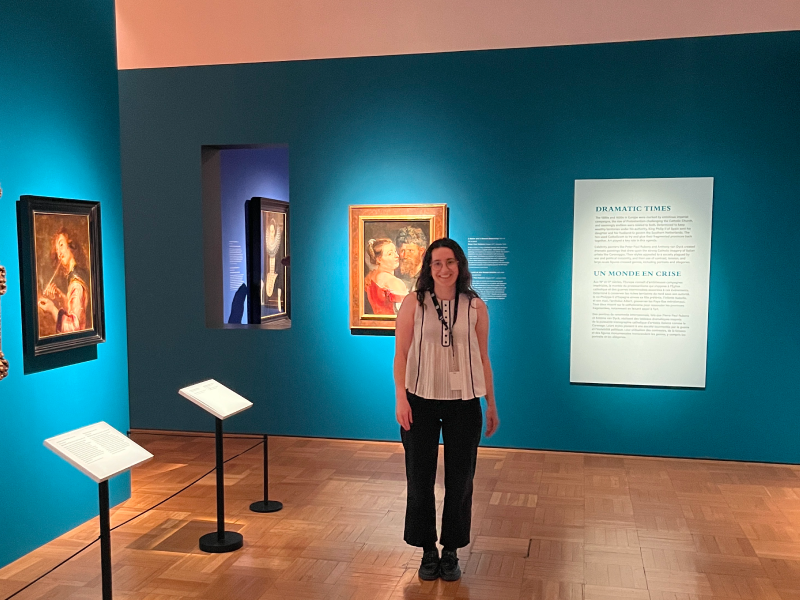
Stephanie Philp (external link) ‘16 grew up going to museums and had a deep love for them. But she never thought about working in one until she was in grad school, spending most of her free time at The Metropolitan Museum of Art.
When she saw a job posting at The Royal Ontario Museum (ROM), “it at first felt like a long shot,” but in the interview process, she was able to make a case for how her background in journalism meant she was a curious person who cared about details.
In February, she joined the ROM as an interpretive planner. Her role involves working with the exhibition development team from concept to installation.
The team can include a project manager, curator(s), 2D and 3D designers, preparators, AV specialists, conservators, registrars and more.
“Every day is different, and it depends [on] where we are in the exhibition development process,” said Philp.
For one project, she was able to go on the floor and test a new interactive with visitors to see what’s landing and consider their feedback, making edits as needed.
“I work on creating an interpretive plan for the team, which develops throughout the process and helps organize exhibition text. It might start as a thematic bubble diagram and then expand to a more fulsome document that describes the purpose of each object or belonging in an exhibition,” said Philp.
Philp explains that her role is “at the intersection of curation and design to help shape the overall story of an exhibition.”
When she started working at the ROM, the museum had been putting together Saints, Sinners, Lovers and Fools: 300 Years of Flemish Masterworks (external link) , an exhibition co-organized by the Denver Art Museum and The Phoebus Foundation SON, Antwerp (Belgium).
Her role in that exhibition entailed finalizing the exhibition text, working through the stages of proofing the labels and putting together ‘I Spy’ clues for the artwork in the gallery.
“We just worked with the curator and the rest of the team to identify what's an interesting detail that we can then blow up to put on a label, and then our awesome designers design the labels and make everything work in the space,” Philp said.
This involved choosing an artwork that had something appealing that a visitor might miss if they weren’t specifically looking for it. Among some of the things to look out for, said Philp, are an asparagus, a bird near a game board and a child holding an egg.
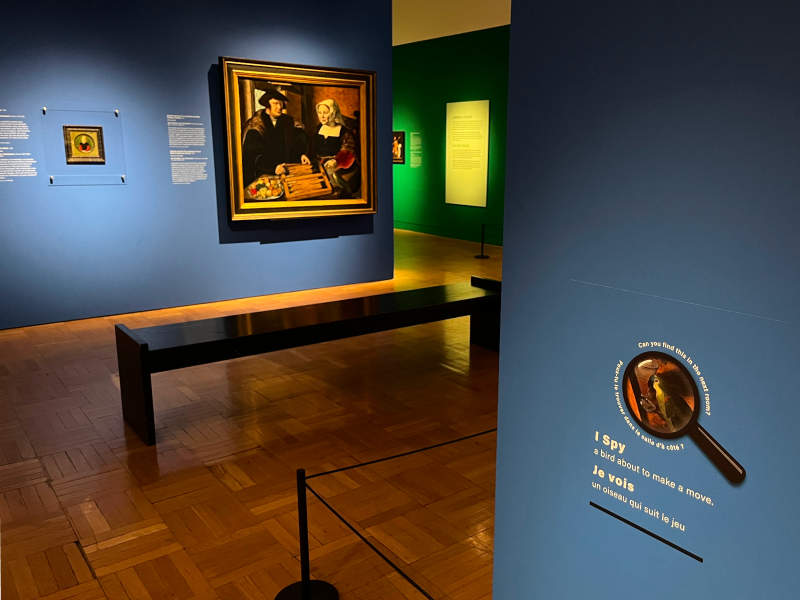
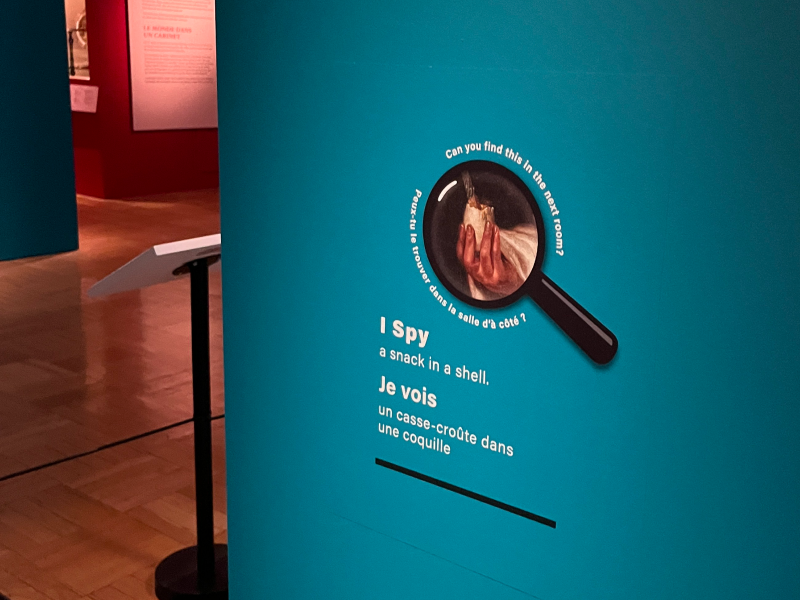
I Spy clues Philp wrote.
“It's always great to have a family-friendly activity. An activity like I Spy encourages close looking at the artworks, which is something we always want to do,” she said.
Now, she’s preparing for other shows, both borrowed from other museums as well as ROM originals.
“A great part of the job is I'm always learning.” She explains that one of the borrowed shows this fall is on sharks, which has allowed her to expand her knowledge of them.
Sharks (external link) is an exhibition organized by the American Museum of Natural History, New York, and opens at ROM this October.
“Did you know the Greenland shark can live up to 500 years and doesn’t reach reproductive maturity until it’s 150?”
Philp expressed that she learned so much about sharks while working on the show.
“I feel really excited about working on all the shows, but getting to work on a ROM original show is really great. We have one opening at the end of September about Crawford Lake (external link) , which was the proposed site for the Golden Spike for the Anthropocene,” said Philp.
The co-curators on the Crawford Lake exhibition are Soren Brothers, ROM’s Allan and Helaine Shiff Curator of Climate Change and Deborah A. Metsger, Assistant Curator of Botany in ROM’s Department of Natural History.
“And I'm working on another ROM original show with the Bishop White Committee Associate Curator of Japanese Art and Culture Akiko Takesue,” she added.
The upcoming ROM original exhibition (external link) is based on Takesue’s original research that explores how the sense of touch is essential to the collection, appreciation and circulation of Japanese art.
Philp mentions that they’re always collaborating with a curator to understand the natural or art history involved in the objects and artworks so that they can help communicate that information to a visitor.
“It's really cool to work with curators at ROM to shape something that is coming out of their field of expertise and shape that into an exhibition for the public,” she said.
Philp sees a crossover in her role to that of a journalist as “an interpretive planner is really in service of the visitor,” and both jobs can include “synthesizing really complex information into something that's really bite-sized.”
She added that aside from her typical role as an interpretive planner, she also gets to pitch and write stories for the ROM magazine.
Philp has a piece on Crawford Lake coming out soon, and she’s going to write one about Sharks in the fall.
Some advice she has for current students is to be flexible with how you want to apply your skills, be open to new opportunities and keep trying new stuff. “Something I like to say to myself is ‘don't say no to yourself.’”