J-school Alum Co-produces a Story of Reconnection
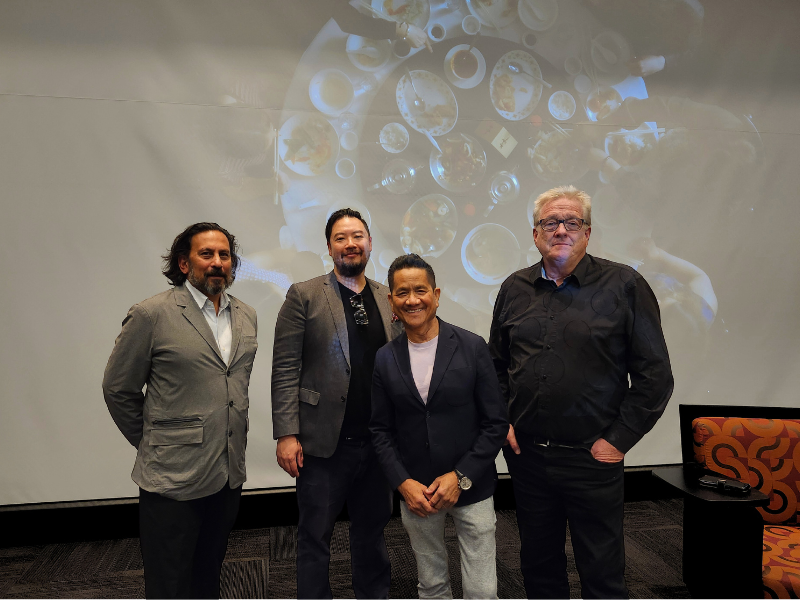
Left to right: Journalism chair Ravi Mohabeer, associate professor Adrian Ma, co-producers Justin Poy and J. Craig Thompson at the Exclusion: Beyond the Silence documentary screening on Oct. 8, 2025.
Toronto Metropolitan University students and faculty, and community members came together on Oct. 8, for a special screening of “Exclusion: Beyond The Silence (external link) .” It featured a Q&A with the documentary’s producers, Journalism alum J. Craig Thompson ‘82, and RTA alum Justin Poy ‘93, after the viewing.
“Exclusion: Beyond The Silence” is a powerful documentary exploring the impact of Canada’s 1923 Exclusion Act on generations of Chinese Canadian families.
The discriminatory Chinese Immigration Act of 1923 (external link) , better known as the Chinese Exclusion Act, is defined by the Canadian government as “the culmination of anti-Chinese racism and policies…All Chinese persons living in Canada, even those born here, had to register with the government or risk fines, detainment, or deportation.”
The act was in effect until 1947; during those 24 years, the government is said to have only let in between 12-50 Chinese people, but the exact number is unknown.
“Exclusion: Beyond The Silence” follows Keira Loughran, the director and Helen Lee as they trace the legacies of their grandmothers, Jean Lumb (external link) and Foon Hay Lum (external link) , who fought for family reunification during the Chinese Exclusion Act.
The film starts off with the history of the act while introducing how Lumb and Lum became activists. The documentary’s location then moves from Canada to filming in China with Loughran and Lee.
They went to China to connect with distant relatives, visit family houses and burial sites.
Q&A moderator and associate professor Adrian Ma (opens in new window) asked Thompson and Poy if it was true that the China segment of the documentary almost didn’t happen.
Thompson had previously done work in China; he said it wasn’t impossible, but it was harrowing.
He described that he had gone location scouting in July 2023, visas were approved in September, and then four to five weeks later, the team was in China.
“I can’t imagine what the film would be without the Chinese element,” Thompson said.
Initially, when the team approached the subject of this film, neither Loughran nor Lee wanted to go to China because they were afraid of the reactions they might receive when meeting their families.
Thompson knew the reaction wouldn’t be what they were expecting because he had been in China arranging everything. He kept that to himself, though.
“The joy you saw on screen in China was completely spontaneous and unrehearsed. We had two cinematographers, and we rolled on everything,” he explained. “That's how we got that natural emotional material in China.”
Poy shared that he had always been aware of the Chinese Exclusion Act, as his grandparents, father, and aunt were four of the small number of people allowed in during those years.
He thought that the project was quite interesting when he heard about it from Thompson. Poy loved the unique storytelling aspect of the film told by two granddaughters.
“This was the human side of it, I thought that was a great way to tell this story,” Poy said.
While the documentary has been screened in over 30 cities across Canada, Poy hopes that the film can continue to be shown in educational settings.
“We want to get this in schools, so that it can be taught,” he said. “There are many things in our past as a country that we’re ashamed or embarrassed of, but if we don’t teach it, then nobody will ever know.”