Students, alumni, faculty explore future journalism
From innovation in local newsrooms to gamifying journalism to deciding on international standards for news reporting, j-school students, alumni and faculty attended and participated in journalism conferences exploring the evolving role of journalism in society.
At the Canadian Communication Association (CCA) conference, Masahda Lochan-Aristide ‘24 presented her findings from research she conducted alongside associate professor Nicole Blanchett ‘93 and Sibo Chen.
Their project focused on The Green Line’s solutions and community-based journalism. Lochan-Aristide spent a year interviewing staff, attending events and observing how the outlet approaches storytelling.
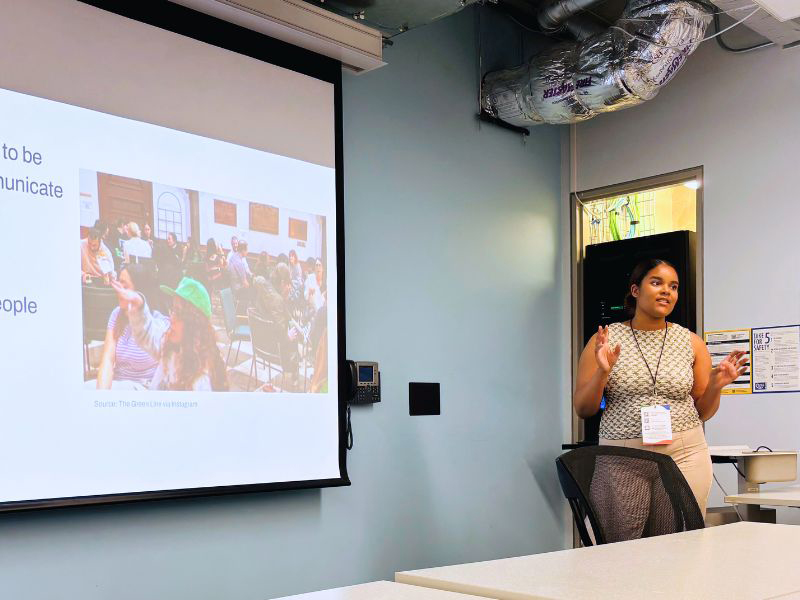
“Leading up to the presentation, I was really nervous, because I'd never been in a space like that before,” she said. “But the research that I did was honestly very engaging, I felt really connected to it.”
The conference was held at George Brown College in downtown Toronto. This year’s theme was “Reframing Togetherness,” which CCA describes as an intentional response to increasing polarization and the rise in echo chambers fueling confirmation bias.
“As a research assistant, and not a main principal investigator, I felt like I got really good networking. Just meeting all of these other professors and PhD candidates was really awesome,” Lochan-Aristide said.
She says the conference opened her up to other possibilities in journalism aside from solely being a journalist.
“The biggest thing that stuck with me is this new level of inspiration that I have for research,” Lochan-Aristide said.
She says she’s now looking into potentially pursuing a master’s focusing on journalism and research.
“I think everybody should get the opportunity to attend something like that. It's nice to be in a room with like-minded individuals who also share your passion,” she added.
Aia Jaber, a first-year graduate student, worked as a research assistant at the Engaged Journalism conference and also attended the “Reporting news in a disbelieving age: standards of practice amid the crisis in journalism's credibility” colloquium.
The two events, she says, were completely different but both equally important.
Held in The Venn at the Rogers Communications Centre, the Engaged Journalism conference hosted a group of Canadian academics, designers, educators and non-profits exploring the use of games to engage audiences with issues related to media literacy, misinformation and polarization.
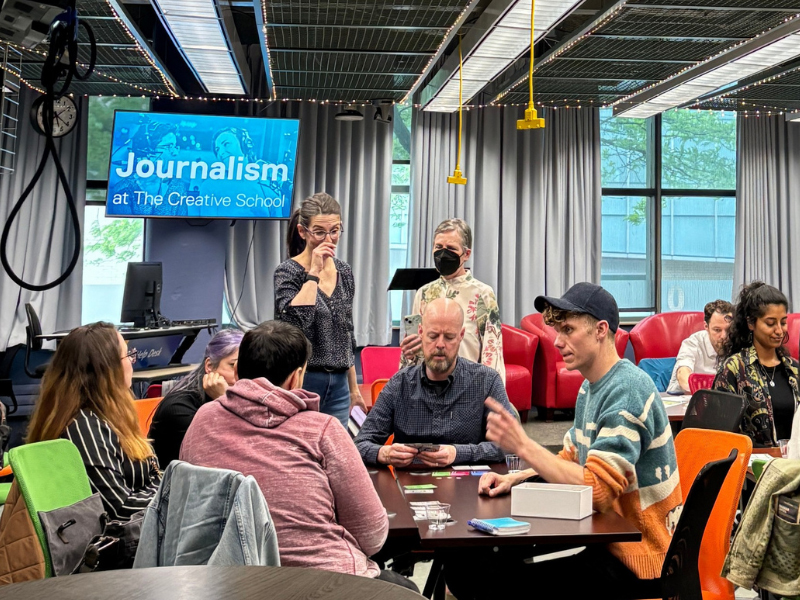
Attendees got to try their hand at innovative games designed to develop critical thinking and agency in the digital information ecosystem.
The conference, Jaber says, focused on how to “steer journalism in a way where it gives back and informs and includes people in the community, as opposed to the whole discussion of objectivity.”
She says she not only left with better connections with professors and people in her classes but meeting like-minded people gave her hope that journalism could be changing in a way that better serves its communities.
The colloquium, which was hosted at the George Vari Engineering and Computing Centre, had a different atmosphere and demographic with the conversation centred around traditional journalism instead, Jaber said.
Ivor Shapiro, scholar in residence at the Centre For Free Expression at The Creative School, led the effort of putting it together.
He explains that it was held to form a consensus on the foundational standards that define news reporting and set it apart from other kinds of communication.
Shapiro said the team spent about a year coming up with themes in codes of conduct for journalists that different organisations have.
Then, they invited scholars, journalists, lawyers, policy people and advocates to the colloquium to discuss a long list of standards, and see how many are controversial.
An example of a news standard where there was no disagreement Shapiro says is, “if you make a factual error, you correct it.”
“So the question is, if that's one, are there any others, and how do you discover what they are?”
By the end of this project, Shapiro hopes to have a defining list of news standards to offer organizations.
Jaber says despite being nervous at first and questioning whether she belongs in this space, she was able to find people that resonated with her through the panels and discussions at the colloquium.
“That was what the colloquium was about, bringing people together to discuss candidly the areas of agreement and disagreement around the standards of journalism,” said Shapiro.
Jaber says she took a notebook with her and kept scribbling ideas for her master’s research paper, alongside potential research ideas if she chose to complete a PhD.
“Now that I've been in that space, I don't want to leave that space,” said Jaber. “I was sitting during the colloquium and I was like, ‘how do I get myself invited next year?’”
Jaber encourages everyone to take advantage of these free conferences. “We get so caught up in bylines … in name or reputation or legacy media that we fail to realize that part of what makes us journalists is research. So being in a space where you have journalists, where you have lawyers, where you have a judge, where you have researchers or professors or whatever the case is, really helps you see the larger scope of what you're doing.”
With files from Julia Lawrence.