‘The little memoir that could’: Q&A with author Rachel Phan
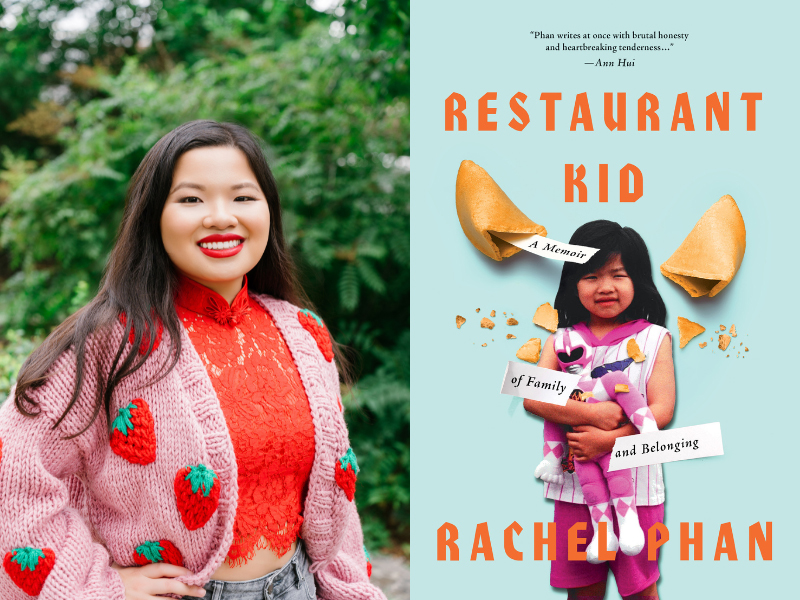
Rachel Phan (‘13) has published her first-ever book, “Restaurant Kid (external link) .”
This intergenerational dialogue dives into Phan’s childhood, where she felt a constant yearning for love and attention from restaurateur parents, who seemed so distant despite being in the same room.
Journalism at The Creative School sat down with Phan to learn more about her writing journey and family dynamics.
This interview has been edited for clarity and length.
How did you choose to look at Rachel in the book as a separate person from yourself now?
Having never written a book before and a lot of the writing I've done previously was creative nonfiction, so I always saw myself as the person I was writing about, because I am.
It wasn't until I had a conversation with my agent who said, “Yes, it is your life, and yes, you are writing about Rachel, but Rachel is a separate character from you. That is not the you of today, this is a Rachel who existed in the past, and you should treat her as a character.”
That kind of blew my mind, it gave me the chance to look outside of myself a bit and zoom out.
I think there is a temptation to apply my adult self to what younger Rachel was going through, and to add more of that adult lens to what I was writing.
So, treating it as a separate character for me just gave me more freedom to explore what little Rachel was going through, what she was thinking. Even if I'm cringing as an adult…it serves the narrative, because that is what younger Rachel was thinking and doing. Adult Rachel is face-palming, but you need to get through the cringe to get to adult Rachel.
What was it like going from writing personal essays to writing a book?
It wasn't until the pandemic started that I was seeing more people share personal essays, especially when there was a rise in anti-Asian hate crimes.
I felt the need to write something and to start putting myself out there. I did that in bits and pieces, little essays here and there.
When I suddenly got this book deal, all the impostor syndrome came back.
I've spent the past decade writing communications for different organizations, this is not what I felt capable of doing.
It wasn't until I had so many pep talks with my agent, who just reassured me, “You have a story and a voice worth sharing.”
What did you take away from writing this book?
The three things that I wanted to take away were, one, I wanted to prove to myself that I could do it. Two, I wanted to find a way to connect with my family on a deeper level. Three, I wanted to foster healing and actual discussion within my family.
I did all three of those things.
The greatest gift for me was it did spark a lot of healing for my family, and I came away feeling like I know who my parents are.
Because a big theme through my book is that I grew up with parents who were constantly working at our restaurant. Even though they were five steps away from me, they were always so distant I couldn't reach them because they were always focused on working.
I always said one day I'm going to take them back to Vietnam, where they were born and raised, and I'm going to find out all these answers to these questions I have.
But then one day turned into next week, six months from now and then years went by. I was afraid to open old wounds because my parents grew up during a time of war, talking about their past and being boat people and landing in a country that was completely foreign to them.
It was a lot of hard years and lots of sacrifices that they had to make, and I didn't want to have those conversations and see them hurting. So, I just put it off forever.
With this book, I suddenly was contractually obligated to ask those questions. And I did.
We went back to Vietnam, and it was the greatest gift having the chance to talk about things that we had just repressed and kept silent about for years, and that we probably would have never talked about.
What was it like sitting down with your parents during the writing process?
I ended up having multiple interviews with each person in my family and recording it. The beautiful thing about that was that my family didn't shut me out once.
They never once said, “No, you don't need to know that. I don't want to share.”
For me, it was really eye-opening. I realized so much of the early chapters of my book are feeling unlovable or there was something wrong with me because I wasn't getting the time and attention from my parents and my siblings that I was desperately craving, because they were so focused on working.
My mom never talks about her time growing up in Vietnam because it's so traumatic, she started sharing as best as she could. It was heartwarming for me, I realized, these are people who want to know me back.
I think it makes for an even more satisfying arc in the book. Rachel, in those early chapters, is just so confused about, “Why don't my parents have time for me? Why am I always second place?”
Then it shifts from those big questions and the loneliness I felt and the yearning to actually sitting down as an adult and being able to understand the decisions they made, why them working all the time was actually an expression of their love.
How was the experience of giving your parents the book? How did the language barrier affect this moment?
I always say that this is the most heartbreaking part of the experience. I wrote my book as a love letter for my parents, and they will never really be able to read it because it’s in English.
My dad can read English, but he’ll miss a lot of the nuances, and my mom just isn’t able to at all.
So for them, holding it and seeing the photos has to be enough, and it is. They tell me multiple times, “We're so proud of you, Rachel.” They're selling the book at the restaurant. They have me in the newspaper laminated at the restaurant.
My dad is slowly [reading], he's like, “I started reading the first page, but I couldn't stop crying, so I haven't been able to read more.” And then my mom said, “Rachel, I'm really sorry that I can't read it,” which broke my heart.
Although there are some chapters that I'm kind of glad they can't read.
What has the response been like since publishing?
I am so overwhelmed with gratitude and awe at how much people are rallying around my book. As a writer and author, you never know how what you create is going to be received, and you put so much of yourself out there.
I was really scared. What if I poured all my life's trauma, and put so much of myself on this page, and then it's just crickets?
I felt like this is a little memoir that could. I feel like it's because people are seeing themselves reflected in a way that they maybe never have before.
A lot of the feedback I've gotten, overwhelmingly, is people saying that it's just so raw and unflinching, like it takes a look at the reality for Third Culture Kids, members of the Asian Canadian diaspora. I'm not afraid to go there or and I'm not sugar coating what that reality is.
I talk very candidly about my exploration of my sexuality and the ways that I've been fetishized throughout my life. Asian women specifically are so used to being fetishized and sexualized, but we're also expected not to talk about it.
I'm glad that I was like, “You know what? I'm going to air my really dirty laundry.” It's seen as shameful or taboo, but I'm always here to drag bad men, and I'm always here to be a messy protagonist, because that's human.
You mention community a lot. What would you like to say to your support system?
I had a year to write my book, and I think I ended up actually writing it in about three to four months. For the first part of that year, I was stuck in my own impostor syndrome and self-sabotage and I think a big part of that was because I hadn't built out my writing community yet, so I was really doing it on my own.
It wasn't until my publisher encouraged me to go on social media, because I hadn't had social media in nine years, it was a whole new world for me.
It gave me access to all these other authors who were debuting in 2025 and helped me meet so many aspiring authors, debut authors, established authors. I really noticed a difference, I felt more capable and supported.
Thank you, my community, for giving me the life and the energy I needed to keep going, because otherwise I would have burnt out a long time ago.