Two Master of Journalism Students Win RTDNF Scholarships
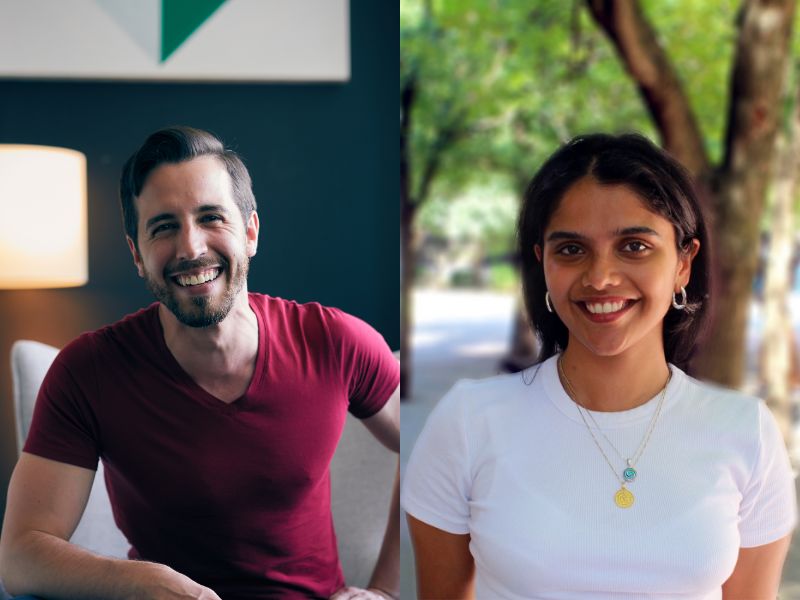
Mark Henick (left) and Sahaana Ranganathan (right) both received their masters from the School of Journalism this spring
Sahaana Ranganathan and Mark Henick won awards for their exceptional work in radio documentary and interviewing diving into the ethical responsibilities of journalists.
Henick worked on an episode for the Dear Journalist podcast (external link) at the Review of Journalism (external link) , which earned him the CBC/Barbara Frum Scholarship, recognizing students' work in interviewing.
He talked with veteran journalist Kevin Newman, former host of W5 and anchor at the Global National. He explored what Newman learned in his decades of on-the-ground journalism experience that he could then offer back to aspiring journalists.
One of the main lessons Newman shared with Henick was the importance of empathy.
He told him, “Never forget how you treat people matters.”
Newman explained that journalists must be aware of how they’re treating their sources and audience. “The real world isn’t a textbook, it's not a classroom and you gotta figure that out.”
Something Newman told him that is important for journalists early on in their career is that, “it all comes down to how you can sleep at night.”
It’s about getting into journalism for the right reasons, Henick added. “Do you want to get into the line of work that is gotcha journalism just for clicks, or do you want to get in there and tell real stories and hold people accountable to tell the truth?”

Sahaana Ranganathan (right) and co-producer of the podcast, Mariana Schuetze Andrade (left), recording their podcast episode. (Photo courtesy of Ranganathan)
Ranganathan won the JJ Richards Scholarship for Best Radio Documentary for her episode on the Reviewed podcast (external link) , “Language Matters when Reporting on Palestine.”
As part of the Review of Journalism, Ranganathan said, students are tasked with critically analyzing pieces of journalism, the potential implications of framing and why certain decisions are made.
She and her co-producers, Mariana Schuetze and Lidia Rajcan, felt that context was being left out in the language that big news publications were using, which was leading to misunderstandings of the actual situation.
“I was really frustrated and disappointed on a lot of the reporting when it came to Palestine. There was a lot of nuance missing,” she said.
On the episode, they invited Mount Royal University sociology professor, Muhannad Ayyash, and journalist Pacinthe Mattar to discuss how discourse is related to oppression and how objectivity can be weaponized in the newsroom.
Part of making this episode, Ranganathan says, was to explain to non-journalists the way language influences how we perceive things and why journalists need to be responsible in their use of language.
Marsha Barber, professor and graduate program director at the School of Journalism, expressed pride in the accomplishments of Henick and Ranganathan. “This highlights the strengths of our program in giving students a strong foundation and a wide range of opportunities as they move forward with their journalistic careers,” she said.
Congratulating the two winners, School of Journalism chair Ravindra Mohabeer, said, “The work of Mark and Sahaana exemplify how, in two short years, the MJ program at TMU allows students to build on their experiences and backgrounds to accelerate their pathway toward being recognized and impactful professional journalists.”
Looking back on their experiences, both Henick and Ranganathan shared advice for students entering the field of journalism.
Ranganathan said, “I think when you challenge yourself to meet your own expectations, that's when you start producing journalism that you personally are proud of.”
Henick stressed the importance of resilience. “It’s tough out there, but that’s okay, because you're tougher.”
At the end of the day, “It’s not about the awards, it’s about doing good work.”