Invisibility from a social perspective: Q&A with Chair Ravindra Mohabeer on his award-winning paper
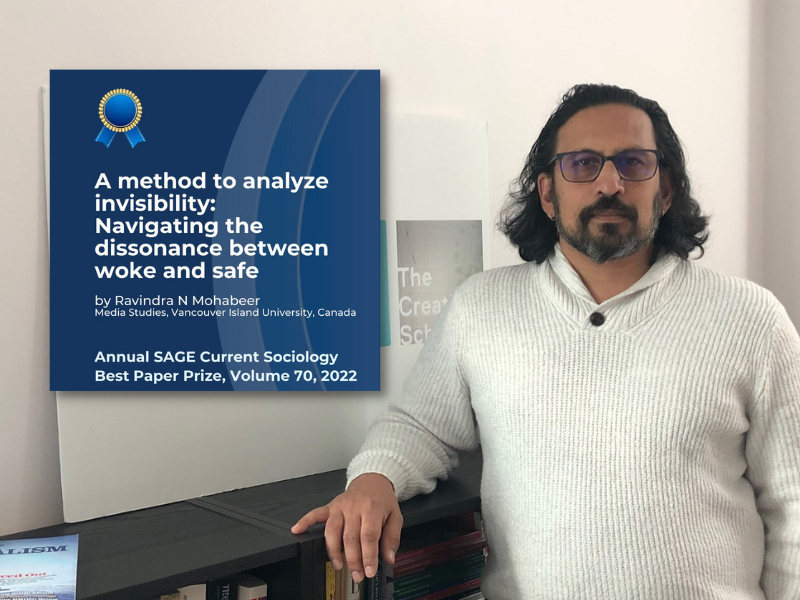
Exploring invisibility has given Ravindra Mohabeer some unexpected visibility.
A scholarly article examining invisibility as a social rather than only a physical phenomenon, authored by the chair of the School of Journalism has been awarded 2022 Best Paper published in the journal, Current Sociology.
Mohabeer explores invisibility as a social rather than just physical phenomenon in his paper (external link) called "A method to analyze invisibility: Navigating the dissonance between woke and safe (external link) ,"
"If we move beyond the idea of invisibility as something that is exclusively about seeing things (or not), we can start to explore how some things that we do see can also be invisible to us because we don't care, they don't have the power to control their own narrative, or a voice to express themselves and are spoken for rather than speaking for themselves," says Mohabeer.
We asked Mohabeer some questions about his award-winning paper, and here is what he had to say.
How did it feel to win the award?
It was a great honour to receive this award. Even more because of how many versions and revisions I went through to write the paper, sitting on it for years before mustering the courage to submit it to this journal. It represents an idea that I've been playing with for more than a decade and to be told that it was seen as important and valued is both humbling and deeply meaningful to me. Plus, who doesn't like to win something. It's nice because I didn't even know that there was an award possible and I did this work because it was important to me and I wanted to share it with others. Winning this first edition of the award is amazing.
Why are competitions like the "Annual SAGE Current Sociology Best Paper Prize" so important to you/others?
Best paper awards that academic journals and associations, and in journalism, that industry bodies and others give out are important because they recognize work that often happens in isolation, and is less directly recognized day-to-day. Being nominated is a recognition that the work we devote ourselves to matters. Winning an award like this helps you feel like your idea is impactful and is seen and appreciated by others. But, to me, it also acknowledges everyone who does this kind of work whether or not they win. It's a very nice way to acknowledge that most academic publishing is done 'for free,' that is, it is a part of your job if you are lucky enough to be a wage-earning academic worker, and off the side of your desk if you are not. Editors of journals equally do it as service to their discipline and rarely get paid much if at all to do that work. These kinds of awards are great for the people who win them but they reflect the whole backbone of sharing ideas and trying to keep the world thinking and exploring and is a special opportunity that we get to which not everyone always has access.
How would you say invisibility plays a role in the social construct of the world?
As we navigate the world, some things come to our attention, and other things don't. But how and why? In this paper, I was thinking about how invisibility is an intersection of seeing, feeling, power, and voice and that whether or not something is socially invisible changes depending on context (time and place). In this way, you can imagine the idea of looking through some people, perhaps like the unhoused. Sure they are visible in a physical sense but they are socially and often structurally powerless, often voiceless in public discourse, and they are often people who come in and out of our collective care. On the other hand, if you think about the idea of the economy, we see money being spent but the bigger picture, the whole system, that's almost invisible (unseeable). Despite being invisible, the economy impacts everything we do and is powerful despite being unseen.
Why is it important to look at the topic of invisibility and the role it plays in a social dynamic?
Thinking about invisibility in the way that I proposed allows us to navigate a new way to imagine how and why people and things come to matter. It helps us think about a lot of different things in our lives and ask why some of them are more present than others, and why some of them are more important and others less. It does so by forcing us to think about everything as always at an intersection of ways of knowing. As a parallel example, you might imagine the value of thinking about invisibility by thinking about how being seen - being visible - is not the opposite of being invisible. The more something is hyper-visible, everywhere, all the time, in your face, the less likely it is that you can actually see it in a nuanced way. Hypervisibility is its own form of being invisible because being hypervisible often comes at the expense of being able to control (exercise your own power) or construct your own narrative (voice), or encourage people how to feel about you. You can see that with some celebrities who, once they become known for one thing, often can't change tracks and try something new. If you go to a concert for a prominent artist, for example, their hypervisibility makes it almost impossible for them to try out new material or do something different without their fans saying "play us your hits, that's why we paid to be here!" That shows that the more visible you are, sometimes the more invisible you become.
What impact does your research have?
Impact of academic work is hard to measure in the short term. My hope is that exploring invisibility as a complicated question adds a critical thinking lens that we can apply to a wide range of subjects. I haven't yet found a field or discipline where I can't think through at least some ideas using this framework. It sometimes helps explain 'that missing piece' people struggle with because of its layered approach. But, to be fair, as an academic, I have the luxury to play with ideas and sometimes that luxury is best realized as being able to share something you've been working on that might help other people reconsider what they are working on or how they are doing it. Many people measure academic impact by way of citations or other familiar metrics. For me, I just hope that this helps somebody work out an explanation that has eluded them.
What advice would you give to journalism students looking to explore topics like this at a sociological level?
The funny thing is that I am not a sociologist by training even if I often take an interdisciplinary sociological approach. To link this work to the social dimensions of journalism, it is always key to understand what is at the heart of your story. Most people will be able to see the obvious layer(s). Hopefully taking an approach like this, one where you really and truly can ask a multilayered set of questions will help you see your story as always an intersection of many things happening at once even if it's easiest to focus on the most obvious ones. Such intersections are where new angles or deep hooks can come from. Sure, your story you can tell us what you saw, but perhaps this helps you prioritize why we care (or should care), who's voice is present (or made absent), and how that all comes to pass (power and control). It's never a bad thing to see the same story as everyone else, but in deeper and more nuanced and complex ways.
What will you be working on next?
On the invisibility front, I have been playing with a few ideas for some years now. One is a book-length project tentatively called "Invisible Inc.: The art of selling something as nothing." It considers 'indispensability' as a core design principle where businesses want their products to melt into the fabric of how you live (like automatically reaching for your phone but never actually seeing the phone itself, just the experiences that it offers). This makes products invisible, not seeable. They are always physically there but so deeply embedded in our lives that they become invisible by way of being patterned into our worldview.
The other project that I am considering re-visits the idea of participatory-action-approach around the idea of community-based journalism. I hope that it can build on the negotiation of invisibility as a platform to imagine new models of making more stories come to matter in ethical and deep ways. That work is not 'new' since many people have done it before and in different ways. I'd like to see how it could work here.
Complex ideas take time to develop
Mohabeer concludes that some complex ideas take different amounts of time and attention to develop than others, but he adds that this does not make them any less critical.
"Along the way, you have to share these ideas a lot before they are fully formed and equally important to thank the people who helped you interrogate them before they are ready to be shared widely. I'm always appreciative of the many people who helped me work through this idea, including scores of students and colleagues along the way," says Mohabeer.