The language of all journalists: alumni create a new fact-checking guide
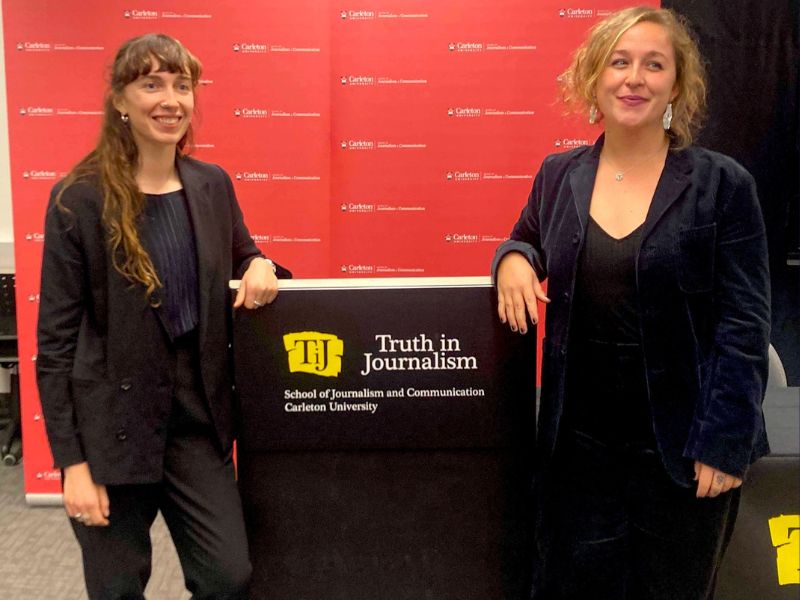
Vivianne Fairbank and Allison Baker at the Truth in Journalism conference in October.
For the past year and a half, two journalism school alumni have been working on a new interdisciplinary guideline for journalists fact-checking.
Allison Baker ‘16 and Viviane Fairbank ‘16 have just launched The Truth in Journalism Fact-Checking Guide (external link) that navigated best practices for ethical situations and how journalism practices can address truth, accuracy and verification.
The beginning
The project started when Fairbank and Baker were working at The Walrus in research at different times.
"While Vivian was the head of research over the course of like 2017, and 2019, she sort of set the standard of the Walrus' fact-checking process," says Baker.
The Walrus is one of the few publications in Canada, which fact checks all of its content in print and online. While Fairbanks was head of research, she wrote the initial fact-checking guide, which she and Baker used as the foundation of the fact-checking guide they have released.
"I was a fellow at The Walrus when Viv was head of research; we worked together in fact-checking capacities after that and before that, as well,” says Baker. “We talked about all these ethical implications of fact-checking and the challenges that come with (following) a standard set of rules with every story."
What they wondered was whether standards could be set for fact-checking stories on a case-by-case basis.
"How you fact-check a story about sexual violence, for example, isn't the same way that you'd fact-check a story about a politician. And the approaches should be different," says Baker.
When Fairbank created the initial fact-checking guide at The Walrus, she worked with several consultants to establish a precedent for a standard of verification and methodology for the magazine.
Baker and Fairbank took the guide further by examining the ethical challenges of the verification process.
Bringing together the research methods
The fact-checking guide introduces new ideas, but Fairbank says that the guide also includes a general methodology of fact-checking stories, which magazines have used for decades.
"It's not like we created it from scratch; there are like these general practices that are out there," says Fairbank.
Eight principles structure the guide.
"The first principle, for example, is that you should always be thinking of there being two layers on top of the fact before it can be published. So the first layer is that you've recorded it. And the second layer is that you verified it, and like, you should never kind of end up publishing something that has only one of those layers," says Fairbank.
Fairbank also says that the guide builds on the ideas already in practice but are only sometimes discussed.
"I think we made explicit ideas that were already in the practice, but just like weren't being talked about," says Fairbank.
They have borrowed research concepts from other fields into journalism to create a methodology.
"This is stuff that other fields have been thinking about and talking about a lot, or people in other fields have been thinking about and talking about a lot and have established practices, and we sort of just brought it or tried to bring it all together," says Baker.
The authors contacted more than 60 journalists, journalism scholars and non-journalists to discuss research practices.
Fairbank says that fact checkers struggle with speaking to those who experienced trauma, so they've reached out to experts who helped them come up with methods to talk to victims of trauma.
"What we found really helpful was actually going to speak with people who work in sociology or social psychology, or who are used to conducting those interviews, but who just aren't journalists. And so they actually have all the answers basically, already for us. It's just that journalists don't use them yet," says Fairbank.
What makes a "good" journalist
They found other disciplines value ‘integrity’ and so, that is emphasized in their guide, along with accuracy and transparency.
"I think those are the three tenants that make good journalism," says Baker.
As for Fairbank, she says verification is key to being a journalist.
"You can't report something without verifying it and call yourself a journalist. So, what the journalist does, that other domains might not, is this idea that they're gonna have those two layers, and they're gonna go back and make sure what they're publishing is accurate,” says Fairbank.
Challenges
Baker says one of the main challenges creating the guide was recognizing the limitations of the guide itself.
"You will always be picking and choosing what you focus on, and you just need to acknowledge the limitations of your knowledge, as I was saying, and of your resources and things like that. So I think just acknowledging our limitations while also trying to include as much as possible," says Baker.
Advice for up-and-coming journalists
Baker says her advice to aspiring journalists is to ask questions and always keep learning.
"I think, never being afraid to ask questions, also never feeling like, wow, everybody knows what they're doing, and I don't know, you know. I think we should all be in a constant state of learning," says Baker.
Fairbank says that student journalists should question what kind of reporter they want to be and take their time to figure out answers to their questions.
"What part of the industry do I actually want to work in? Do I want to be fast paced? Or not? Do I want to work with marginalized communities? Or do I want to report on people with power? Like, are these things that actually define your practice? It's okay if you don't know the answer," says Fairbank.
Baker adds the reality is that learning never stops.
"We don't know a lot either, you know, and the people who are more senior to us also are in the same position, like everybody is always learning, and everybody has a limitation to what they can know," says Baker.