The Journalism Research Centre launches a new, long-form, digital magazine: The Otter
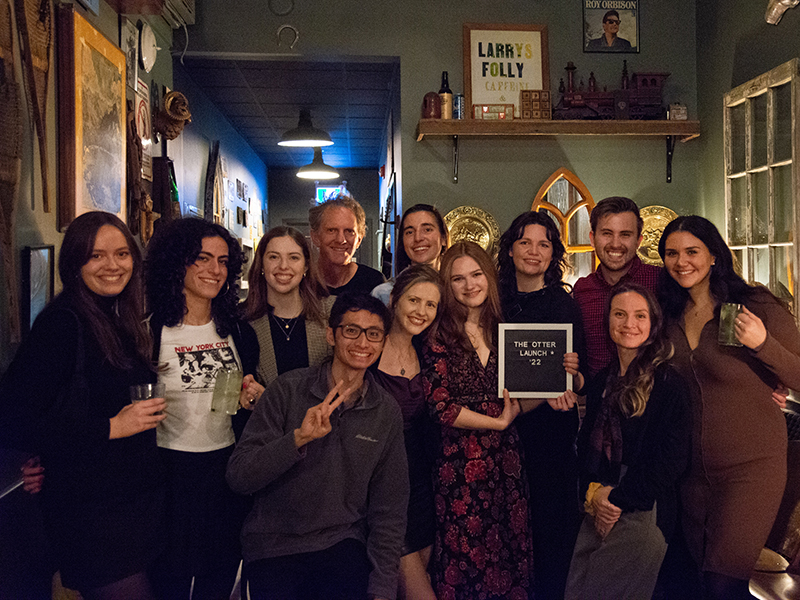
The Otter’s masthead had their launch party on Monday November 14 in Toronto (The Otter/Aloysius Wong)
Professor Bill Reynolds has always been disappointed to see his students write a feature from scratch but only sometimes land in magazines.
When Rachel DeGasperis and Maighdlin Mahoney took Reynolds' narrative journalism class they, too, wanted to see more student articles get published.
Mahoney recalls the coffee meeting with Reynolds in August to discuss the idea of creating a new digital magazine for master students to publish their work.
"He got there early, and when I sat down, he had written out all these ideas on a little pad of paper. He's a very analog guy. And he was like, I've been thinking about this online magazine, and it's been an idea of mine for years. But I think that we should do it," says Mahoney.
The Otter, a digital magazine, was launched in November by the Journalism Research Center at Toronto Metropolitan University. The magazine consists of a volunteer masthead of master students at TMU.
DeGasperis and Mahoney are co-editors at the Otter and second-year master journalism students at TMU.
How it all came together
Professor Reynolds says while he initially came up with the idea with his narrative journalism graduate class, it took structure to get the ideas going.
"In mid-August, we started meetings, and we decided that there would be meetings every once a week," says Reynolds.
The Otter's team also consulted with Luc Rinaldi, a senior editor at Toronto Life and j-school alum. Reynolds says that Rinaldi agreed to be a consultant under one condition.
"He said, okay, I'll be part of your project; I'll be a consultant. But these stories have to be fact-checked if they're going to go into the real world," says Reynolds.
The Otter also needed a libel lawyer, so Reynolds contacted Ryder Gilliland, who agreed to help.
"You might not see legal issues with stories because your mind isn't trained to look at legal issues as a writer or as an editor. But yeah, libel lawyers, that's what their job is to look at something," Reynolds says.
Everyone on the masthead of the Otter knew which roles they wanted.
"So basically, what we did was we started from nothing except an idea. And then we thought, Well, what do you have to do? Well, we have to form a magazine masthead, right? Okay. So we have to decide who's going to be what And, you know, that just kind of was a natural evolution of two or three or four weeks maybe where everybody kind of dropped into their roles," says Reynolds.
Reynolds says that The Otter was indeed a student-driven project, especially regarding fact-checking.
"When we had our first meeting, you know, and Luc [Rinaldi] said, "Well, I'll be part of this, but you have to have fact-checking; otherwise, it won't work." In that meeting, there was a point where I looked at everybody and said, I'm not doing this. You're doing this. And everybody kind of looked at me, and I said, Yeah, you're doing it. I'm not doing it. I have other things to do. So I think that was a cool message for them to receive right off the bat. It really is their project. I'm the consultant. I'm the person who's setting it up and saying, but you know, I'm not going to tell him how to think," says Reynolds.
Reynolds says that the students behind the Otter impressed him with how far they've come.
"We're talking under three months, they pulled this off, and their confidence level and their ability level, I think, grew at a pretty quick pace through that. So as you know, that's a credit to them. I'm proud of them. And I think they did a great job. And they're gonna keep doing a great job," says Reynolds.
Mahoney says that the success of The Otter comes from excitement, collaboration and dedication.
"We all know each other on the masthead and we collaborate all the time for classes and stuff like that. But it's been really cool and exciting to see how excited everybody is to collaborate on this thing that is optional, I guess. We don't have to be doing this," says Mahoney.
The mission of The Otter
Mahoney says that The Otter publishes long-form journalism on topics that aren't always covered in prominent magazines.
"I hope that what makes us unique is making a place for pieces that are unique and cool and not necessarily what you would expect," says Mahoney.
DeGasperis says that The Otter allows writers to create stories while preserving their voices.
"I think what we really want to brace is that all of our pieces will be long-form narrative journalism, but the writer's voice won't get lost. They'll have their own unique way of telling stories," says DeGasperis.
DeGasperis also says that the mission of The Otter is keeping it going and not lose the momentum built up thus far.
"I think a mission is to keep young journalists just really engaged in it and excited that they do get to be published in this digital magazine, and that they do get to tell stories that way they want to tell them," says DeGasperis
DeGasperis wrote a story about sugar babies (external link) . She recalls how she was attached to her story since she witnessed her friend Veronica going through the world of sugar babies.
"A lot of these girls are doing it either because they really just need the money, which is concerning, or they're doing it because it is giving them some sort of false sense of empowerment, and in the end, a lot of them wind up in a lot of dangerous situations. And so I think that it needed to be looked at with care," says DeGasperis.
One of Mahoney's pieces on the Otter is about fashion in the metaverse (external link) . Mahoney says that the goal of writing the piece was to find a balance between something in the news and something that can be poked fun at.
"I don't think I had had that many chances to write something that long before in terms of a journalism piece. So it was cool to just get to really dive into all the nuances of it. It's just fun. You're like, well, I can talk about every part of this and kind of come to my conclusion about how I want to present it based on all of this information and months of research and I really enjoyed that part of it," says Mahoney.
Sustainability and the future of The Otter
For Reynolds now, he says the tricky part is sustainability and the logistics behind keeping a digital magazine alive.
"Could we get other journalism schools in Canada interested? Could we get other journalism schools in North America interested? Could we get other journalism schools in South America, Australia, and Europe interested?" says Reynolds.
Reynolds is currently the director of the Journalism Research Centre. He is involved in the International Association for Literary Journalism Studies (external link) (IALJS) through which he has many colleagues who can potentially contribute to the Otter.
Reynolds, DeGasperis and Mahoney are proposing to present at the annual conference for IALJS where Reynolds says he hopes to introduce the Otter to journalists worldwide.
Mahoney says that she and DeGasperis are thinking of what the handoff of the Otter would look like to the next masthead, which she says is a big challenge they will face.
Challenges the masthead faced
"We're starting to think about what handoff would look in terms of how we would kind of pass things off to a new masthead," says Mahoney.
DeGasperis says she's concerned about a lack of interest or dynamic among the future mastheads.
"What if, next year, students aren't as interested? Or maybe what if they don't work as well together and don't have the same motivation to keep it going? If they don't really enjoy the process of putting it together?" says DeGasperis.
For DeGasperis, she says that the biggest challenge was communication among all the members of the masthead.
"I think we're still kind of finding our footing, and we're making some mistakes along the way. But I think that the more we do it, hopefully, the easier it will get and the more natural it will feel, and we'll sort of figure out exactly how we should be doing things," says DeGasperis.
DeGasperis also says that scheduling meetings was the most challenging part.
"We're all bouncing around all over the place and the meetings that we have to have are Friday morning at 9 am, which is not an ideal time to get a bunch of sleepy overworked students together. But it's the only time that really works for everyone's schedule," says DeGasperis.
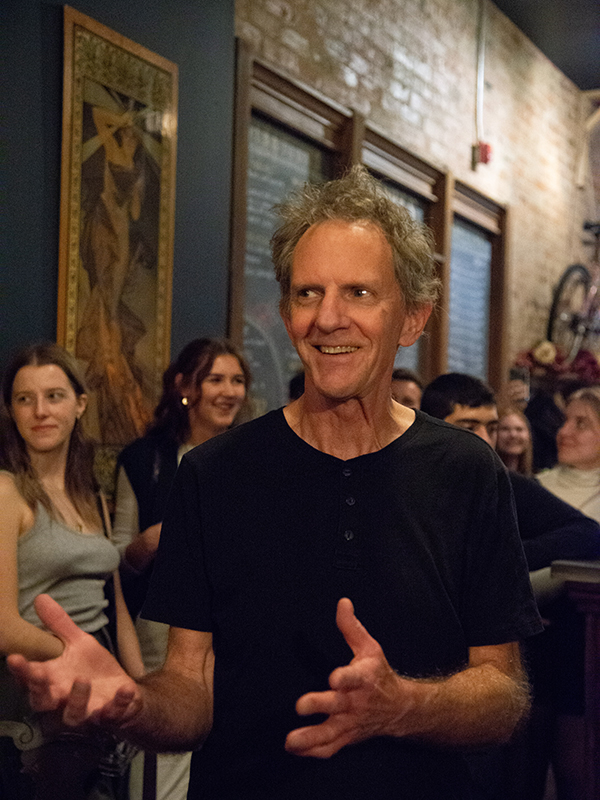
Prof. Bill Reynolds at the launch party for The Otter (The Otter/Aloysius Wong).