‘Art is founded on human connection’: Q&A with fourth-year Sahara Mehdi, author of “Love Letters to Myself”
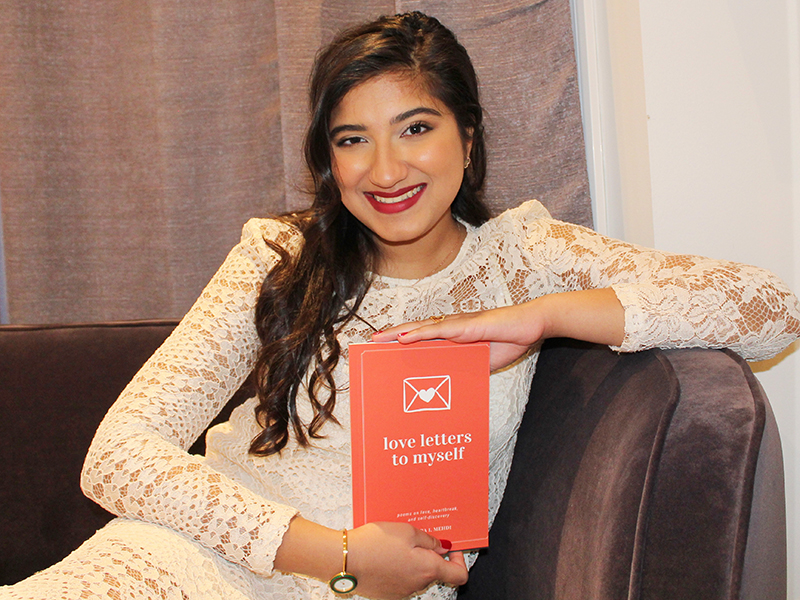
Fourth-year student and author Sahara Mehdi (external link) ’s poetry book “Love Letters to Myself (external link) ” follows a storyline of love, heartbreak and self-discovery. Although this self-love project started when Mehdi was in her grade 12 creative writing class, she’s spent almost 40 per cent of her degree writing and editing this poetry anthology.
How did “Love Letters to Myself” come to be?
I actually started out when I was in high school, in grade 12 I did a creative writing course and our final project was to create some sort of anthology. I thought of the title “Love Letters to Myself” and it really stuck with me. When it came to a point, where last year when I was thinking about putting this together, again, I think I had been wanting to put out like a really large anthology of all my poetry. But then I was given the opportunity through a contest to do a short one. So, I thought if it was going to be a very short book that I would want it to be a cohesive theme, and I wanted to have kind of like a narrative arc through the poems. I thought focusing on love, heartbreak and self-discovery would be a really good thru line to have. And then that’s kind of where I thought the title would work really well and then I started figuring out which ones go where, what the order would be and that’s kind of how it came to be.
What was the process like for deciding which poems to include?
It was a grueling process because I write a lot. So, I think I started out with 45 to 50 poems that I was like these could work and again, I really wanted it to be a narrative arc kind of through it. I wanted you to feel like you were going on a journey with these poems. I basically had three sections, the falling in love phase then the breaking up phrase and the finding yourself phrase. That’s how I aligned it in my head and then I organized all my poems into those groups. Then one of my best friends, Yasmin, who’s known me probably six or seven years now since I started writing poetry came over one day and we literally read all of them, like all 50. She would rank each one out of 10 and then I just picked the ones she liked the most. I think I get so attached to the memories I have associated with each poem, so, it’s not very easy for me to decide which ones are objectively good. Yasmine’s very honest, so it was really helpful to have her be like, ‘this one needs to be in it and this one doesnt.’ So that’s kind of how I did it.
How was it working on this project while being in school?
I think it was kind of odd, because it was like, my journalism courses are juxtaposed with me going through like this really, like an emotional period of my life. So I think it was nice because I had an outlet, separate from school, to kind of just blurt out everything I was feeling on a page and not have to worry about whether it made sense or whether it was factual or whether it was backed by any information. I think that's part of the reason why I like journalism is because it's not based on me. I think poetry can be really vulnerable and it's good to do sometimes to kind of get your emotions out and kind of process things.
What has support from readers been like so far?
I think when I was younger, I always imagined myself going through a big publishing house and that was the dream. I pitched to a lot of them last year, and it’s obviously a very difficult industry and especially for poetry it doesn’t sell very well, not a lot of people are interested. So, when I had the opportunity to self-publish, I was kind of like, ‘okay, I’m going to have to market this myself and I’m not really expecting it to get a lot of people interested.’
So when the response was overwhelmingly kind, I was really surprised because I wasn’t expecting it. It was just crazy, it went number one in its genre in the first week. But I think the best part about it for me has been, there have been a couple of younger girls aged 10 to 12 who have reached out or whose parents have reached out and are like, ‘my daughter read the book and she really liked it, you really inspired her.’ That made me cry my eyes out because that was kind of like, I’ve always wanted to have that in mind. Because when I was younger, writing didn’t seem like an actual profession, to me it seemed like a dream job like being on Disney Channel. It didn’t seem like real people did it, so the fact that there could be younger kids who read my work and are like, ‘oh that’s cool, I want to try this,’ that was the best part.
How did you find out you reached #1 in Literary Letters and Correspondence on Amazon?
I remember I was on FaceTime with my uncle and my aunt, and my uncle was like, ‘oh, yeah, it’s number one,’ and I thought he was joking because he always is like, ‘yeah, you’re gonna be famous one day,’ and I was like ‘that’s great.’ He’s like, ‘no, literally, I checked last night I was on it, we hit it,’ and it was just such a surreal moment.
What advice would you give someone wanting to get into writing?
I think my advice would be to be vulnerable. I think that’s something that like growing up I’ve always been very emotional and I think for a long time I thought that was a flaw. But writing and poetry specifically has allowed it to make it my superpower in a way. I think my advice to anyone who wants to get into writing would just be to leave it all on the page and you can always edit it later if you don’t feel comfortable. But I think vulnerability is the greatest thing to work on as a writer because it allows people to connect to you and to your work. And just art in general, I think that art is founded on human connection and so I think the more you allow yourself to connect to people out there who could be seeing your work the better your work will get.
Where is your work headed in the future?
I feel like recently my writing has kind of been leading to exploring more of my heritage, and my culture. I think that's something that as I've grown older, I've kind of got out of that phase, like writing about every crush I've ever had, and more exploring, like my identity and like my family's history. So I think it'd be really interesting to kind of focus on that, especially because, in the last couple of years, there's been a few South Asian or brown Desi poets who have been kind of talking about like, the diaspora and things like that, that I find myself kind of leaning towards a lot more. So I think that would be something I'd really like to focus on in the future.