Remembering John Honderich
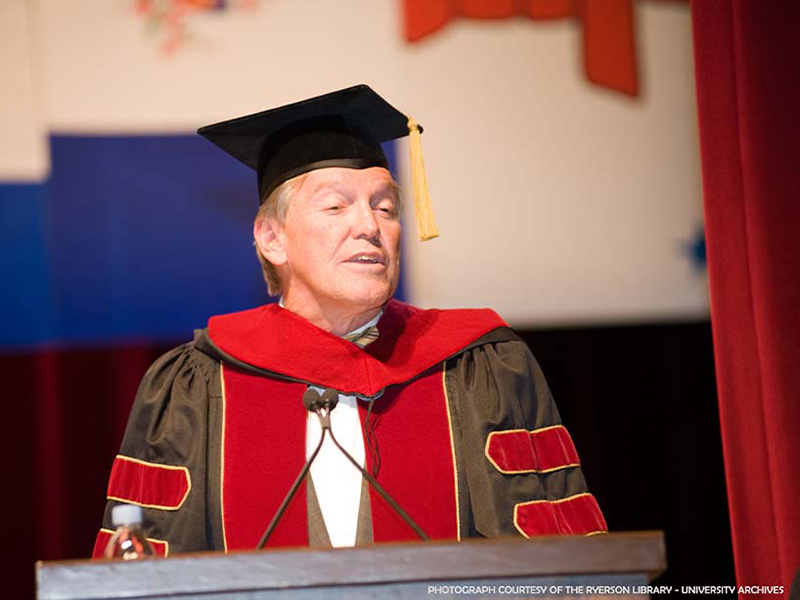
John Honderich, the former publisher and editor of the Toronto Star who died on Feb. 5, 2022, at the age of 75 was an enthusiastic supporter of young journalists. He made regular donations to the School of Journalism to help support both its students and its journalism education, though much of his support wasn’t only financial.
“He always knew journalism was going to be nourished, as much as any occupation, by its youngest people,” says Paul Knox, former chair of the School from 2005 to 2010.
Knox, along with other former chairs, had consistent contact with Honderich because he was a regular donor and an annual participant in the journalism school’s awards ceremonies.
The school offers both a bursary and an award named after the Toronto Star publisher. The John A. Honderich Bursary is awarded to a journalism student with financial need and the John A. Honderich Gold Medal in Journalism is awarded to an outstanding graduating student from the School of Journalism.
"The John A. Honderich Gold Medal was one of the most prestigious awards in the program,” says Knox, who attended the ceremony that marked the first recipient of the medal, Jordan Press. Press now works as a national affairs reporter for The Canadian Press.
Although Honderich wasn’t present at the ceremony where Press won the medal (his father Beland had recently died), so he later invited Press to get coffee. During their hour or so talk, Honderich had given Press his phone number and told him to call him if he had any questions or if he needed any help during the start of his career.
“The thing about him that I remember quite vividly was that he was very happy to talk to a young journalist,” Press says. "That was really strange for me at the time because I didn't think that the publisher of the Toronto Star would want to talk to me on a regular basis, considering I wasn't working at the Star at all."
It wasn’t Press' first time coming into contact with Honderich. In his first year of journalism school, the Toronto Star made a donation to the school for new computers, and Honderich had visited Press' reporting class. Saturday Night magazine just folded, and Press had read a line in the Star’s story that Honderich had declined to comment on the magazine’s closure. During the class, his professor told Honderich that Press had a question for him about why he didn’t give a quote.
"I remember him saying, 'I don't want to dance on other people's graves,’” Press says.
His professor then got the class to scrum him, and so Honderich stood in the middle of a silent group of first-year students and proceeded to tell them examples of good questions to ask him. “He was literally asking the questions and trying to show us what you can do as a journalist and teach us something in the moment,” Press says.
Ivor Shapiro, chair of the School from 2011 to 2016, says he remembers being told by his predecessor to have lunch with Honderich because the head of Torstar Corp. wanted to get to know each new j-school chair.
"He believed in the School of Journalism not because of any particular attachment to Ryerson, because he didn't have one, but because he had seen so many good journalists emerging from the school that he'd seen hired, particularly at the Star,” Shapiro says. "No wonder the publisher of the Star believed in the School of Journalism."
Honderich was a significant donor to J-Source, a journalism project produced by journalism students at Ryerson University and Carleton University. When the Canadian Journalism Foundation ceased its funding for J-Source in 2013, Honderich took the lead and guaranteed the existence of the project with annual funding.
"He gave it in memory of his father,” Shapiro says. “He didn't ask for any acknowledgement of his donation, and he helped J-Source raise funds from other people.”
Honderich was also a financial supporter of the school’s magazine produced by final-year students. Shapiro said that whenever a student from the Review contacted Honderich for financial support, he would always say yes. When the Toronto Star told the Review one year that they didn’t have the budget to advertise with them, Shapiro found a way to “very quietly” make sure that Honderich knew about it. . Honderich subsequently made sure that the Star had enough funding.
The Toronto Star also funded the creation of the Toronto Star Centre for Reporting, which is now a shared work and study space for journalism students and includes computers and production software. It also includes the newsrooms for the Review of Journalism and On The Record. When Shapiro initially told Honderich about his idea to create a shared physical space to unite journalism students, Honderich had told him to use the money the Star donated every year to complete it.
For Press, winning the John A. Honderich Gold Medal was a reminder that someone was taking a keen interest in journalism education. "I feel a little sad for anyone who receives it going forward that they won't have that kind of moment that I had where there are people that are going to take an interest in making sure you know they can help you through your career,” he says. “Hopefully they find it through other avenues.”
Ryerson University awarded Honderich an honorary doctorate in 2008 for his contributions to the university and for his leadership with the Toronto Star. He was also a founding member of the Ryerson Image Centre’s Advisory Board. A dedicated study area for graduate students in the Student Learning Centre bears his name.