Masih Khalatbari
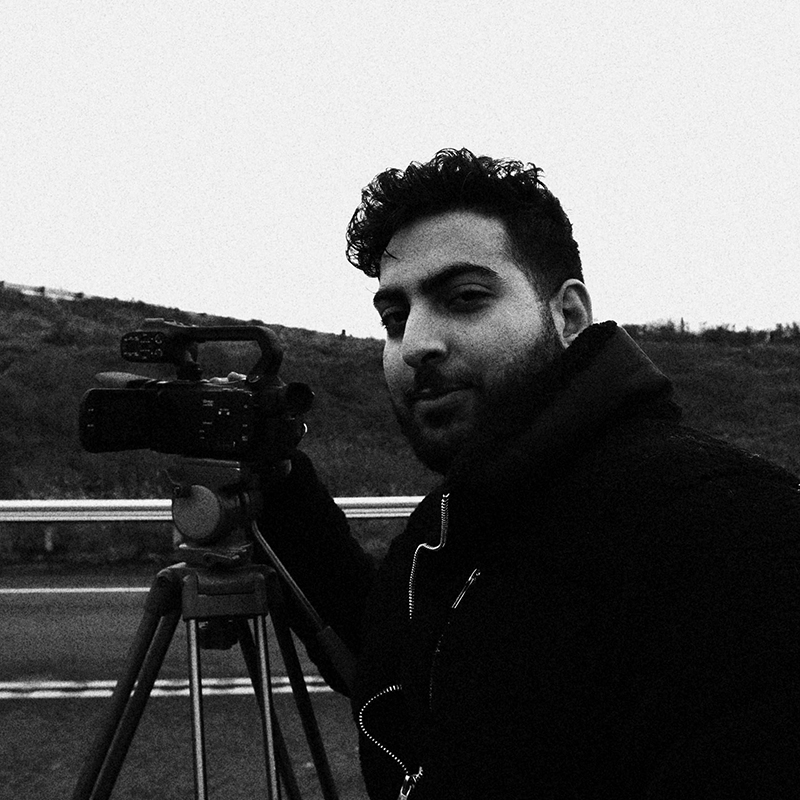
Masih Khalatbari (external link) ‘22 is a reporter for the Investigative Journalism Bureau (IJB). He got his start as a reporting intern in 2021, quickly moving up the ranks from an assistant reporter to a reporter.
This interview has been edited for length and clarity.
Why did you choose to study journalism?
I grew up with a knack for writing, but I wasn't into fiction. I was always interested in the real world and how actions of powerful people and decision makers trickle down into the lives of everybody else. I watched tons of documentaries and conspiracy theory videos as a kid and I was always fascinated how there could be two entirely different narratives on one thing. I really wanted to learn how to transcend black and white and delve into the gray and get to the truth, if there even is a truth.
Do you think that's what got you interested in investigative work?
Yes. In investigative, there's a lot more gray, you don't have a tight deadline, you have a lot more time to dive deep into really complex matters. I think that's ultimately what drew me to investigative and actually keeps me in it, because it can be very tough to do that and to constantly grapple with moral, ethical, legal implications that are more nuanced than you would like them to be.
Have you ever had to deal with moral, ethical or legal implications in your line of work?
Yes. I did reporting on things like medical assistance and death in Canada, which was a very controversial program. That's probably where I had to grapple with it the most because some of the time it seemed like there's no one size fits all, sometimes it almost seems like there's no right call. I spent months just thinking about, talking about and reading about death, which is probably the most existential topic there is so there was a lot of grappling.
Did you have any experience with journalism in the past?
I went straight from high school. My past wasn't journalism per se. My parents and family friends were in the media and film industry in Iran, where I was born. I came here from a young age. But in one of my earliest memories, I remember seeing a photo of one of my family friends in the newspaper. He was being featured because he was jailed for work he did that the government didn't like in the media and watching that struggle for freedom of expression and freedom of speech from that age led me to be interested in the social and political underpinnings of the world, which eventually brought me to journalism.
What did you originally see yourself going into after graduating? Did you know you wanted to go into investigative work?
I wanted to be in investigative eventually, I just didn't know the path that I would take. I definitely didn't know that I would get into it right after graduating. But I was lucky to find the IJB. I was lucky to find my mentor, Rob Cribb, who taught me everything I know, but also gave me the opportunity to do the work and now I'm teaching other people who are journalism students or recent grads, trying to arm them with the knowledge and understanding that I was so privileged to have.
What was the process of getting your current position?
I think the main thing was that I didn't give up. I actually didn't land the first application that I put into the IJB for an internship. It was really competitive, as a lot of the internships are, but I just didn't give up. I volunteered my time because I was so interested in the work that I was doing in the investigative class, which is how I was introduced to Rob Cribb and introduced to the IJB. I guess I took enough opportunities to prove myself and was dedicated and also lucky enough to be able to stay in this field.
What do you enjoy the most about your position?
I enjoy working with such a small and tight-knit, dedicated team that's committed to in-depth and impactful reporting. We report at the highest level using the highest level tools and publishing with some of the greatest professionals in the industry. Being able to work at the caliber that we do is something very humbling and something I'm honored to be a part of and very grateful for.
Could you walk us through what a typical day in your job looks like?
It's always a little different, as is with most journalism jobs, but it entails a lot of reading, a lot of research, looking through databases, creating databases, interviews, looking at backgrounding people and really the point of it is to get new information that is revelatory and could lead to a change or some sort of impact.
We do a lot of long hauls. So we spend a great amount of time, weeks, months, even sometimes more than a year to immerse ourselves into the nuances, the topic, no matter what that might entail, whether it's talking to people or looking at data, creating data, or looking through documents.
What would you say is the most impactful thing that you've done at the IJB?
So we spent around two years on and off digging into the clinical trial industry in Canada. We essentially found that there's this subculture of professional drug trial participants who lend their bodies to science for a living and who routinely lie to researchers to get cash to test experimental drugs. These are Canadian private companies that recruit thousands of economically desperate test subjects every year. They use incentives that some experts say are exploitative and push the participants to lie. When they lie about things like their medical history or what medications they're taking or how many trials they're enrolled in, it can taint the science behind the research and I found that most impactful.
We won a national newspaper award for it and created that narrative into a documentary film, which is up for an award at one of the longest running film festivals in North America. But also, we were the first ones to unearth this phenomenon that was happening in Canada. Despite it being well known by researchers and people on the inside, we brought it to light. And that was a great feeling.
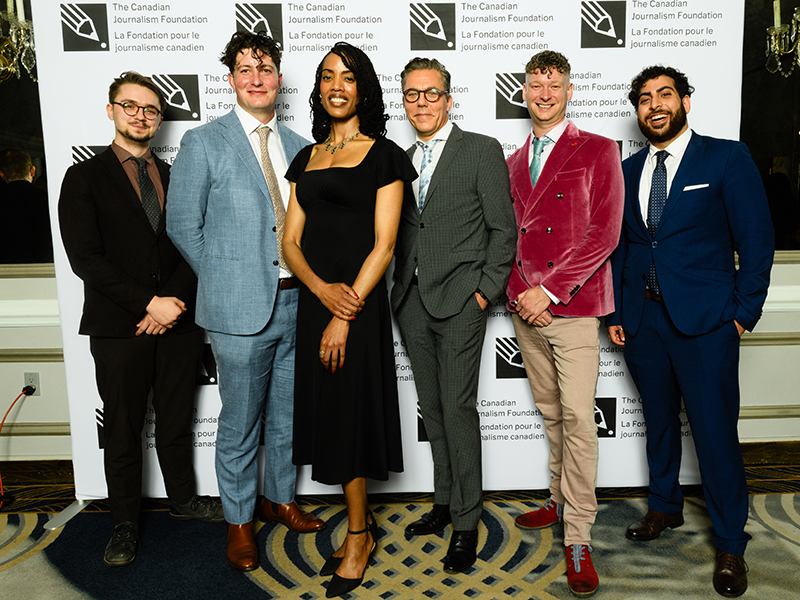
Masih Khalatbari with Investigative Journalism Bureau (IJB) colleagues at the 2025 CJF awards gala.
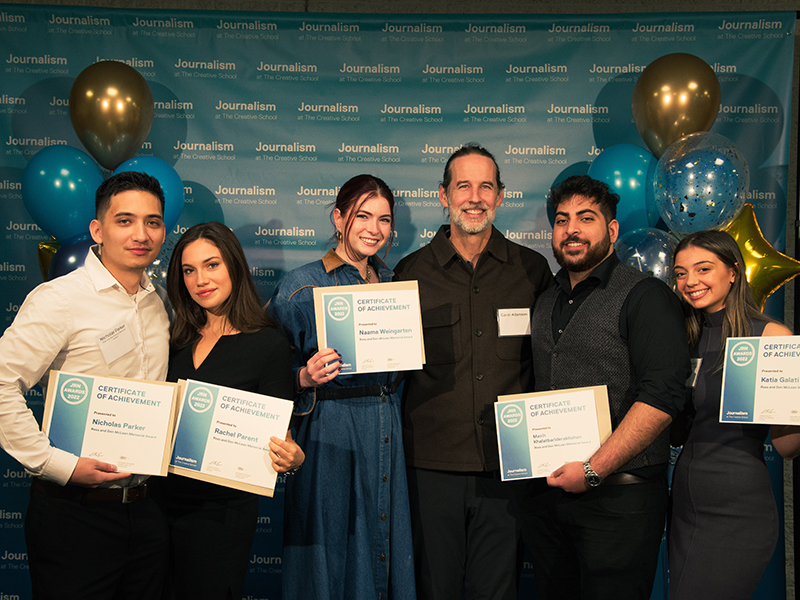
Masih Khalatbari with friends and fellow award winners at the 2022 School of Journalism AWards.
Could you talk about one of your biggest accomplishments as a journalist?
Beyond the work that I've done and the reporting that I've done, I've had the opportunity to bring on students and bring on people who want to get into the field, learn more about it, and pass on the knowledge that I've gained to other people. The core part of our mission, what we do with the IJB, is train and arm the next generation of journalists. So, it's an honor to do that.
How did what you learned in j-school prepare you for your career?
In every way, really. It taught me that journalism goes beyond just textbook skills, goes beyond what you can be graded by, goes beyond CP style and writing and clarity. It has more to do with who you are as a person, how you view the world, in nuanced ways, and can develop interpersonal skills that [are] applicable to both your personal life and your job as a journalist. It's really the things that went beyond the textbooks that I learned from the great instructors at j-school that have prepared me the most.
Thinking back to your first-year self, how do you think they would react to where you are now in your career?
I haven't thought about that one in a while. I would be proud. I think I'd also be astounded. I remember first-year me was really naive and wide-eyed, ambitious, but also unsure about where I'll end up, which I think almost every journalism student is. Most journalists that are working right now, including myself, it's always a question about what's the future of our industry, what is the future of my life. But ultimately, I think I would be proud and grateful.
You spoke about the uncertainty behind what's going to happen in the future and how a lot of people are saying journalism is a dying field. As a reporter, how do you navigate those kinds of feelings or fears?
Take it day by day. Focus on the story that you're on. Rather than focusing on the trepidation, focus on what you can do to serve your industry and serve society. There's a lot of dark moments in journalism. There's layoffs, there's media companies struggling. But at the same time, we have real impact every single day. We change laws. We give people different perspectives. And there's a lot of power in what we do. It's not every day that we see that. But when we do see that, it serves as a reminder that we are needed and we are valuable. And one way or another, we're going to stick around.
Do you have any favorite memories from j-school?
I'll never forget meeting and hanging out with my peers at the j-lounge at the RCC. It's where I met some of [my] closest friends for life. It's where I learned so many things about this industry outside of the class. One of the best parts was the tight-knit community of friends and peers who are now in the industry everywhere, all over the place.
What advice would you give to current journalism students?
If you have a dream, chase it vigorously. Be relentless. Don't hand in your assignments and go for your GPA and call it a day. Start doing amateurly what you want to be doing professionally. You're much closer than you think. Your wildest dreams are much closer to reality than you might think. And start now. No matter how far-fetched it seems, you can do it.
And if you want to get into investigative, hit me up. Come to the IJB. We have tons of opportunities for internships, fellowships, and learning engagement that we're more than happy to offer those who are willing.
Grads at Work is a series of profiles of alums. If you know of a notable grad you’d like to see featured, send us an email at office.journalism@torontomu.ca.