Q & A with Chair Ravindra Mohabeer on Bill C-18
For more than a month, Canadians have been blocked from accessing news via Facebook and Instagram, as the platforms’ parent company, Meta, campaigns against the Online News Act which requires tech giants to pay news organizations for using their work.
Seemingly all Canadian news media are being blocked, including the two campus publications at Toronto Metropolitan University - On The Record, published by the School of Journalism, and The Eyeopener, the independent, student-run platform.
The federal act is an attempt to create a bargaining framework to ensure the tech giants compensate news businesses for the news content on their sites. However, as news outlets scramble to find other means of reaching their audiences, the Canadian journalism industry is, yet again, facing uncertain futures.
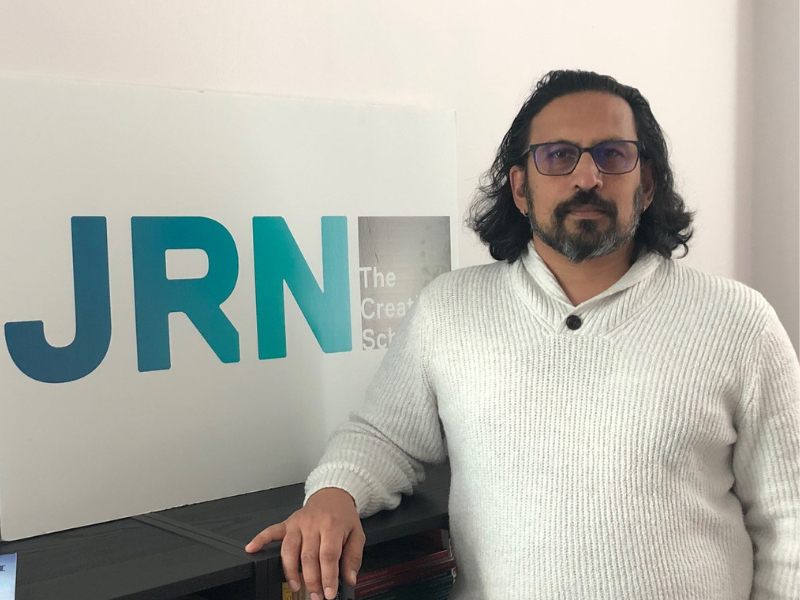
J-School Now’s Sophia De Guzman sat down with the chair of the School of Journalism, Ravindra Mohabeer, to talk about how he sees the school navigating and negotiating the latest challenge to the industry.
What was your experience while watching the Online News Act (Bill C-18) go through the various stages of development?
The Online News Act is an interesting thing, just like many pieces of legislation, it is important to recognize that it doesn't come out of nowhere. Canada wasn't the first to do this. But at the same time, Canada is responsive to the idea that our journalism industry is suffering. So I was looking at how a nation like Canada takes on such a large tech entity that doesn't really adhere to very specific rules of operation outside of stakeholders.
I was also really curious about the fact that there are very different ramifications for [different news outlets] - large news organizations are going to have a different footprint of benefit from this than smaller organizations. Some small organizations are really worried and are really feeling the pinch because most of the distribution was exclusively through [social media]. So looking at the different impacts on all of those different organizations was key to me.
Equally, [after looking at what happened when] Spain tried to push back on (Meta and Google), it was a year and a half before things came back on. In Australia, it was two weeks, but in Spain, it was well over a year and it was devastating. I was curious what would happen if that occurred in Canada, and how people would behave or react as individual citizens looking for news.
What were your initial thoughts and feelings after the Online News Act was passed, and Meta and Google made their respective announcement?
If you're a practicing journalist, you can foresee where there's an industry change going on and know that it's been going on for a long time. Ultimately, and importantly, journalists rely on these platforms, but these platforms are using a lot of their work and they’re not really getting credit for it.
Journalism in Canada is quite precarious in terms of its financial viability these days, not because people aren't interested in news, but because the nature of where they get it from is really revolving around free models of distribution that aren’t actually free. It costs money to make a living in order to be able to continue to contribute, and journalists are not getting the revenue from their work–because whoever is distributing it is taking most of the cut. So there was apprehension, but I was also very glad that the government was finally saying, “Okay, this isn't something that [Google and Meta] can just continue to get away with, with no benefit to journalists.”
There's always going to be a win and a loss and hopefully, journalism in Canada comes out on a better end of the win side than the loss one.
How can the School of Journalism be a leader in Canada’s journalism landscape during this time?
So that's actually one of the primary goals and motivations we have this year. One thing that we have going for us that is very hard to replicate elsewhere is that we're a large entity so we can cover a range of different topics and subjects concurrently, that some schools simply can't. We can still focus on the core foundational values of journalism in the skills and techniques and we don't have to sacrifice that in order to pursue or complement with other new avenues. We teach everything from podcasting and digital-first newsrooms as well as other distribution techniques and methods. But more importantly, we're spending a lot of time being attentive to the idea that how we reach audiences is changing, we have to be careful to make sure that we're reaching all audiences. We don't want to leave people who have been marginalized to be further marginalized, so we've doubled down on making sure that we have equity-focused courses that prioritize Indigenous communities, Black communities, and Queer communities. As a leader in this field, we want to make sure that our students are capable of recognizing themselves as proponents of how they want the field to change and develop rather than people who are just subject to it. We're also supporting and embracing students who are approaching multiple pathways, and our curriculum identifies entrepreneurial journalistic skills, storytelling skills, and other transferable skills as foundational goals. We teach everything from branding to freelance work to working on multiple platforms.
Another goal is to start to share a lot more of this work and invite people from the journalistic community to be able to have these conversations with us a little bit more actively, because one, we have the capacity to, but second, we have an obligation to do so. As the largest school of journalism in the country, taking that lead allows people who are not resourced enough to be able to contribute to the conversation.
It’s not helpful if we're able to stay afloat and everybody else disappears because they can't keep up.
Outlets on campus, like The Eyeopener, are being blocked. How can the School of Journalism support them?
So, one of the things that the school’s newsroom, On the Record (formerly The Ryersonian), started to pay attention to was the recognition that a large audience is a great, great thing to have, but an engaged audience is even better. After the passing of the Online News Act, OTR started to revert back to their newsletter approach where they do a digest of their news every issue. That approach is an interesting one because I've listened to a lot of smaller campus papers across the country, radio stations, and so on and many of them are saying where they used to have a large contributing audience they could reach out to fundraise and so on, now they have started to reach out to audiences more directly. And through those direct relationships, they're starting to find more people engaged in different ways. The Eyeopener is an independent newspaper; they're entirely a separate entity, even though they're on the same campus. If The Eye came to us and was struggling in those particular ways or was interested in having a shared exchange of audiences, I think that would be a reasonable consideration. We have, in many ways, relied on a congenial relationship with others in the local journalism community, to help promote work we're doing and we will continue to do so.
But equally, I think the key to the whole thing is recognizing that deeper, more intimate relationships with your audience is more important now than before. We have the ability to go back (before social media) and say “Okay, what do we have in our history, in our archives of how we connected with people before?”
What do you hope to impart to incoming journalism students as they try to navigate this new landscape?
So I think for any incoming student, particularly in the first year, the key to keep in mind is that what drew you to journalism is central to why you're here. It's central to why we're all here. What will keep students moving forward is thinking about themselves as self-propelled, capable of carving out careers for themselves, using the skills they have, the platforms they have available to them, and, the experiences they have.
One thing that's really hard to do when you're in Toronto, is to realize that there's a whole great big world out there, and in a lot of those places, these industrial shifts are happening, as well. But right now, it is more profound and accelerated. But this happened in the 80s. It happened in the 50s. It happened in the 70s. It happened in the 90s. What happens shortly thereafter, is things even out as a new pattern emerges. So, as we continue to work towards that new pattern, we must stay attentive, curious, and focus on how to be adaptable. A lot of people like the word ‘disruption’ and some people like the word ‘maintenance’. ‘Adaptable’ is that in-between (area) where you can create something new if it's necessary, you can work towards keeping something that was there before.
Most of you will land in probably roughly the same places you thought you would. Perhaps there might be a different name on the masthead but they'll be in the places that you're looking for.
This interview has been edited for length and clarity.