Bridging the Divide: Skills, AI and Inclusion for Canada’s Future
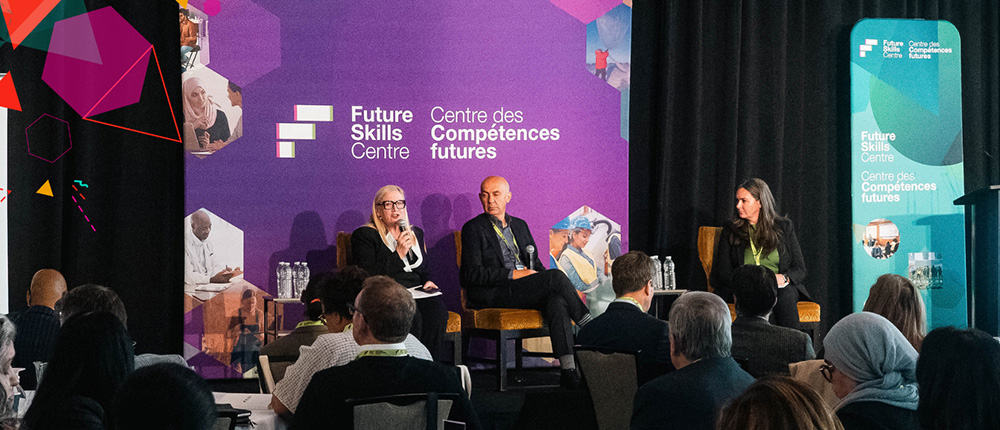
On October 15, 2025, at the at the Future Built on Skills event hosted by the Future Skills Centre, Wendy Cukier, Founder and Academic Director of the Diversity Institute, addresses leaders, discussing AI, skills and inclusion. (Photo courtesy of the Future Skills Centre)
Speaking on the Future Skills in Demand panel, I joined others in highlighting three critical areas shaping our future—AI and digital skills, social and emotional skills, and green skills—and how Canada’s success depends on preparing Canadians for the jobs of tomorrow.
Our latest research from the Survey on Employment and Skills conducted by the Environics Institute and in partnership with the Future Skills Centre shows that people across every sector are worried about their jobs. It’s not just those in industries being disrupted by automation. When one sector struggles, it ripples through the entire economy.
And nowhere is that change more visible than with artificial intelligence (AI). Depending on how you define it, anywhere from 11% to over 50% of small and medium-sized businesses are using AI tools. But what’s striking is that employees are adopting AI faster than leaders realize, and half of them have no formal training. That’s a risk, but also a huge opportunity.
AI literacy now needs to be as fundamental as reading and writing. Every worker, in healthcare, trades, education, or tech, needs to understand how to use AI safely and effectively. Generative AI is even helping close the digital divide. I like to call it the English major’s revenge, because success now depends as much on communication and critical thinking as coding.
We can’t forget that 90% of private-sector jobs in Canada come from small and mid-sized businesses. Their needs are different from big corporations, and if we ignore that, we’ll miss the mark on productivity and innovation.
Skills, though, aren’t the whole story. Our research shows deep systemic barriers: women, Black Canadians, Indigenous peoples, and persons with disabilities continue to face inequities in education and employment. This isn’t just a social issue, it’s an economic one. Canada can’t afford to waste talent.
And let’s be clear – equity, diversity, and inclusion aren’t about political correctness or “wokeness.” They’re smart strategies. Canada’s population is changing. Marketing 101 tells us we need to change our strategies accordingly, whether in recruiting talent or developing products and services. The research is clear – diversity fuels innovation – our island entrepreneurship. Canada’s immigrant diasporas are a competitive advantage as we seek to develop new markets.
If we want to thrive, we need accountability, scaling what works and stopping what doesn’t. Technology can help, but it’s only part of the equation.
The future of work isn’t just about adapting to change. It’s about shaping it, with inclusion, adoption, and accountability at the centre.
These remarks were shared at A Future Built on Skills, a national forum convened by the Future Skills Centre. Watch the full talk, Future Skills in Demand (external link) .

This blog was originally published by the Future Skills Centre.