Immigration and the housing crisis: Debunking myths to advance an inclusive economy
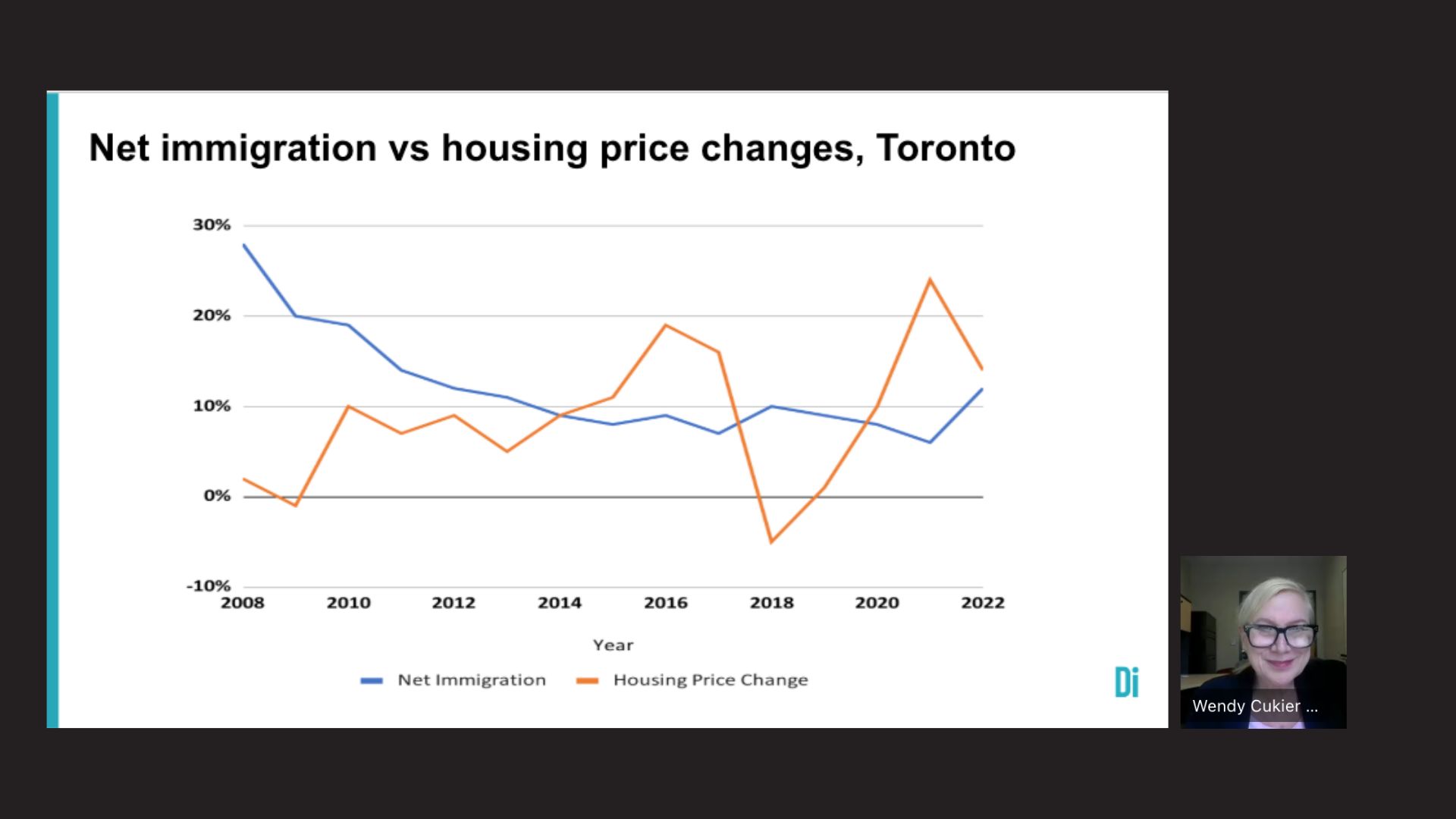
At an event hosted by Immigration, Refugees and Citizenship Canada (IRCC), research by Wendy Cukier, Academic Director of the Diversity Institute, and Morley Gunderson, Professor of Economics at the University of Toronto, challenged myths about immigration rates causing the housing crisis.
A recent “Research Matters” event hosted by Immigration, Refugees and Citizenship Canada (IRCC) chaired by Chantal Goyette, a senior director of research and knowledge mobilization at IRCC featured Wendy Cukier, Academic Director of the Diversity Institute (DI) and Morley Gunderson, Professor of Economics at the University of Toronto along with Haozhen Zhang, senior advisor of research and knowledge mobilization at IRCC.
A 2024 journal article by Cukier and Gunderson, “Immigrants and House Prices: Myths and Realities” highlights that while there may be correlations between housing prices and immigration rates, the trends are complex and immigration is not a sole or even principal cause of rising housing costs. They also emphasized the complexity of the issue, given immigrants’ important contributions in the construction and infrastructure sectors in particular. In the presentation, Cukier flagged the lack of evidence underpinning the “moral panic” about immigration rates and highlighted the multiple factors, including speculation, which are fueling the global housing crisis.
“It’s really important to untangle that notion that there is a single factor that is causing the rise in housing prices,” Cukier said. One of the most persistent narratives in Canada’s housing debate is that immigration drives up home prices, but the data tells a different story. In Toronto, net immigration surged more than 15-fold between 2005 and 2022, yet housing prices rose unevenly. In Vancouver, prices dropped by nearly $240,000 between 2017 and 2019—even as immigration climbed by over 50,000 people. The pattern is clear: immigration contributes to demand, but it's not the main driver.
Cukier’s and Morley’s paper discusses how Canada’s housing supply is held back by a range of structural barriers. Zoning regulations, environmental reviews and slow permitting processes delay construction and increase costs, especially in cities like Vancouver. Local opposition, often driven by community resistance NIMBYism (not-in-my-backyard), further blocks new developments, particularly affordable or multi-unit housing. In cities such as Vancouver and Montreal, natural geography, like mountains and waterways, also limit expansion, adding to the pressure on available land and driving up prices.
Cukier also presented results from a forthcoming media analysis, which suggests claims that “out of control” immigration was driving housing shortages and price increases played a role in shifting Canadians opinions on immigration. She also cited evidence that deliberate misinformation is fueling the hate filled narratives against immigrants including spill over effects from the United States. Paid influencers identified through the Foreign Interference Commission have a decided anti-immigrant focus. While social media may narrowcast, many of the outrageous claims are amplified through reporting in mainstream media. Business voices, largely silent during the debate about immigration levels, became very loud only after the immigration level cuts were made. Ironically, some of the same media outlets who called for the cuts and claimed the system was broken then began criticizing the government for the cuts. Cukier said, we need to strengthen the narrative that immigrants built Canada, from the railroad, to our homes and our businesses, and they will continue to build Canada.
Haozhen Zhang presented Statistics Canada and IRCC research on the housing of immigrants and non-permanent residents (external link) , looking at the use, outcomes and market impacts. The first study traced the different patterns of housing use by different categories of immigrants. His work (external link) with Dr. Feng Hou and Évamé Koumaglo shows that new immigrants account for only 11% of the overall increase in housing prices, which provides solid evidence to support Gunderson and Cukier’s theoretical paper. Zhang noted their research found that during the pandemic, the population growth dropped while prices surged, emphasizing that immigration isn’t the cause of housing prices rising. Zhang also explored affordability challenges, as well as rental price gaps, showing how immigrants and non-permanent residents face disproportionate housing pressures.
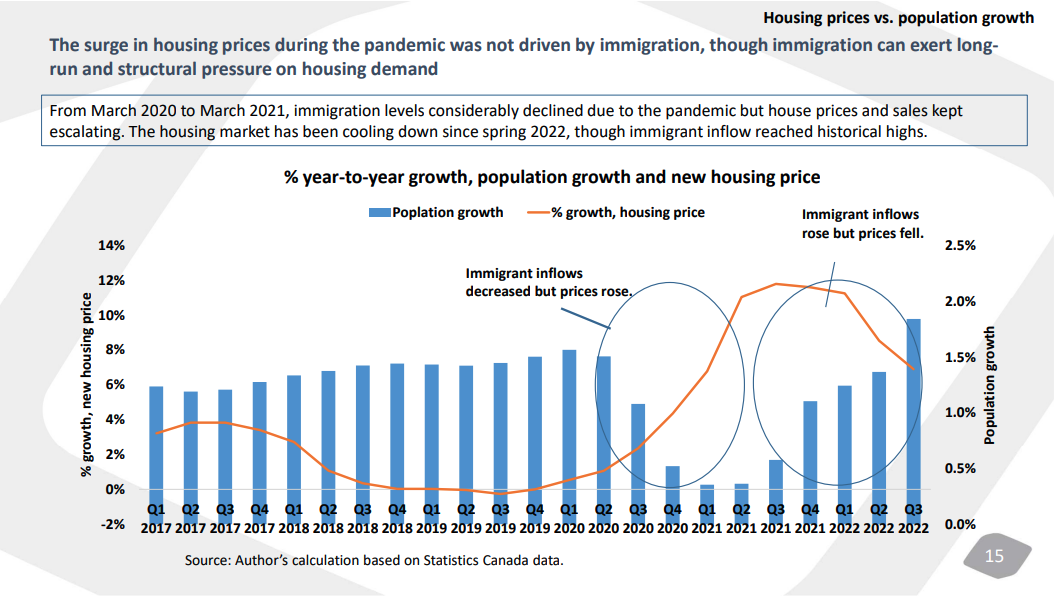
Haozhen Zhang, senior advisor of research and knowledge mobilization at IRCC, presented IRCC and Statistics Canada research, which found that the surge in housing prices during the pandemic was not driven by population growth. (Credit: Slide provided by Haozen Zhang).
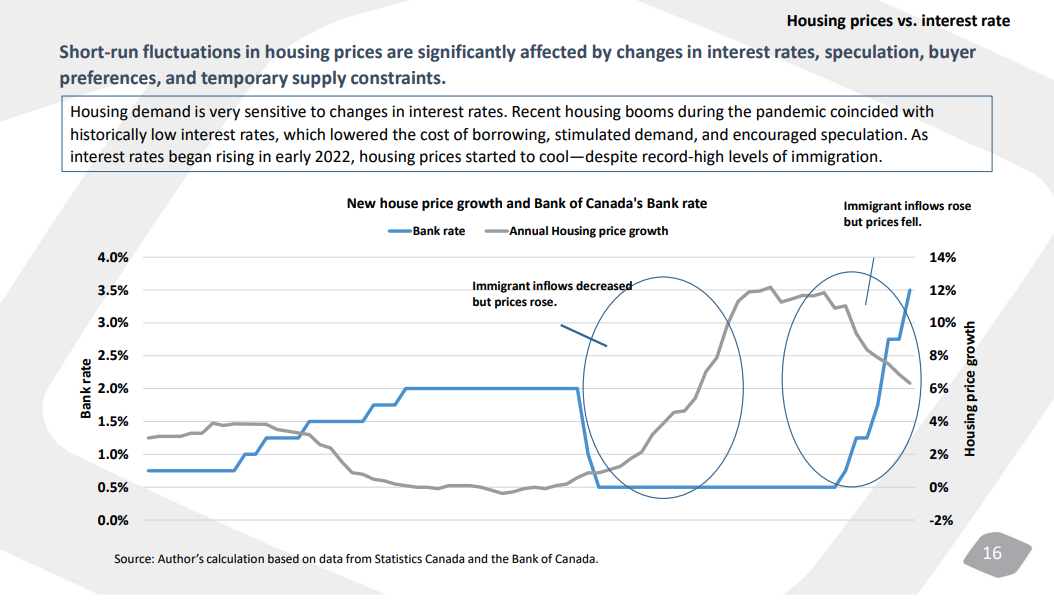
Haozhen Zhang shared research showing the relationship between interest rates and housing demand. His graph illustrates the opposing trend of housing prices lowering while immigration surged after the pandemic. (Credit: Slide provided by Haozen Zhang).
Immigration a solution for Canada’s labour shortages and infrastructure needs
Cukier emphasized the economic imperative for immigration and that immigrants are critical to help alleviate housing supply pressures by filling critical labour gaps (external link) in construction and related sectors. For example, previous research by DI, Infrastructure Trends and Innovations: Implications for Employment and Skills in Canada, highlighted that immigrants account for roughly 23% of Canada’s overall labour force but comprise 19% of the construction labour force and 18% of workers in construction trades. Immigrants also represent a larger portion of sector business owners, comprising 23% of all general contractors and builders in the residential sector and 40% of civil engineers are immigrants. However, many more do not practise in their profession; only 18% of internationally educated engineers work as engineers in Canada.
“Over time, immigrants are really drivers of economic growth. “In the longer term,” Cukier said, “immigration contributes to improving access to supply.” A balanced, evidence-based approach is needed—one that acknowledges immigration’s broader economic role and addresses both housing and labour market challenges. Immigrants have a positive multiplier effect on the Canadian economy: they fuel innovation, launch new businesses, help close labour shortages across key sectors, and strengthen the infrastructure industry which is critical as we build a resilient, innovative and sustainable economy.