Tackling the AI Paradox: Why helping Canada’s SMEs accelerate AI adoption is vital to unlocking economic and workforce development
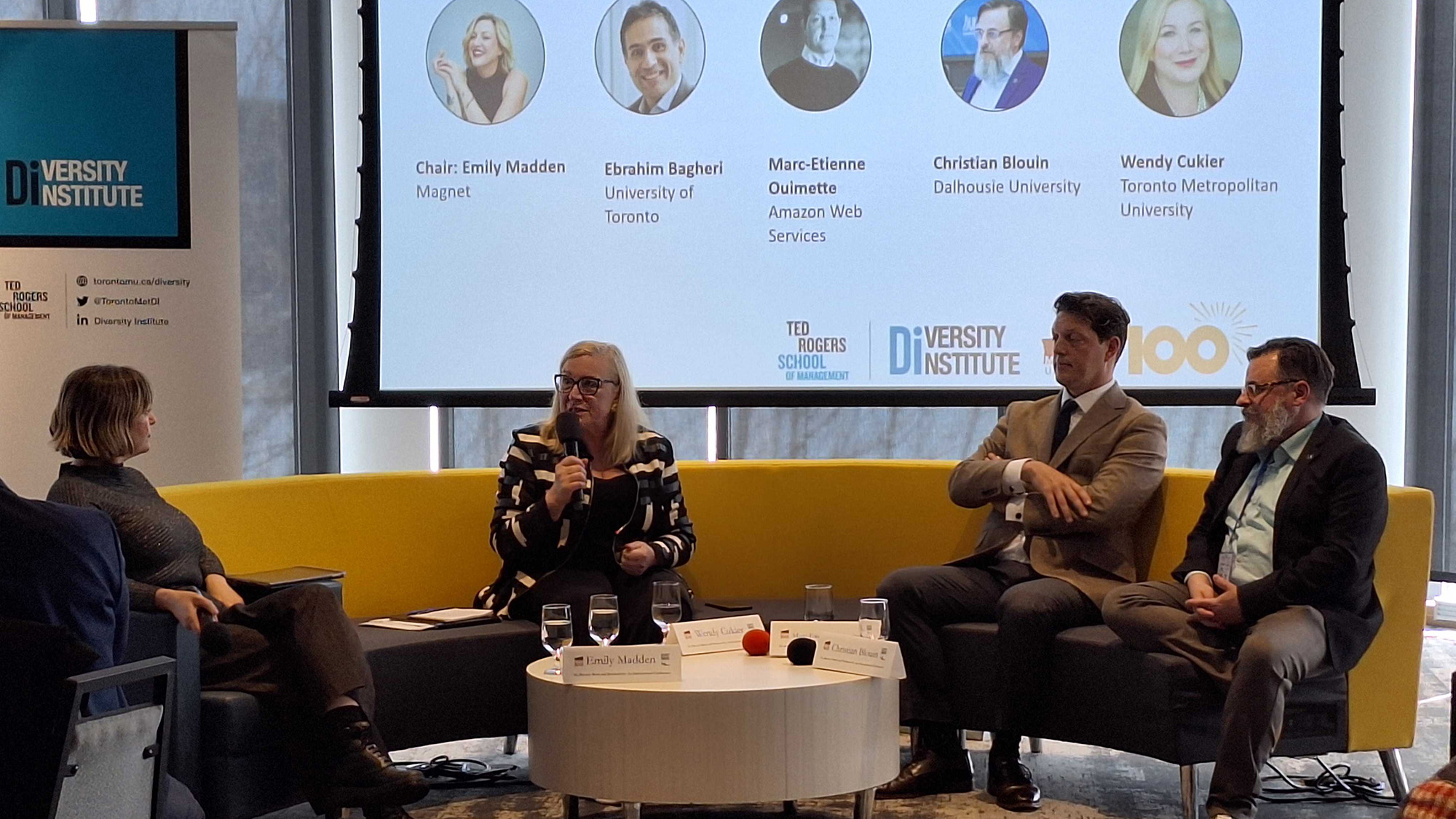
(Left to right) Emily Madden from Magnet, TMU’s Centre of Innovation; Dr. Wendy Cukier, Founder and Academic Director of the Diversity Institute; Marc-Étienne Ouimette, Global AI Policy Lead at Amazon Web Services; and Christian Blouin, Associate Dean at the Faculty of Computer Science, Dalhousie University; discuss global insights around the evolving impact of AI, at an international conference in St. John’s N.L.
At a May 2025 conference on AI and productivity, Dr. Wendy Cukier, Founder and Academic Director of Toronto Metropolitan University’s Diversity Institute (DI) made the case for urgent action to ensure Canada’s small- and medium-sized enterprises can unlock the business benefits of artificial intelligence (AI) and help address Canada’s AI paradox.
“The AI paradox is that while Canada is a world leader in AI development, we are a laggard in AI use and adoption, especially among small and medium enterprises (SME) which represent more than 90% of Canada’s economy,” explained Dr. Cukier in a panel discussion entitled ‘Artificial Intelligence and (Other) Innovations in Technology’. “Big corporations … can spend a billion dollars upskilling, reskilling, and investing in infrastructure and models, but in a SME-driven economy, we have to recognize and adapt to both opportunities and threats regarding AI adoption.”
Co-presented by DI and Memorial University of Newfoundland (MUN), the 2025 AI, Remote Work and Productivity International Conference brought experts from academia, industry and government together to explore global insights and strategies around the evolving impact of AI, skills development, and inclusive innovation – a timely focus given current market uncertainty, geopolitical tensions, and a backlash against equity and inclusion. Supported by the SSHRC Connection Grant, Bridging Divides Research Program and the Future Skills Centre (FSC), Dr. Cukier and the DI team developed this year’s conference program in collaboration with colleagues at MUN, including Tony Fang, Professor of Economics and Jarislowsky Chair in Cultural and Economic Transformation.
The call for Canada to shift from developing foundational AI science to adopting and applying AI technologies, especially in ways that build a more inclusive and prosperous future, emerged as a dominant theme in in the opening panel discussion. Chaired by Emily Madden of Magnet, TMU’s Centre of Innovation focused on the future of work, the session featured insights from Dr. Cukier and leading national voices in AI development and deployment.
Panellist Dr. Ebrahim Bagheri, professor at the University of Toronto's Faculty of Information, Faculty Member at Vector Institute and leading researcher into responsible AI, observed that many organizations are missing the transformational opportunity that AI represents.
“We are trying to take AI technologies and adopt them within the context of business as-is,” he explained, whereas “the bigger potential of AI is to revolutionize and redefine, rather than simply automate what already exists.”
Marc-Étienne Ouimette, Global AI Policy Lead at Amazon Web Services, argued that Canada is at an inflection point with respect to AI adoption rates, pointing out that businesses need to move away from the idea that they have to build their own bespoke models which are both complex and costly to create. Instead, their focus should be on adapting and applying the tools and applications that already exist.
Rather than prioritizing only graduates in computer science, for example, Ouimette emphasized training technologists – people who can adapt and deploy AI solutions in real-world contexts. “Success in enhancing productivity in Canada is going to be about graduating people who know how to take an AI model and apply it seamlessly to a SME – for example, a factory or a plant.”
Innovating for the world we live in today – and tomorrow
Christian Blouin, Associate Dean at the Faculty of Computer Science, Dalhousie University, raised a critical red flag: enrollment in computer science programs is plummeting. “We’re graduating students for a world that no longer exists,” he warned. While AI is disrupting entire fields, many post-secondary institutions are struggling to evolve curricula and infrastructure quickly enough to keep pace. Blouin called for creating “innovation spaces” – safe environments for experimentation where students and faculty alike can test and experiment with AI applications designed for the world in which they live and work today.
Dr. Cukier echoed the value of courage and the spirit of innovation within organizations seeking to harness AI’s potential. “We need to focus on what businesses need and match the solutions to their requirements,” said Dr. Cukier. “That takes an entrepreneurial mindset, and a ‘just try it’ approach - whether you run a small business, work in a government department, or at a university.”
Next Steps for Inclusive and Scalable AI Adoption in Canada
The session’s panellists agreed that Canada has the talent, research, and infrastructure to lead in AI – but adoption must become the priority. That means shifting from bespoke, costly models to off-the-shelf solutions, making adoption accessible to SMEs, embedding AI literacy across sectors, and creating innovation ecosystems where new ideas can be safely tested.
To accelerate AI adoption in Canada – especially among SMEs – governments should focus on helping sectors adopt existing, proven solutions. This means investing in capacity building, to ensure SMEs have access to skilled talent, training, and relevant tools, and then supporting organizations in applying them. Hands-on guidance, wayfinding, financing, and real-world examples can help overcome barriers like lack of knowledge, data privacy concerns, and high implementation costs.
Diversity and inclusion must be central to this effort, said Dr. Cukier. A more inclusive workforce drives innovation, and programs that support equity and work-integrated learning are key to creating environments where diverse talent can thrive. “With nearly 30% of entrepreneurs in Canada born outside the country and 20% identifying as women, our strength lies in harnessing that diversity as a competitive advantage,” she explained.
This requires closing the digital divide and expanding access to upskilling and reskilling opportunities, particularly for women, Indigenous peoples, newcomers, and other underrepresented groups.
It also means addressing the risks inherent in today’s rapid pace of AI development. In his overview of AI’s current capabilities and limitations that kicked off the panel discussion, Professor Bagheri explained that most of the current discourse on AI centers on statistical machine learning – algorithms trained on large datasets that identify patterns and make predictions. While these tools can be powerful, they generalize from historical data and often reinforce systemic bias and marginalize outliers.
Cukier articulated the vital importance of clear guardrails and frameworks to ensure AI is developed and deployed safely, ethically, and without bias. This means embedding ethics into AI-related education and training, ensuring strong data protection standards, and promoting AI literacy across all sectors and communities.
“Ultimately, we've got to think about developing fundamental principles around AI application in Canada,” said Dr. Cukier, “but we have to translate them into practical, actionable guidelines that SMEs and other organizations can operate with.”
After all, she explained, “The future depends on our ability to use AI wisely, ethically, and inclusively.”