Understanding the challenges facing equity, diversity and inclusion management and research in Canada
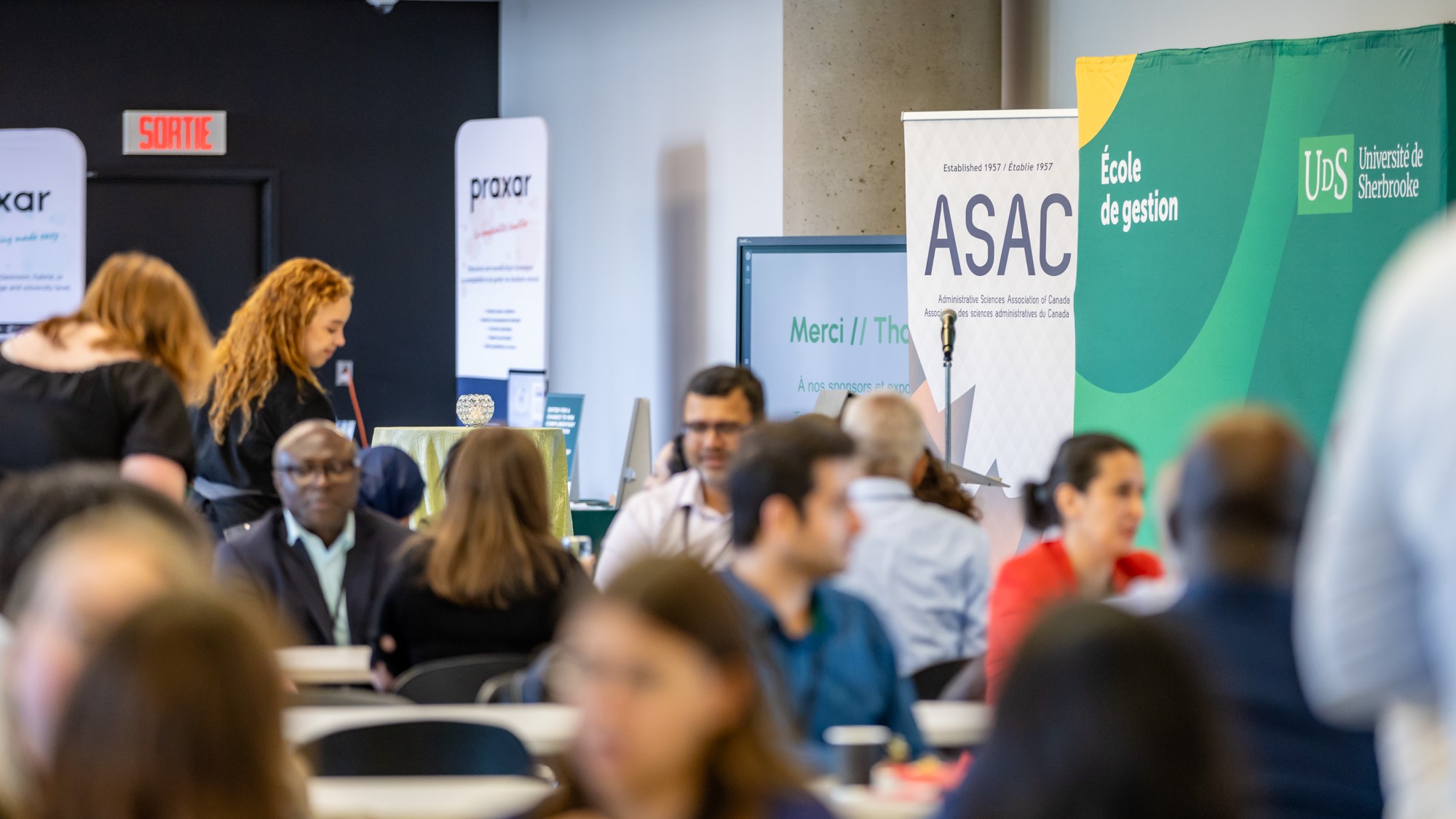
At the opening reception of the ASAC Conference, hosted at the University of Sherbrooke in Longueuil, Que., dozens of attendees interacted. (Photo credit: ASAC)
From June 1 to 3, 2024, academics gathered at the University of Sherbrooke in Longueuil, Que. for the Administrative Sciences Association of Canada (ASAC) annual conference. The conference hosted hundreds of academics in the business field, researchers and students from across Canada. Representatives from the Diversity Institute (DI) took part in several events during the multi-day conference, leading more than six workshops and panels where they shared DI research and provided actionable insights for doctoral students and professionals.
Wendy Cukier, founder and academic director of DI and academic research director of the Future Skills Centre (external link) , was invited by the Gender and Diversity in Organizations (GDO) division to deliver the keynote address to the division. Sponsored by the Asper School at the University of Manitoba, the speech, Current Challenges in Equity, Diversity and Inclusion (EDI) Management and Research in Canada, focused on the state of EDI research and the ways in which it can advance practice. Cukier stressed the importance of GDO academics, regardless of their particular focus, thinking about how their research can help advance EDI, particularly in the face of ongoing and recent backlash against EDI.
Despite traditions in academia that sometimes imply research excellence and relevance are mutually exclusive, Cukier argued there is growing recognition of the importance of both. Academics have the privilege, knowledge, and academic freedom many others lack and can use them to help drive change. Additionally, funders are increasingly looking for evidence of partnerships and broader efforts at knowledge mobilization, she said, adding that beyond top-tier journal articles, community engagement can produce other benefits. Cukier said that research ethics boards are now embracing the mantra of “nothing about us without us,” and while they’re undertaking research on women, Indigenous peoples, persons with disabilities, and racialized or 2SLGBTQ+ communities, she emphasized that it requires authentic engagement with the communities it serves.
While traditional institutions often appear to undervalue applied work with business, government and non-government organizations, many PhD graduates will find themselves in non-academic careers, she said, emphasizing that engaged research can produce many benefits. “So what would happen,” Cukier asked, “if we flipped the script and focused on what research is relevant to driving change?”
Cukier noted research that documents the nature and extent of the problem, the ongoing lack of EDI, is fundamental to driving change. What gets measured gets done, she said, adding that progress in recent years on EDI can be tied to better disaggregated data, which has driven the development of new legislation, voluntary codes and practices. She cited examples from Diversity Leads, a study of representation on boards and senior leadership roles that provided the first insights into intersectionality, because it included data on race as well as gender.
The study, which has been undertaken regularly for more than 15 years together with long-time collaborators such as Suzanne Gagnon at the Asper School of Business and Tania Saba at the University of Montreal, showed, for example, that in Toronto where one-half of the population is racialized, white women outnumber racialized women by 17 to 1 in leadership roles. Such insights from the research, which has been extended to 10 major cities in Canada, helped support government efforts to move beyond gender in corporate reporting. It informed the development of Bill C-25 and the 50 – 30 Challenge (external link) , a voluntary code that aims to advance gender parity (50% women and/or non-binary people) and representation of other equity-deserving groups (30%) on Canadian boards and/or in senior management. In this case, a complex analysis wasn’t needed, Cukier said, because descriptive statistics helped to drive change.
Similarly, during the COVID-19 pandemic, research from the Women Entrepreneurship Knowledge Hub (WEKH (external link) ), led by the Diversity Institute and involving hubs across the country, showed that more than 80% of women entrepreneurs are self-employed and not incorporated; this is also true of Indigenous entrepreneurs. That simple insight helped inform adjustments to COVID-19 pandemic relief programs, as well as subsequent programs like the Canadian Digital Adoption Program, to ensure self-employed women and Indigenous Peoples were not excluded by eligibility requirements and systems designed for men.
Cukier also presented DI-led research that has informed the development of a critical ecological model to drive change by recognizing the importance and interconnectedness of barriers and enablers at the societal, organizational and individual level. The model also is helpful in bridging paradigmatic perspectives; it brings together researchers focused on structural change with those interested in organizational policies and practices, as well as those focused on individual agency. She provided examples of research into government policies and programs, stereotypes and media representation, which shape organizational context and programs like WEKH’s See It. Be It. (external link) campaign, which aims to counter stereotypes.
Cukier described how a focus on organizational policies and practices can help us understand barriers to EDI, as well as what works to advance it. She pointed to examples of research on governance and strategy, human resources, culture, metrics, the value chain (including procurement, product and service design, and marketing), as well as community engagement and outreach, demonstrating the linkages between the research and shifts in practices to drive change. For example, the Diversity Assessment Tool (external link) , which was developed based on funding from the Social Sciences and Humanities Research Council, has been used by 350 companies to develop and implement EDI strategies.
A similar approach has been taken to the research that aims to build an inclusive entrepreneurship and innovation ecosystem, she said. That approach considers not only policy, but also the practices of stakeholders. including financial institutions, venture capitals, angel investors, incubators and accelerators, educational institutions and intermediaries.
At the individual level, Cukier talked about how research has informed important work on competency frameworks and skills development, not just to empower individuals, whether it be students, job seekers or entrepreneurs from equity-deserving groups, but also to challenge bias and discriminatory behaviours and build capacity among decision-makers, gate keepers and employers across sectors.
Drawing on the extensive work DI has done on social innovation and technology adoption, Cukier also discussed concrete examples of factors that enable change. She said one of the key enablers is the development of an entrepreneurial mindset: being prepared to question and challenge the status quo, and pursue goals without an eye to the resources available. She described many of the evidence-based action-oriented research projects that DI has undertaken, including digital skills training and the private sponsorship of refugees, which has produced not only respectable research but also changed people’s lives.
She ended with encouragement to everyone, and particularly young scholars, in the room. “Follow your supervisor’s guidance,” she said. “They will help you get your doctorate finished and set you up for publications and research funding. But also think about your privilege, your sphere of influence, the impact your work can have.” Sharing a link to a meaningful lesson (external link) , she said, “Be an ally, not a bystander.”