How online hate grows and why we need solutions now
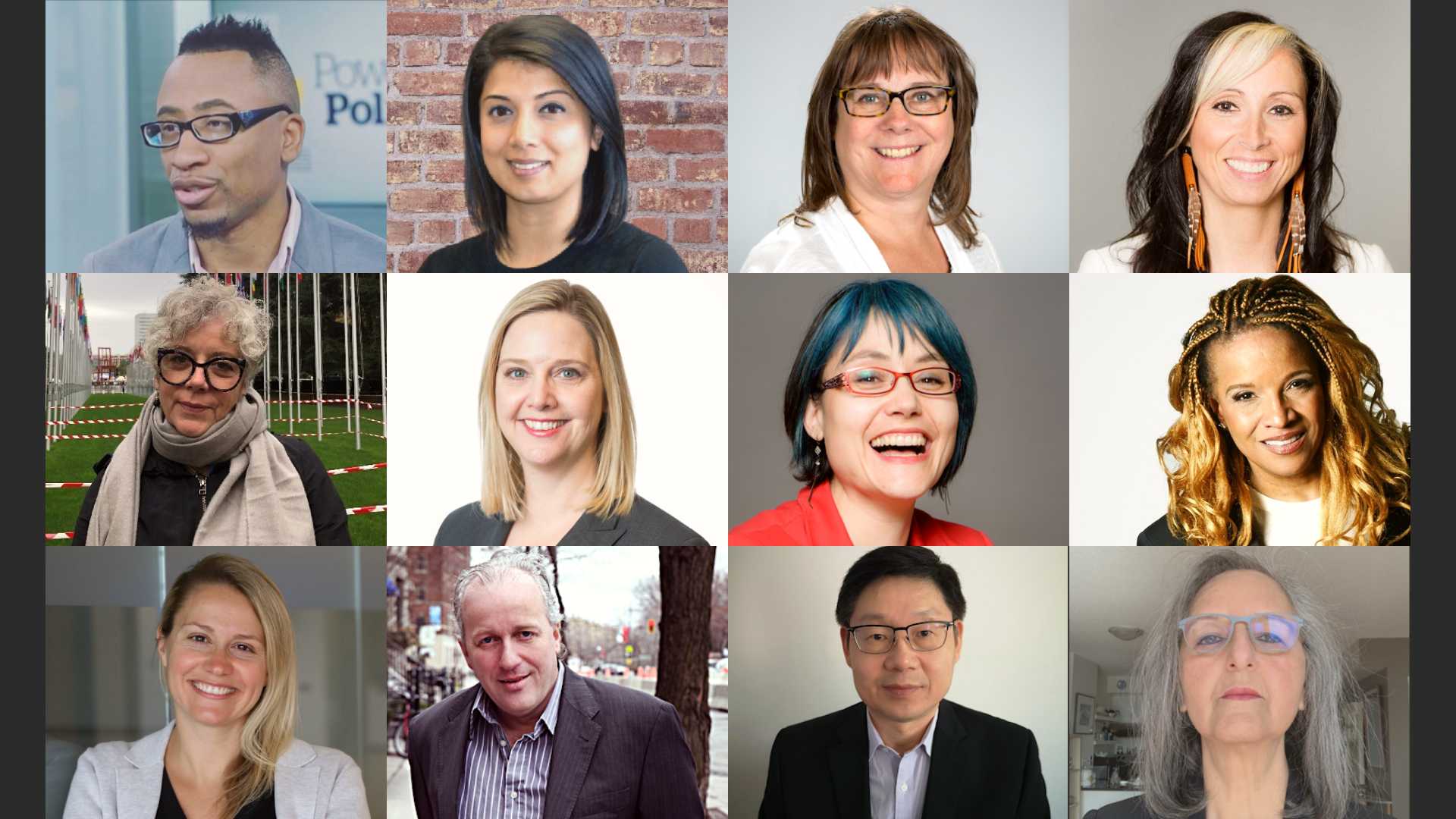
The first day of the Online Hate, Media (Mis) Representation and Racism Conference organized by the Diversity Institute took place on Jun 22, 2023. It featured panelists and moderators (from left to right, top to bottom) Peter Flegel, Nadia Hasan, Barbara Perry, Pamela Palmater, Amanda Dale, Emily Laidlaw, Jaigris Hodson, Tamara Thermitus, Kaitlynn Mendes, Jack Jedwab, Andi Shi and Nuzhat Jafri.
On June 22, 2023, more than 450 people attended the first day of a two-day virtual event hosted by the Diversity Institute (DI), where experts discussed the rise of hate crimes and hate in online spaces targeting Indigenous Peoples, Muslims, Jews, women, Black and other racialized people, the 2SLGBTQ+ community and other equity-deserving groups. The first day of the Online Hate, Media (Mis)Representation and Racism Conference, funded in part by the Social Sciences and Humanities Research Council (external link) , created a platform for experts to break down the issues.
The second day tackled solutions for individuals, organizations and governments. The conference is part of a series of training events building on DI’s Anti-Racism Action Program (external link) funded project. Led by DI founder and academic director, Wendy Cukier, the Media Bias and Under-represented Groups project is a study that aims to understand how Canadian news media represents people who are Indigenous (First Nations, Metis, and/or Inuit), Black, Muslim, and/or Jewish; the impact of media representation on members of these groups; and ways to improve their representation in Canadian news media organizations. The two-day event was chaired by Juan Marsiaj, director of research for special projects at DI.
Barbara Perry, director of the Centre on Hate, Bias and Extremism at Ontario Tech University, kicked off the conference with a keynote on trends in right-wing extremism in Canada. She highlighted the existence of an extremist ecosystem and how it spreads online hate.
“It's really important that we acknowledge the many manifestations of hate that we see, whether it's online or offline, whether it's hate crimes, whether it's far-right-extremism. It doesn't emerge in a vacuum,” she said.

The conference is part of a series of training events building on DI’s project, the Media Bias and Under-represented Groups, led by Wendy Cukier (right). The two-day event was chaired by Juan Marsiaj, director of research for special projects at DI.
Perry dispelled the notion that right-wing extremists act independently as "lone wolf" actors. “There is an enabling climate or an environment of hate that allows for the flourishing of these sorts of patterns,” she said, adding that misinformation is a catalyst for the growth of online hate.
Cukier noted Perry had caught the trend, surfacing the problems of right-wing extremism before many others. She said for over thirty years, there has been a tendency, particularly among policing and security professionals, to focus on international threats and post-September 11, 2001, on certain forms of terrorism while overlooking the very real and present danger of extremism and hate in Canada.
Real-world outcomes of online hate
In the panel discussion that followed, Nadia Hasan, chief operating officer of the National Council of Canadian Muslims, emphasized that while hate can begin or grow online, it has a deadly real-world impact. She pointed to the attack on the Islamic Cultural Centre of Quebec City on January 29, 2017, where six people were killed before evening prayers. Hasan said six months prior a Facebook group encouraging people to “hunt Muslims” began gaining traction. Echoing Perry’s presentation, Hasan emphasized that it was a whole ecosystem of hate that led to the shooting.
“We can see how right-wing extremism traverses so many planes of existence, from an ordinary experience, like a child scrolling on social media, to extreme violence and death,” Hasan said.
Pamela Palmater, professor and chair of Indigenous governance at Toronto Metropolitan University, highlighted how hate crimes have targeted Indigenous Peoples and how there are clear intersections between different manifestations of white supremacists. She noted that law enforcement and the RCMP represent a portion of participants in hate groups that share misogyny online, particularly towards Indigenous women.
“When state institutions that are there to protect or serve Canadians hold these views, that can be the difference between someone getting shot or not. That can be the difference between a law enforcement agency providing so-called ‘freedom truckers’ and all the hate groups that are gathering and laying siege to Ottawa with intel and strategy,” Palmater said.
She added that mainstream media plays a role when it gives platforms to hateful ideologies by presenting as “balanced” a polarizing view from an extremist as another side of an issue. Palmater emphasized the importance of social media and online and critical thinking education. She said, without it, “The implications for the future could potentially be even more devastating."
At the Online Hate, Media (Mis)Representation and Racism Conference hosted by the Diversity Institute on June 22, 2023, Pamela Palmater discusses the importance of critical thinking education.
Amanda Dale, a fellow at the Human Rights Research and Education Centre at the University of Ottawa, highlighted “pearl-clutching” and ignorance as a part of the problem. Echoing Palmater’s sentiment on the insurrection in Ottawa, Dale noted that while Canada has always tried to position itself as an exception globally—especially in comparison to the United States—Canada also has a racist history.
“We need to normalize the discussion that this is not an exception,” Dale said.
Concluding the panel, Dale said it’s important people speak up for each other when they witness injustices. She highlighted part of the famous Martin Niemöller quote, “Then they came for the Jews, and I did not speak out—because I was not a Jew. Then they came for me—and there was no one left to speak for me.”
The role of the social media company
Tamara Thermitus, a visiting scholar from the Centre for Human Rights and Legal Pluralism at McGill University, chaired the second panel. Kaitlynn Mendes, Canada Research Chair in Inequality and Gender at Western University, highlighted the term “technology-facilitated gender-based violence” as a recognition of how contemporary violence transcends online and offline spaces. She pointed to recent data that shows almost 80% of people aged 13 to 18 experienced at least one form of it.
“We need to be holding these platforms to account,” Mendes said, adding that more regulatory bodies are needed so that the government does not let tech companies do whatever they want for a profit.
Jaigris Hodson, Canada Research Chair in Digital Communication for the Public Interest at Royal Roads University, compared virtual platforms to physical businesses. “Why will I get kicked out of a restaurant if I go in and say hate speech, but on these platforms there’s no one kicking me out?” The difference, Mendes said, is that hateful online conversations are profitable.
At the Online Hate, Media (Mis) Representation and Racism Conference hosted by the Diversity Institute on June 22, 2023, Jaigris Hodson and Kaitlynn Mendes discuss how online hate grows because it is profitable.
Emily Laidlaw, Canada Research Chair in Cybersecurity Law at the University of Calgary, said, “We need product safety … The legal obligation should exist at the design phase of these products and services. It requires ongoing monitoring by the company.”
Laidlaw noted privacy data protection laws need improvement because not everything that happens online is a privacy breach. She added social media regulation and platform regulation do not impose due diligence or duty of care.
In the final panel of the day, moderated by Cukier, Andy Shi, executive director of CPAC, highlighted the recent centennial memorial of the Chinese Exclusion Act, which is considered to be racist legislation. He emphasized that while the COVID-19 pandemic brought anti-Asian racism into the spotlight, it is not new. We experience biases, stereotypes and microaggressions, he said.
“Our own (PDF file) research (external link) confirmed that while Chinese communities represent slightly over 11% of the population, we represent only 2% of senior leadership across all sectors,” Shi said.
Continuing to highlight how racism can be baked into government and law, Nuzhat Jafri, executive director of the Canadian Council of Muslim Women, pointed to Quebec’s Bill-21. “In Quebec the situation is even worse because of a law allowing the practice of systemic Islamophobia and denying Quebec Muslim women employment in certain public sector occupations because they wear a scarf or niqab.”
The way forward
Jack Jedwab, president and chief executive officer of the Association for Canadian Studies and the Metropolis Institute, highlighted major differences between police-reported data and polling data and emphasized the importance of data in addressing hate crimes because it provides insight into the issue. He also encouraged the audience to take a coalition-style strategy to fight online hate.
“We need to fight against hate together,” he said.
Concluding the session, Cukier said, “Our intention is really just to open up this discussion. We’re trying to bring people together who might not be comparing notes, because I think one of the key messages that has come out of the discussion today is the commonality.
“We have a common problem, and I think we will hopefully start to shape some of the solutions,” she said.
Peter Flegel, executive director of the Government of Canada's Anti-Racism Secretariat, provided closing remarks. He echoed the importance of coming together to combat online hate.
“Working in close collaboration with you will be essential to ensuring that the Government of Canada has the capacity to drive results, and that combating all forms of hate in Canada is a success,” he said. “We depend on your expertise and your networks.”